
This long-delayed followup is the second post in a series that describes the 2 weeks I spent on an expedition to continue exploration at the bottom of Tears of the Turtle Cave, the deepest cave in the US, in the summer of 2024. Check out part 1 first, or just read this post if you only want to hear about what happened in the cave, and nothing before that. These 2 weeks were the second half of my month of caving I did early July through early August 2024. The first half I was on Prince of Wales Island, Alaska, as I described in a previous post.
We entered the cave at 6:46pm. The upper part of the cave went well. Derek was the only new caver on our team to the cave, so we made sure to tell him the names of things as we passed them and tell him any little stories about spots in the cave that we had. I felt like I was working pretty hard, but overall I felt pretty solid and ready to take on the rest of the cave.
We passed the setup team (Pete, Mark, Sam and Adrian) in this upper part of the cave. There we got some bad news: Adrian had badly sprained his knee on the way up today, and was struggling on the way out. Although, it didn’t seem that he was struggling too bad, as he was actually far ahead of the rest of his group. He didn’t have a pack, so that could explain a part of it, but he clearly wasn’t too disabled with his injury. He was apparently in quite a bit of pain, but was clearly gonna make it out of the cave just fine. We wished him well and continued on, running into the rest of his team a good while later. I’d call this yet another one of the complications of this expedition, but it wasn’t that bad, as Adrian ended up caving later in the 2 week trip, so I’d hardly call it a major complication.
We got to the top of the Bunga Bunga at 9:18pm, just 2:32 after entering the cave. A pretty good time. That was way faster than I expected, given that I felt pretty worked on the way in. We stopped for a quick snack (our first break since entering the cave) in the large-ish room at the start of the Bunga Bunga. I slammed 2 Snickers bars and kept moving before I got cold. The cave is 37 degrees, and even with my nylon suit, I was soaked with sweat from working so hard. In that state you don’t want to stop for more than 5 or so minutes, lest you get cold. Another fun anecdote: in that temperature, you want to keep Snickers bars warm by storing them in your suit, otherwise they get rock hard and difficult to chew.
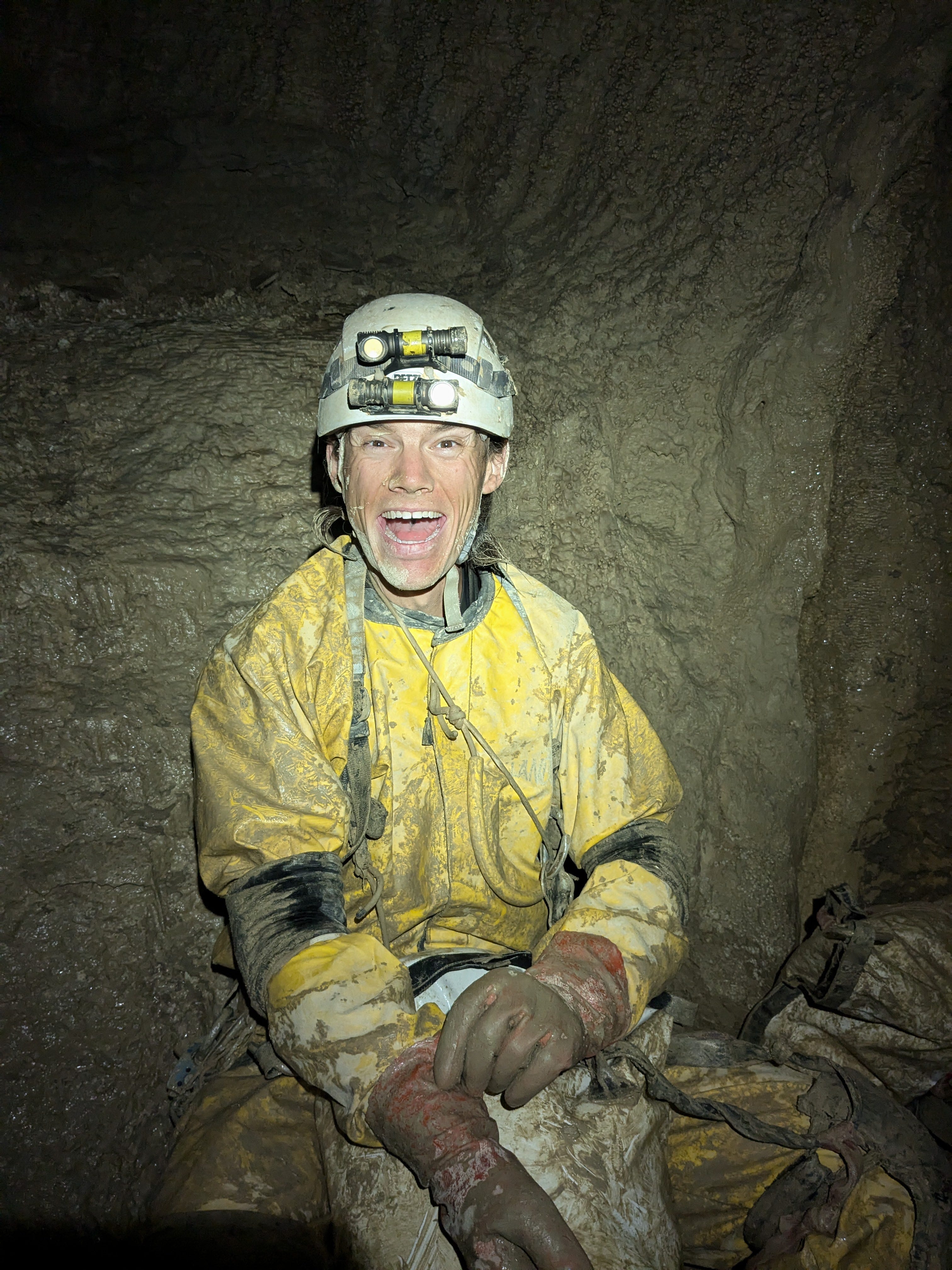
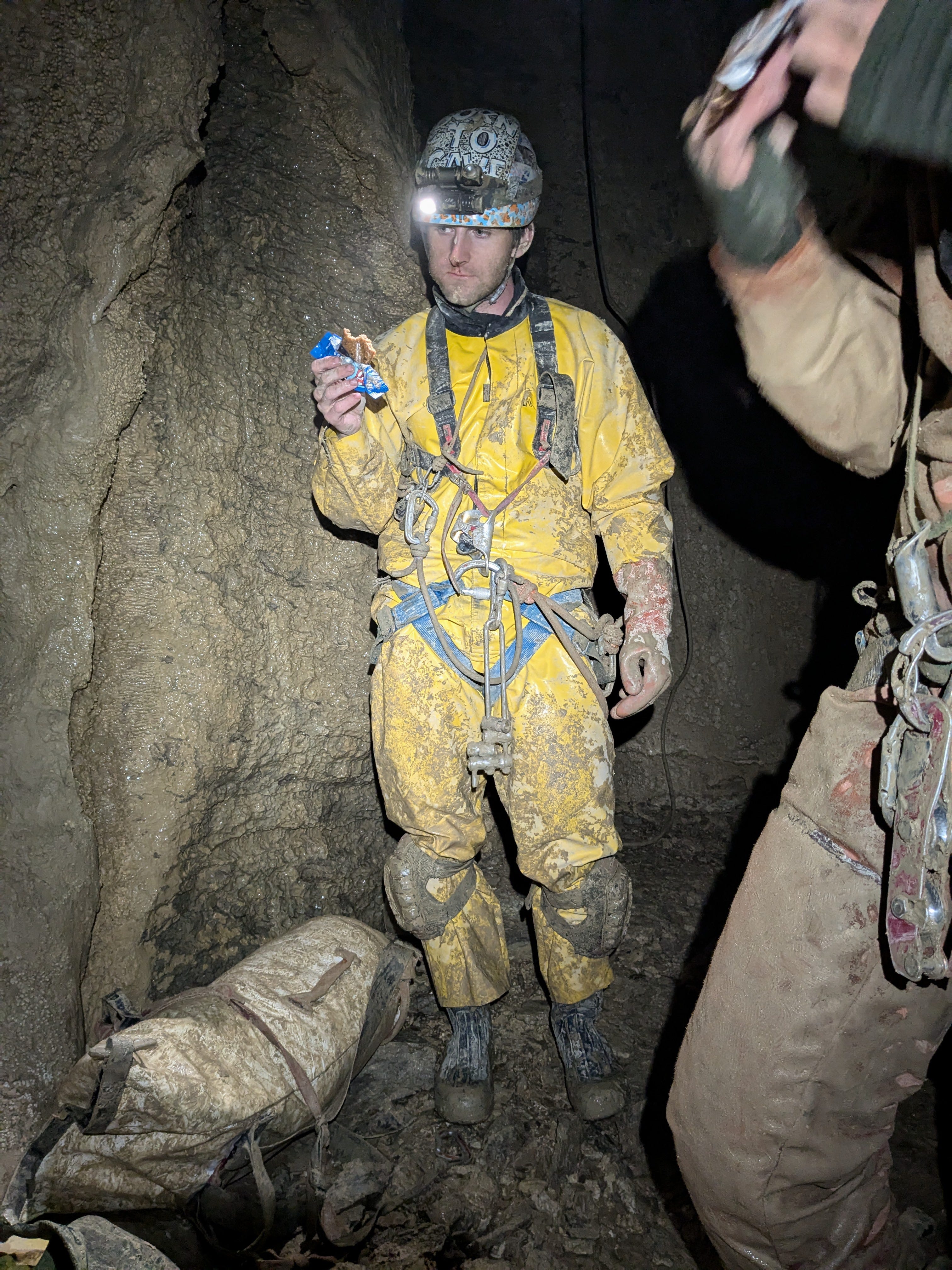
The Bunga Bunga is worse than the upper part of the cave: it gets muddier (although the mud is nothing compared to the thick slime below Camp 1), and consistently tighter. While the upper part of the cave has a few constrictions that are individually worse than any one spot in the Bunga Bunga, the Bunga Bunga is tighter on average, and takes more effort to get through in aggregate. Both parts of the cave above Camp 1 are littered with short (10-30 ft) rope drops, often with tight, awkward pitch heads.
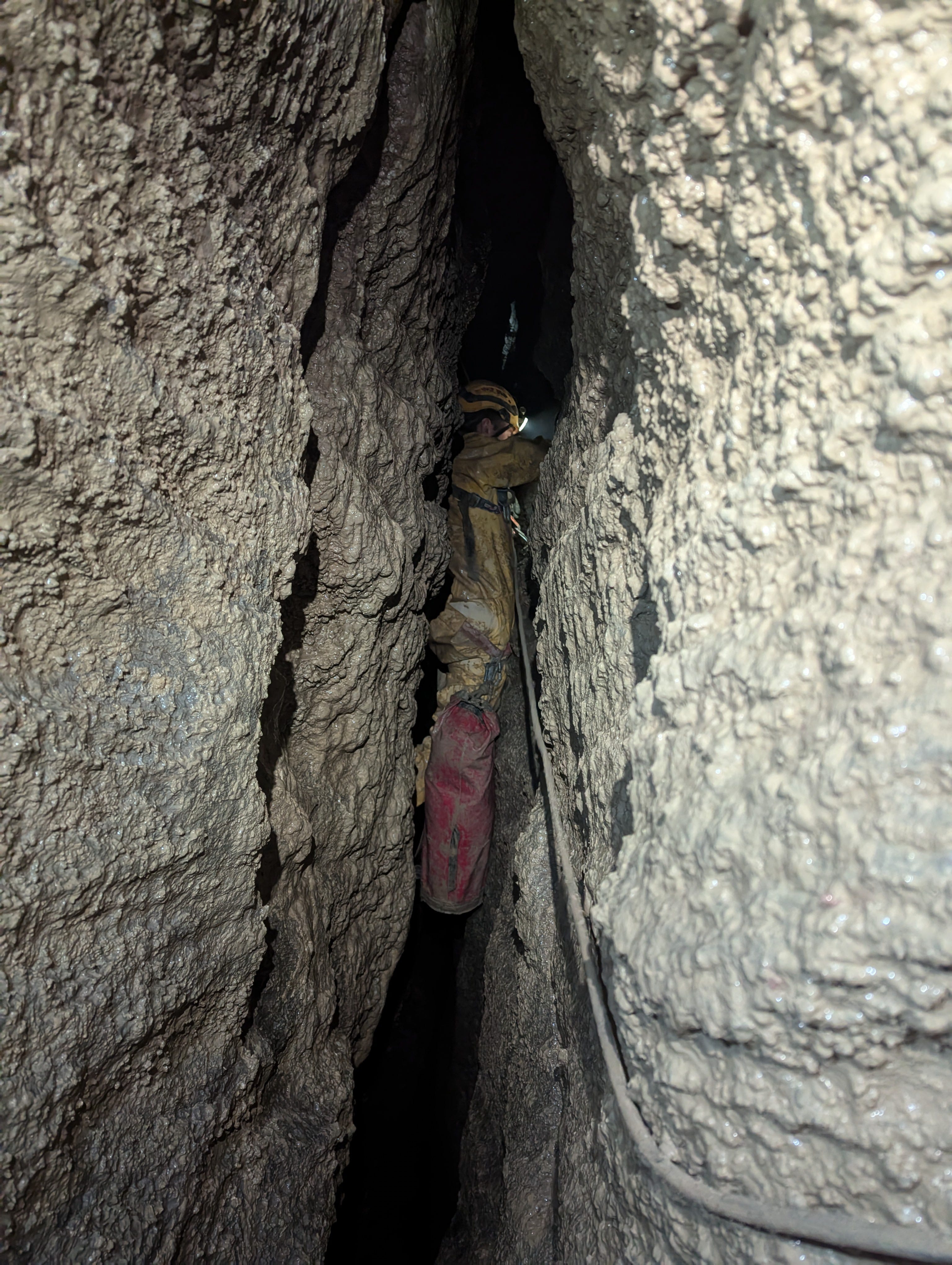
I switched to going first in the Bunga Bunga, instead of taking up the rear as I did in the upper part of the cave. In the Bunga Bunga I felt like I was flying, and I quickly pulled ahead of the group. I’m not sure exactly what changed from the upper part of the cave to the Bunga Bunga, but somehow I felt like the whole cave got easier, despite this being the harder section of the cave above Camp 1. Maybe it was those 2 Snickers bars I ate during our short break. Maybe it was finally spending several hours outside of the intense heat and sun on the surface, which took a few hours to work its way through our system. Either way, I zoomed through the cave, arriving at Camp 1 at 11:28pm. Our time to camp was 4 hours 44 minutes—pretty speedy. I arrived about 10 minutes ahead of the others, and had time to walk back from camp to the puddle that is the water source and leave my vertical gear in the water. We do that in order to get the mud out of our vertical gear, which clogs all the moving parts and makes it harder to operate, especially with thick gloves and cold fingers.
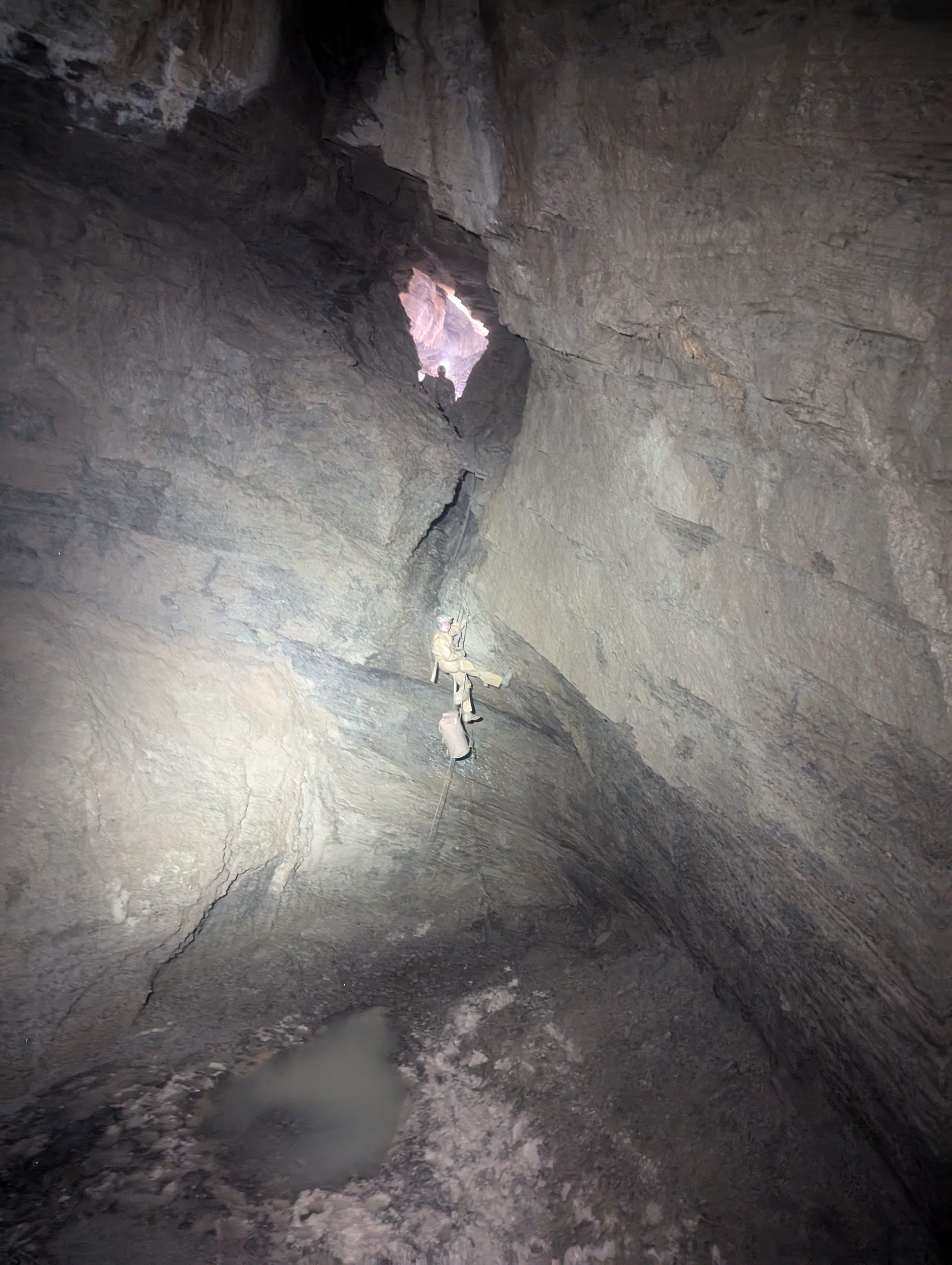
Camp 1 is set up in the one spot in the cave where tight, nasty passage yields to huge, impressive borehole, for mysterious reasons. The borehole is also where the intense, thick mud starts. When you rappel into the borehole, you get on rope in a typical small, annoying section of the Bunga Bunga, then surprisingly find yourself dropping into a huge chamber, so large it’s difficult to see the walls and ceiling around you. You touch ground under some light waterfall spray, on a muddy floor where your boots get sucked into the slop and it’s difficult to walk—foreshadowing less pleasant cave to come after the borehole. The rappel, while only about 40 ft, is one of the nicest in the cave. The first team to find this borehole, which is about 80 ft across at the widest, thought they were finally getting to a nice, pleasant part of the cave, although they were quickly dismayed to find that the borehole pinched back down to a small canyon, while the slimy mud stayed.
Once off rope in the borehole, you walk downstream for a few minutes then pop up onto a mud bank on the right side of the borehole, a few feet above the stream. Against the rock wall of the borehole on this mud bank is Camp 1, or “Mud Camp” as we affectionately call it. Up on this mud bank, the mud is harder and drier, so it’s a reasonable surface on which to walk around.
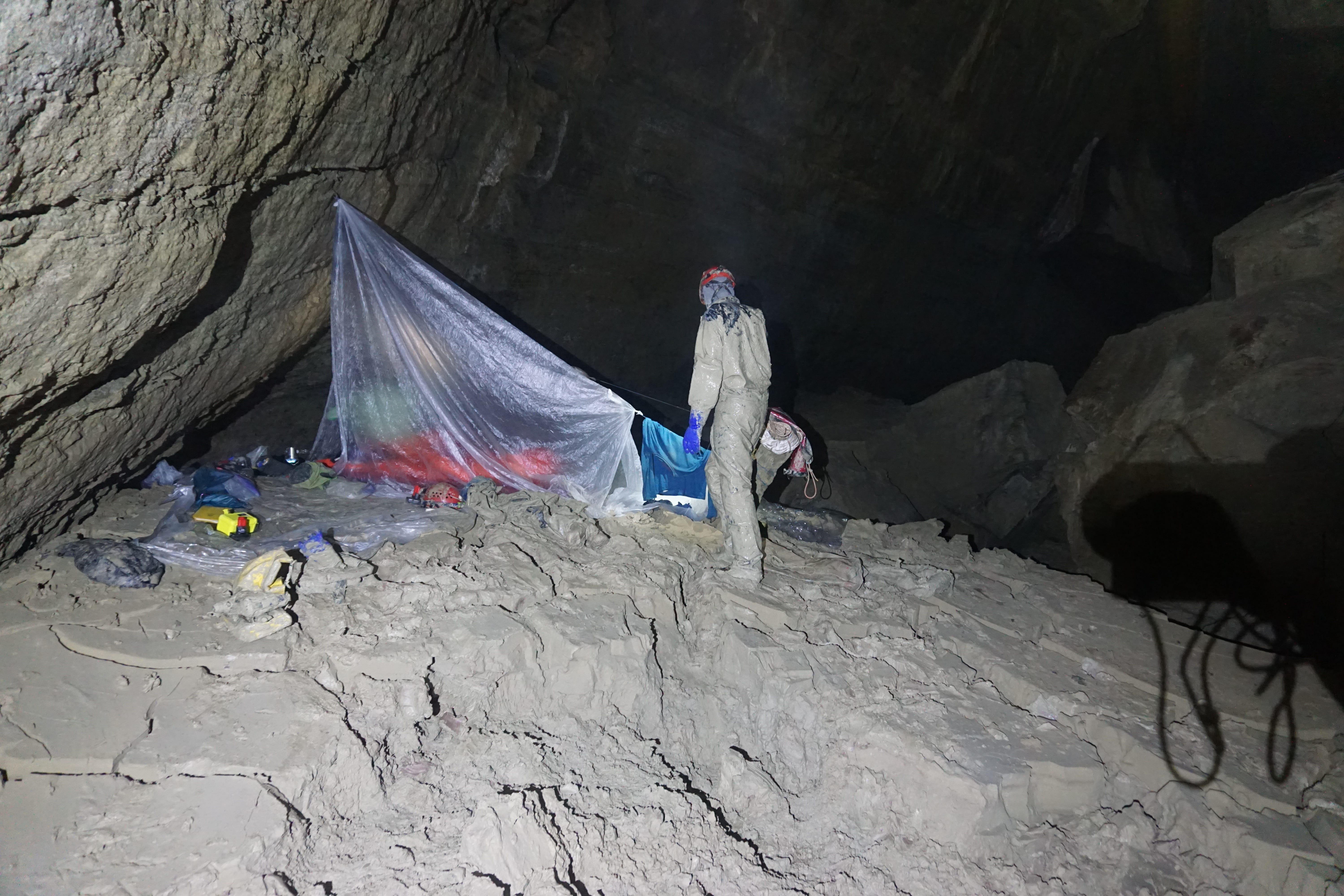
Camp is a small tent we made by suspending plastic sheets from the cave walls and from trekking poles we stuck up in the mud. There are 2 purposes to this plastic shelter. The first is that it adds warmth by trapping our body heat. The second is that it adds psychological comfort by blocking the view of the hellscape you’re surrounded by.
This probably sounds melodramatic; at least, that’s what I thought when people explained it to me when I first went to Tears of the Turtle in 2022. However, when I got to Mud Camp that year, I realized the effect is totally real. When you get to the camp spot, you look around and see a huge chamber, many hours of hard travel under the earth, so large that it fades to blackness before you can see any walls, covered in a foul thick mud that impedes your travel, sticks to you and all your gear, and sucks all the heat out of your body. If anything goes wrong, it would be days before any supplies or outside help could be delivered to you from civilization. You can’t help but think that humans really aren’t meant to exist in these spaces, and this thought weighs heavily on your mind.
When I got to Camp 1 in 2022, we were the first team there that year, so we had to spend an hour setting up the plastic walls and ceiling while carefully avoiding getting the clean floor dirty or wet. So I had lots of time to internalize the fact that I was living a unique kind of hell, very far removed from any vestiges of human civilization. And once I stepped into the tarp shelter we set up, I felt all the weight of the environment I was in lifted off me as I switched from staring down the void to looking at the translucent plastic walls, which blurred away the harsh world outside. At that moment I knew that the psychological comfort aspect of the tarp shelter was real.
This year, the tarp shelter was already setup by the setup team that went in before us. So we could hop in as soon as we got our dirty cave suits and vertical gear off (which is somewhat tricky—you have to step out of your mud boots and cave suit and step onto a clean tarp in one smooth motion, without getting any of the tarp dirty). That, and the fact that the cave was more familiar to me, meant that I didn’t get the strange psychological effect of dread instantly turning into comfort when entering camp this year. At least, not as much as 2 years ago.
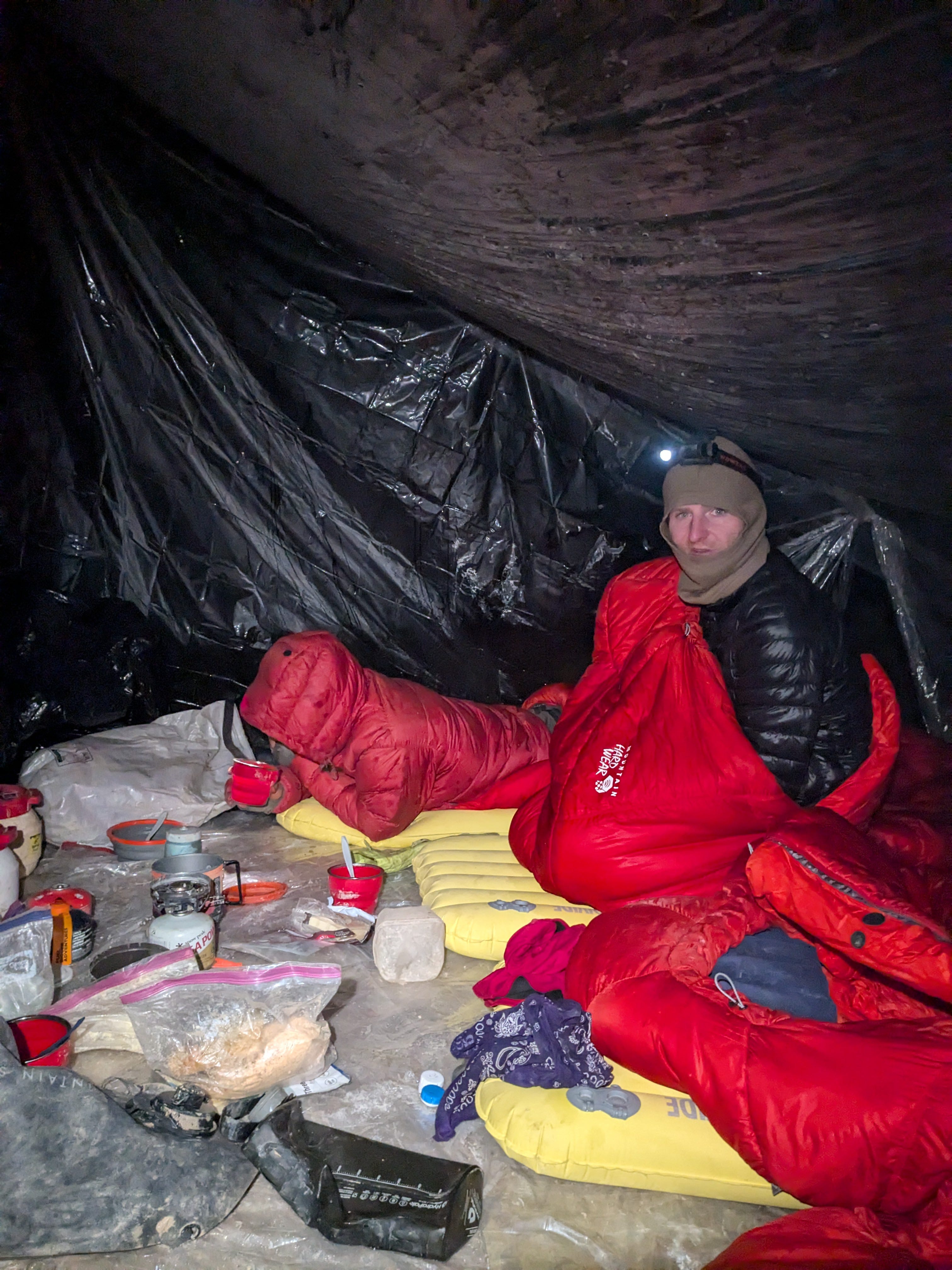
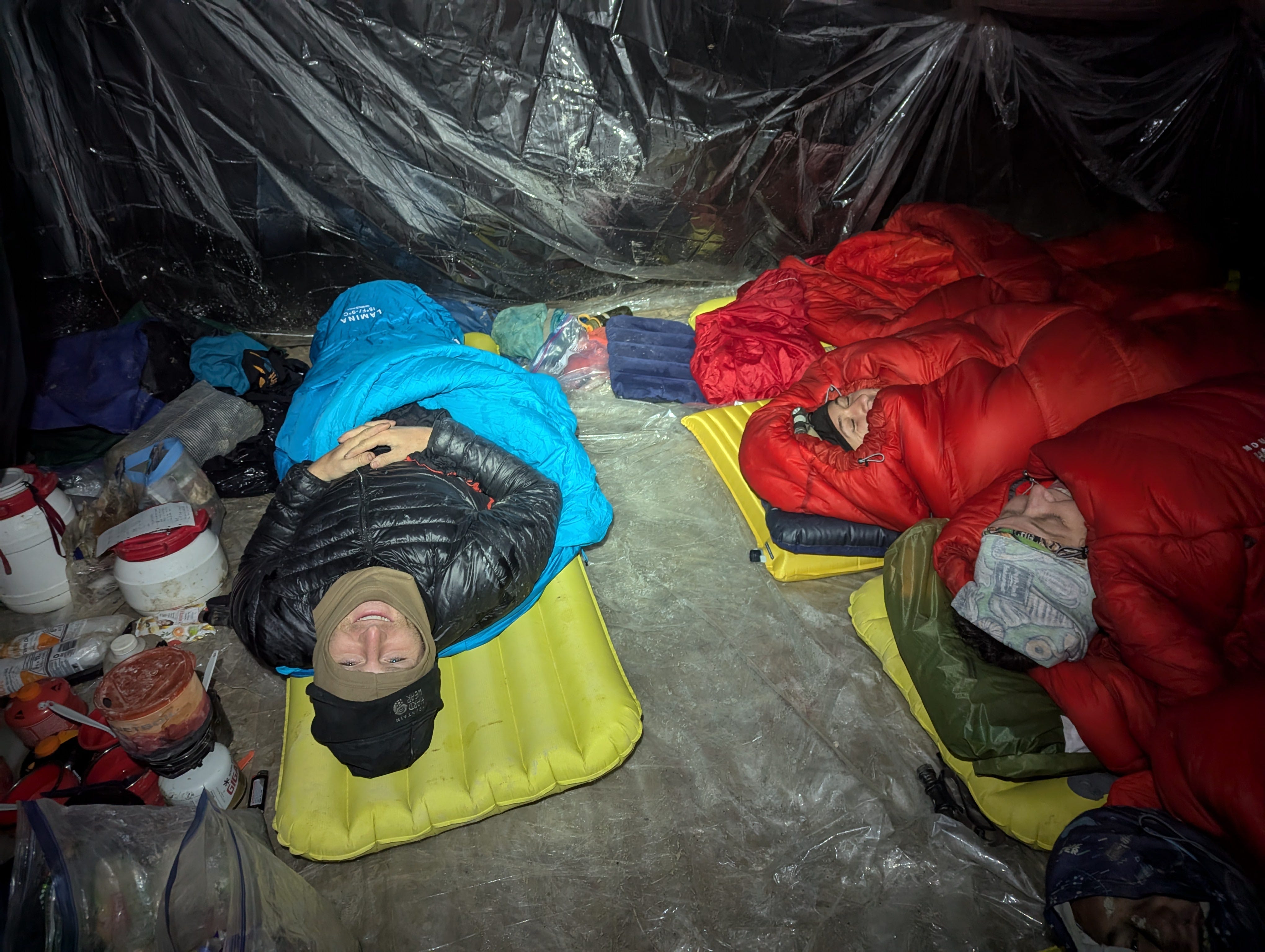
Camp 1 is pretty small—just wide enough for 4 people to lie down side by side, and a little longer than the length of a person. With all 4 people in camp laying down in their sleeping bags, the shoulders of the people on the edge of the pile almost touch the plastic walls, as with their feet, and there are about 3 feet in front of their head available for cooking and storing miscellaneous personal gear. There is enough vertical space to sit up, but not stand up, else your head will touch the plastic ceiling. Whenever you’re in the tarp shelter, you religiously avoid touching the walls or ceiling, as that causes water climbing to the tarp to rain down on everyone. The plastic traps all the moisture from our breath in the shelter, and it condenses on the walls where it waits for the slightest disturbance to make it rain down on everyone. This tends to result in the sleeping bags gradually getting soaked over the course of an expedition. I have always been an advocate of removing the ceiling from the tarp shelter, so we can keep the psychological comfort of the translucent walls while ditching the rain and the warmth we gain from the enclosed shelter, but no one else likes that idea. People like the warmth, and perhaps the mild additional psychological comfort gained from having a roof over your head instead of only walls, more than they dislike getting rained on and having wet sleeping bags.
When we were all settled in Camp 1, Derek told us that he wasn’t feeling well. That something felt off on the trip in to Camp 1, and it wasn’t getting any better as he was laying down in camp. I told him that he couldn’t be doing too bad, since he made it to Camp 1 from the entrance in under 5 hours, which is a pretty fast time. Derek was unconvinced, as he felt that something was definitely not right with him, although he couldn’t describe how he felt any more precisely than that. I figured that maybe he felt a little psychologically exhausted by the remote nature of the cave, or maybe just physically exhausted from working so hard today and in the previous days. If it were the former, I figured getting a good night’s sleep in camp would make the cave feel a little friendlier, a little more like home. If it were the latter, I figured a big dinner and sleep would refuel him. So I told Derek to sleep on it, and I made sure he ate plenty of food before going to bed. He was oddly reluctant to eat any food in camp, and I had to bully him into eating a proper meal. Once we were done with that, we turned our headlamps off and went to sleep some time before 1am.
Thursday, July 25: To Camp 2, and then some
We slept in late, and woke up some time in the late morning. After our breakfast, Derek announced that he did not feel any better after sleeping in camp and eating 2 meals, so he should stay at Camp 1 and let the rest of us go on without him. He still felt unwell in a vague but strong sense, and felt that it would be unwise to continue deeper into the cave to Camp 2. We told him that if he felt uncomfortable going further then he should listen to what his body is telling him, and that we were glad he spoke up and made the safe choice to stay back, as much as we were also disappointed to be losing a valuable team member. This was yet another one of the major complications, things that didn’t go according to plan, of this expedition, but like all the others we would adapt and change the plan as necessary.
We made yet another new plan there in camp before leaving. The obvious was that Dustin, Tommy and I would depart for Camp 2 today, and Derek would stay in Camp 1. We would take all the group gear Derek was carrying, and ditch some of our food to make space for it. The next team at Camp 1, which was already planning on taking the remainder of our supplies we weren’t carrying from the surface to halfway between camps 1 & 2 tomorrow, would take the remaining food we ditched to us tomorrow. They could also, optionally, send one of their members to join us at Camp 2 to be the 4th team member on Push Team A if they so desired. If one of them decided to join us at Camp 2, they would have to take Derek’s food to last them the whole 6 days they would be down there with us, as the team entering the cave tomorrow was only planning on staying there 4 days. If not, we would get our trip done with 4 people, and they’d have to pack like sardines in Camp 1 with 5 people.
We wrote all this down on a piece of paper and left it in camp with Derek so it would be clearly communicated to the next team, that would get to Camp 1 later that day. We also wrote that they should definitely meet us in person halfway between camps 1 & 2, instead of dropping off gear then heading back to Camp 1, so we could discuss the plan in person. With the plan written down, we started suiting up, stepped out of our safe, comforting camp into the harsh mud world around us, and set off from camp at 1:45pm.
Getting into your cave suit from the clean tarp at Camp 1 is always kind of tricky. You have to step off the clean plastic tarp outside the tent into a leg of your cave suit and into one of your tall rubber boots without getting any mud on the clean tarp. This requires some balance, and it is made more difficult by the fact that your suit and boots are covered in slime and therefore difficult to grab and pull onto you. This little dance takes some finesse and some physical effort, which is nice as it makes you warm by the time you get your cold, wet suit on you. My nylon suit worked great on the drier, less muddy part of the cave yesterday, and today I would see how it would work in deep slime.
The cave below Camp 1 is somewhat more varied than that above. It is also slightly less physically demanding, although more unpleasant in other ways. It is generally less tight than the cave above, and you can even wear your pack for much of the cave below Camp 1 when you are not on rope. But the thick, wet, heavy mud makes the cave plenty difficult even when it is not tight. It sticks to you, soaking you and sapping all your body heat out of you. It makes your limbs heavy and difficult to move. It makes all footing slick and insecure, so you have to push extra hard whenever stemming high above a floor (as you often are) so as not to slip. If you are so lucky as to be walking on a floor, the mud sucks your boots deep into the floor, making you step carefully and with intent lest you lose a boot to the mud. It coats your vertical gear and clogs all the moving parts, turning your carabiners into massive chunks of peanut butter and requiring you manually engage the teeth on your ascenders with every move on rope.
The journey below Camp 1 starts out by walking in the same nice borehole that camp is in. The slick and uneven walking surfaces made of slimy mud make the trek not quite a pleasant walk in the park, but it is absolutely a welcome change from all the other caving so far. A 50 ft freehanging down rope, followed by a 20 ft up rope over a mud mound then 40 ft down rope, deposits you into the start of the unpleasantries that characterize the cave below Camp 1. You are in a canyon that is comfortably wide, typically 4-5 ft, enough for you to wear your pack. However, the floor is usually mud so wet and runny that you can’t step into it, else you’ll sink all the way into it. So you stem just above the floor on sloping walls covered in the same slime. The stemming is strenuous and physical, as you have to push hard with your legs and arms in order to stay put on the slick slime-covered walls. At least the hard work keeps you warm, which is critical as the 37 degree mud begins to stick to your suit en masse and act as a giant heat sink.
This stemming continues for a while until you get to a room where the walls get too far apart to stem, and the floor is mud so wet you’ll sink into it like quicksand if you dare step into it. This obstacle is called the “Slough of Despond”; it is the last place reached on any day trip from the surface, before Camp 1 was established. To cross the slough, they had to aid climb sideways on one of the canyon walls, just a few feet above the floor. Now there are ropes we can pull ourselves across with, sometimes stepping on the floor in the more solid sections, sometimes only weighting the rope. Even with the ropes, getting across is quite physical, as the ropes are often a bit low to keep you comfortably above the slime (very forgivable given the circumstances in which they were placed).
After crossing the slough, more strenuous mud-stemming follows, sometimes right above a mud floor, sometimes high above the floor. There is one spot here where I sometimes stay high up, as there it is wider and you can wear the pack, and I sometimes go down to the ground, as it is refreshing to walk on flat ground without any fall danger from being high up, although this means you have to take your pack off as the canyon is narrower at the floor. One of the trickier mud climbs was one of the spots that we were hoping the Mud Camp Team A would fix with a rope, but that would have to come later. There is one spot where the canyon widens and the only feasible path forces you to the floor, where there is a nice large-ish room with a flat bedrock floor and easy access to drinking water via slurping from the little stream in the floor.
This room is even clean washed, which leads you to wonder optimistically whether the mud is over and we’re getting to the cleaner part of the cave near Camp 2. At least, I thought this when I first came here in 2022, before George Breley dashed my hopes and informed me that we had not yet seen the worst of the mud.
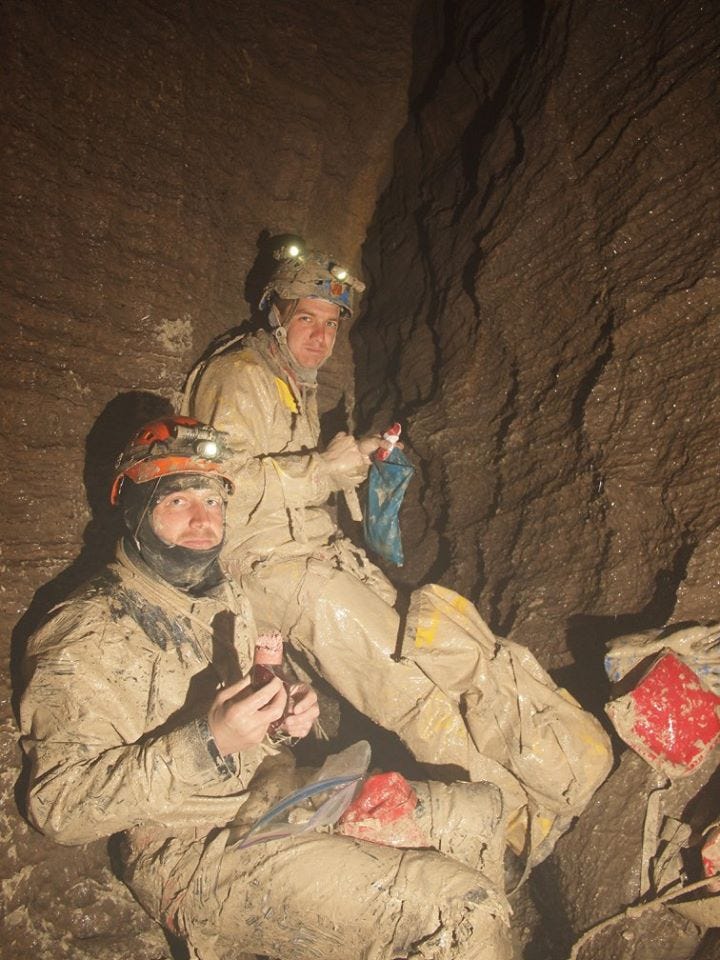
This room is where we imagined the meetup halfway between camps 1 and 2 would be. We never actually agreed on an exact spot, but Dustin and I at least figured this would be the likely spot, since it was approximately halfway between both camps, and it is one of the only spots where there is space for multiple people to stop, stand up on flat ground, and rest. We usually stop and eat food here, and this was no exception. I ate some peanut M&Ms I had in a small Nalgene clipped to my harness.
Tommy showed me the nalgene-full-of-peanut-M&Ms trick back in 2022, and I copied him this year. The reason this trick is so suited for the cave below Camp 2 is that your gloves and arms get so covered in slime that you don’t even want to open and reach into your cave bag, lest you get everything inside it muddy. So it’s better to have your food clipped to you in a small, durable container such as a half-liter Nalgene. Because the cave below Camp 1 is wider than that above, having an extra thing clipped to your harness is feasible, whereas it would get in the way too much and get stuck on things in the tighter cave above Camp 1. This spot also has the best water access so far below Camp 1, as everywhere else it is difficult to impossible to get to stream water in the floor.
After this quick stop for water and M&Ms, we continued onwards. Beyond this room you quickly enter the same muddy stemming canyons as before. They get worse when you encounter 2 series of ropes, each of which bypasses a too-tight section of the cave by going up, traversing sideways, then going back down to the same level it started at. Ascending the up ropes is especially tedious because by now, your vertical gear is totally clogged with thick slime the consistency of peanut butter. With every move upwards you have to manually actuate your ascender cams to make them engage. The traverse lines help a bit, but you still need to do some power-kneebaring into the slimy walls to not get wedged into the tight crack below you.
After these 2 terrible muddy rope series, you start to get glimpses of the cave getting cleaner. The canyon widens and the floor remains so far below you as to be out of sight. The safety ropes here are also terribly rigged, as when they were placed in 2019 the team was very low on resources and had to be parsimonious with their gear. The one solace of this section, which George named the “Brown Trousers Traverse”, is that the cave walls are blissfully not muddy here. The wide, split-stance stemming here actually feels secure, which you want because the safety ropes don’t add that much safety. This was another one of the parts of the cave that we wanted better rigging. Especially because the mostly-clean and mostly-dry cave walls were getting muddied up with even the tiny amount of traffic this passage sees. Again, it would have to wait til the way out.
At the end of the Brown Trousers Traverse, the canyon becomes too wide to stem, forcing you go lower down into the canyon, which turns into a nice, wide open 50 ft pit. George named this the “No More Tears Pit”, as he thought that this is when the cave was gonna get nice and pleasant. Spoiler alert: many tears were shed, and will continue to be shed, beyond the No More Tears Pit.
Beyond the No More Tears Pit is a meander (tight canyon with many turns) that is small and annoying, but thankfully clean-washed. There is a stream in the floor that provides a welcome water source, as there have been none since the halfway room. I always seem to flood one of my calf-high rain boots when I go through this passage, even though I know it should be possible to keep the brim above the water line. But the awkward diagonal stances and sideways planking always gets me. At the end of this meander is a tight squeeze where George and I had to take our vertical gear off when we were there in 2022—the only spot that tight in the whole cave—although Jason and Dustin bypassed it later in the expedition that year by going up and over. So this would be my first time seeing the bypass. Apparently that spot could use a rope.
We found the bypass easily, and yes, it does want a rope. We left a short length of rope there and decided to do it on the way back towards the halfway room. Beyond this tight squeeze is one more short pit that brings you down into a large room. We considered this spot as a possible camp location, although there isn’t much water (we’d have to collect from drips) and there isn’t much flat space, so we’d have to hammock camp. The spot we were planning to establish a camp at, about 15 minutes ahead, still had no flat space and would require hammocks, but at least it had a good water source and was closer to the frontier.
The last obstacle before the Camp 2 site is yet another wide stemming traverse in a bottomless canyon, followed by a pit. I rigged this traverse on the 2022 expedition, and named it the “YAM Rodeo Traverse”. The “YAM” in the name refers to a certain personality type which we discussed frequently that trip—Young Athletic Male. A YAM is a young (late teens to mid 20s usually, although the end date can be pushed back arbitrarily far), strong, physically robust male who has developed the strength and endurance to do incredible things, but has not yet developed the good judgement and sense of one’s own mortality to not do incredibly dumb things. Think “too much testosterone for their own good”. The “Rodeo” in the name refers to the legendary rodeo at the NSS convention from that summer 2022, where bull riding was one of the events, and many of the YAMs (including yours truly) participated, very bravely and very stupidly. Anyways, that’s a subject for another post.
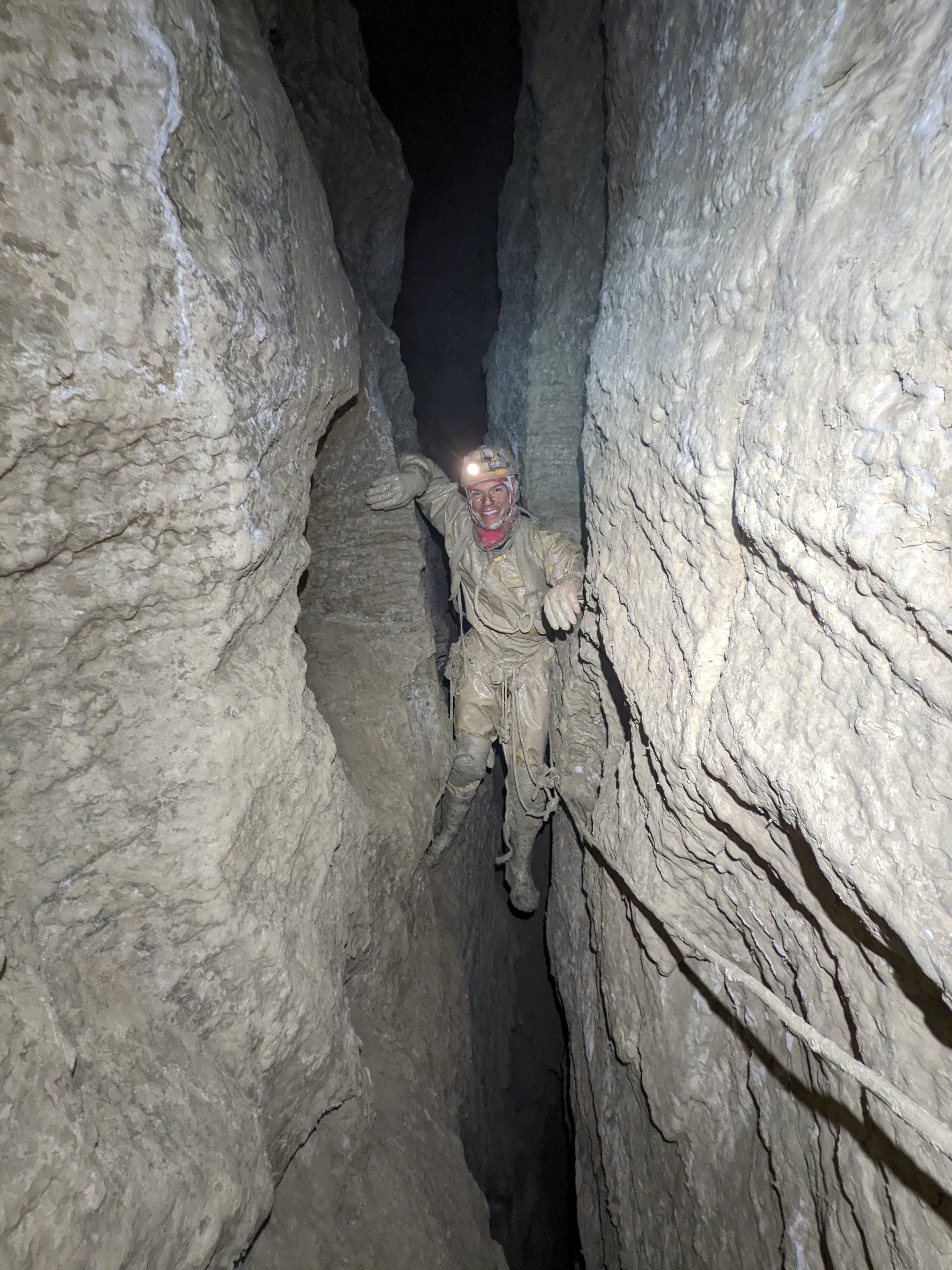
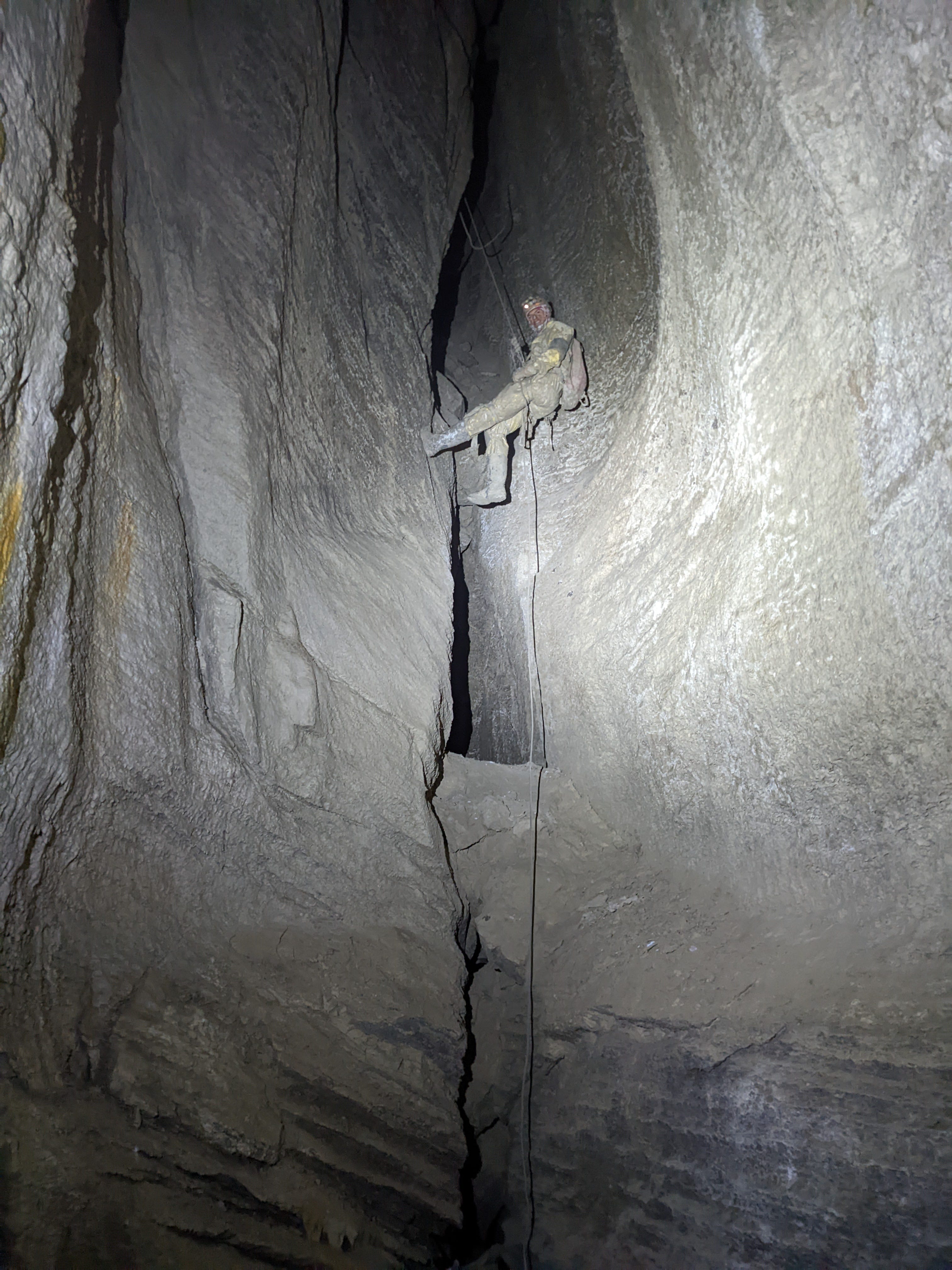
The YAM Rodeo Traverse was one of those traverses that, like the Brown Trousers Traverse, started out easy as it was clean and dry and high-friction. Yet with just a little bit of traffic from a single digit number of parties passing through, it was getting muddy and slick and difficult. At least the ropes were in good spots, mostly (the below picture is an exception).
At the end of this canyon, you rappel ~80 ft into the room where we intended on establishing Camp 2. We got to Camp 2 in a little under 4 hours—pretty good time when hauling full camp packs. I knew that Camp 2 was going to be small and grim, but when I arrived it looked even worse than I remembered. This was going to be a long week.
The Camp 2 site is a room with a floor about 5 ft wide and 15 ft long, although the walls slope away from the floor so it feels a little wider. This space is small, but workable for 3 people. The lack of space wasn’t the problem so much as the fact that the floor was a pool of water. We couldn’t even walk around it without flooding our wellies. None of us, all 3 of whom had been here back in 2022, remembered the floor being deep water like this. I don’t think there was more water because of higher water levels, as 2022 was a higher snow year and we noticed lower water levels on the Flathead River this year. We must have just forgotten how terrible this room would be as a camp. I wish we got a picture of it when we first arrived, before we did any work on it, because it looked so awful. Instead, when I arrived, I immediately started remedying the unusable floor by moving rocks from the passage beyond into the pool. When I had used all the rocks within a body length of the pool, I went further down the tight passage beyond camp and started assembly-lining the rocks into the pool with Dustin and Tommy. After about half an hour of moving rocks into the pool, it was filled up enough that we could at least tiptoe around on the tops of the rocks poking out of the water. Not ideal, but workable at least.
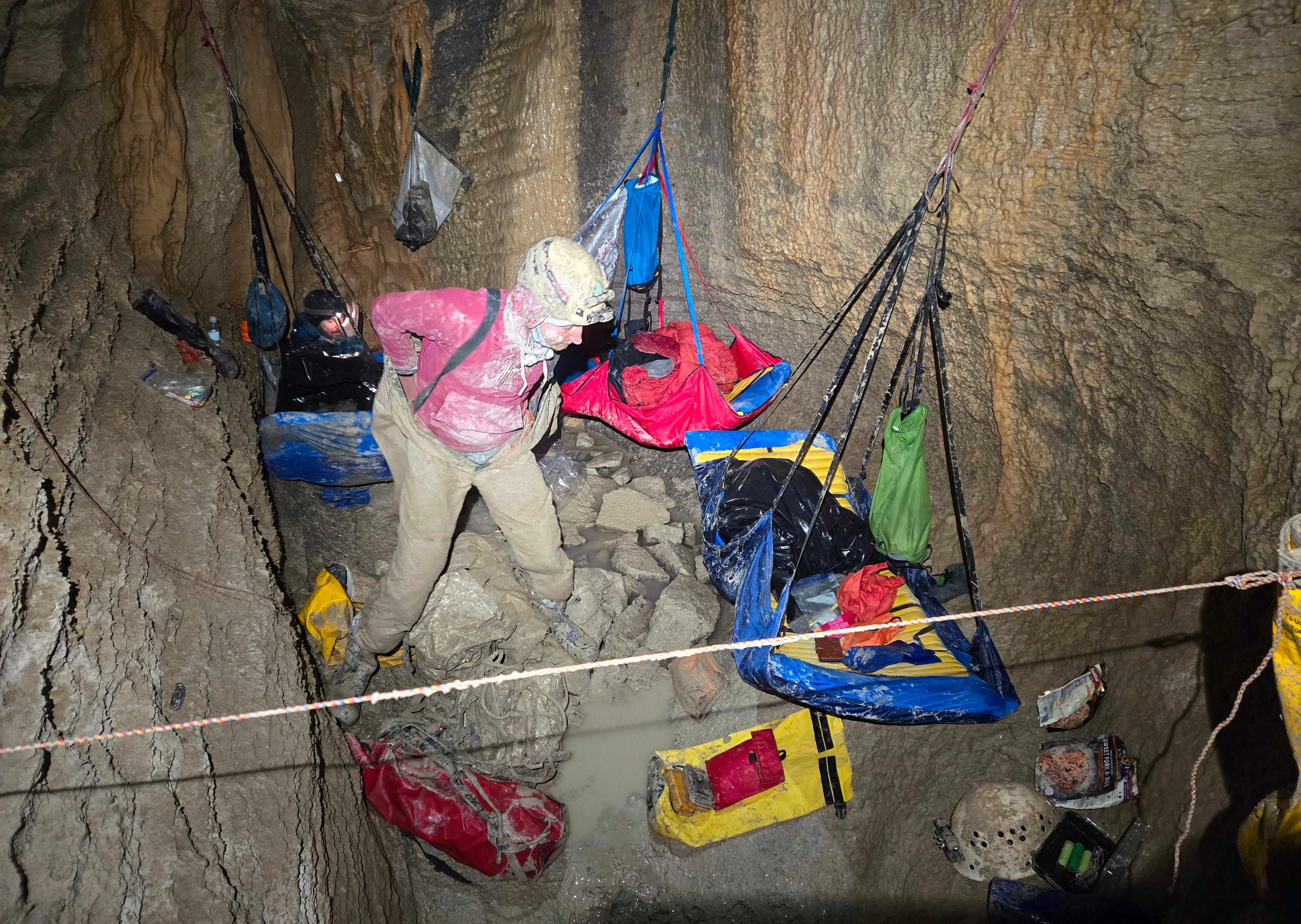
We figured that perhaps it was for the best that Derek didn’t come with us. We were a little optimistic that we could fit 4 people in here; it was going to be tight even with 3. We hoped that no one from the next team decided to join us, as we had written down as a possibility in the note we left at Camp 1.
After filling in the floor with rocks, it was time to head back towards Camp 1 to pick up supplies from the Mud Camp A Team. We figured that one person would stay at Camp 2 to set up the hammocks, set up a cooking station, and unpack and organize the mountains of gear we had in a way that got in the way the least and maximized living space. I was kind of hoping that person would be me, as I certainly wouldn’t mind staying here and sculpting camp to my vision instead of going back through the slime. Also, I was the only one of the 3 of us who had ever used the new Taco portaledge-hammocks that we were gonna sleep in, and I had a vision for how to set them up. However, Tommy was the most worked out of all of us, he ended up staying in camp to set it up while Dustin and I went back towards Camp 1.
Yesterday on the surface we agreed on meeting halfway between camps 1 and 2 between 7 and 8pm. We knew we wouldn’t be able to time it more precisely than that, and in fact we were already late when we started moving from Camp 2. When we got to the bypass above the squeeze, we used the rope we left there to rig it and make it safer, then we were off to the races heading upwards uninterrupted. We didn’t want to make the Mud Camp Team A go much further than halfway, as they would likely do if they got to halfway and we were nowhere to be seen.
8pm passed, and we were nowhere near halfway to Camp 1. Again, we didn’t have any particular spot in mind as our meeting point, just a general idea of approximately where halfway was. We got to the clean-washed room in the middle of mud world, that we figured was the best spot to stop and meet people near halfway, a little past 9pm. We were certainly late, but the other were later. We stopped for a short break in that room, where both of us confirmed with each other that we didn’t want to stay in that room and wait for the others—we’d rather continue towards Camp 1. We’d get very cold waiting there for any period of time, and if for any reason the others weren’t coming, we would want to know ASAP by going all the way to Camp 1, instead of waiting for hours wondering what was going on. So we continued upwards.
Once we got real close to Camp 1, near the Slough of Despond, we started to worry a bit that we hadn’t yet run into anyone. We both started wondering aloud what we would do if something had gone wrong and there was no haul team coming. We figured that in that case we might as well spend the night in Camp 1 and leave Tommy to himself in Camp 2. He was expecting us back that night, and would probably start worrying when we didn’t arrive before he went to bed, but we would meet him again the next morning. We had a little food stashed at Camp 1 that should see us through the night and the next morning. I secretly started to enjoy the thought of staying in the relatively luxurious Camp 1 instead of sleeping in a hammock above a puddle, although of course I hoped nothing was wrong with Mud Camp Team A and that they were there but merely delayed.
Once I got off the final rope that brings you into the borehole where Camp 1 is, I started shouting, as people in Camp 1 would probably be able to hear me from there. I thought I heard voices shouting back, although I was couldn’t tell for sure, and I didn’t know with certainty whether anyone was in Camp 1 until I crested a hill and could see lights in the translucent plastic tent.
I quickly finished hiking up the slope in the borehole to camp, eager to find out what was going on and why they didn’t meet us. I was greeted by Jason, who was on Mud Camp Team A in addition to Irina, Sam, and Alex Lambie. Derek was also still there, making Camp 1 pretty packed with 5 people. Jason told us that they weren’t planning on bringing gear towards Camp 2 today; they thought that was supposed to be tomorrow. I was pretty annoyed about that miscommunication, as I was confident that we all agreed on doing the gear exchange and meeting halfway at 7-8pm on day 2 of our trip, day 1 of Mud Camp Team A’s trip. Oh well, this would just mean more caving for Dustin and I. The expedition was already full of snafus, and one more minor one would not stop us.
We told Jason that Camp 2 was pretty grim, about our efforts to fill up the pool, and that it was definitely better with 3 people. But we assured him it was usable and that we’d have a productive trip out of it. He was dismayed; he also saw the Camp 2 site last expedition, and like us must have forgotten how terrible of a space it was in the 2 preceding years. We confirmed that no one currently in Camp 1 would try to join us and stay down there, and Jason confirmed that when he exited the cave, he’d tell the second push team they should drop one of their 4 members and only come down with 3.
Camp 1 was already over capacity with 5 people, so we were definitely not sleeping there tonight. We would have to go all the way back to Camp 2. Earlier when we were getting close to Camp 1 and I thought it would be empty due to something going wrong with Mud Camp Team A’s trip, I started to looking forward to sleeping on the comfy flat ground there. Now that that was not an option, I started mentally psyching myself up for repeating the long journey through the slime to Camp 2 while loaded down with heavy packs full of more gear. Dustin and I each stuffed our packs with 220 ft of rope, the rest of our team’s food, and various other supplies. The Camp 1 crew made us some hot food from some of our food we had stashed there, and we both ate some cheese from that 2 pound block the first team hauled in for us, then we were off to the races.
The trip back to Camp 2 was uneventful, although both of us felt pretty worked. We arrived at camp at 2:30am. Tommy was in his hammock and looked quite comfy, although we woke him up when approaching camp. We also rained small chunks of dirt down on him as we approached camp—oops. This was pretty unavoidable, as the last part of the YAM Rodeo Traverse goes right above the Camp 2 room before dropping down into the far side of it at the end of the traverse. The walls of the traverse above camp are covered with dry, crumbly mud that is very difficult to not dislodge. Thankfully Tommy didn’t get hit by anything too big—he had his helmet off when sleeping in his hammock of course!—although he did have to scoop dirt out of his hammock before going back to sleep.
Each of the 3 legs between camps 1 and 2 we did that day took under 4 hours, which were all pretty good times, especially the last leg that we did at the end of our long day. Our day in total was about 13 hours when you include the times spent at camps 1 and 2 moving rocks and (un)packing. Dustin announced that this was his hardest day of caving ever. I didn’t think it was at first, but after thinking about the other hard days of caving I had done in the past, I realized that none of them were quite as hard as today was. I have done longer single-day trips in Mammoth Cave, up to 17 hours, but those were definitely easier than what we did today. I was pretty psyched to have been on Dustin’s hardest day of caving ever, and kept up well—Dustin is a superstar, super strong caver, and although he was a bit faster than me in some spots that day, I was never far behind. And I was quite proud of that!
We quickly got out of our suits and vertical gear, and got in our hammocks and sleeping bags, which Tommy had kindly set up for us. No need to unpack the supplies we hauled or cook a real meal—those would come tomorrow. Before I could get in my hammock, I had to rig a plastic sheet on my hammock to deflect a little water drip on the wall, to keep me from getting dripped on. After getting the plastic sheet in place just right, I awkwardly shuffled into my hammock (it is always an awkward maneuver getting into them) and got in my sleeping bag. As soon as I was settled and not shifting around, I heard a “drip, drip, drip…” as water droplets from the drip on the wall splattered on the plastic sheet. At least they weren’t landing on my head. Oh well. Despite the awkward hammock pushing my shoulder against the wall, and the somewhat loud drip, I still slept great after that long, arduous day.
Friday, July 26: Make camp livable, and begin exploration
We slept in late after Dustin and I’s epic day doing 3 laps between camps 1 and 2. The plan was to do a shorter day of exploration after spending some time making improvements to camp in the morning. Or was it afternoon? I forget exactly when we woke up; it might have been after noon.
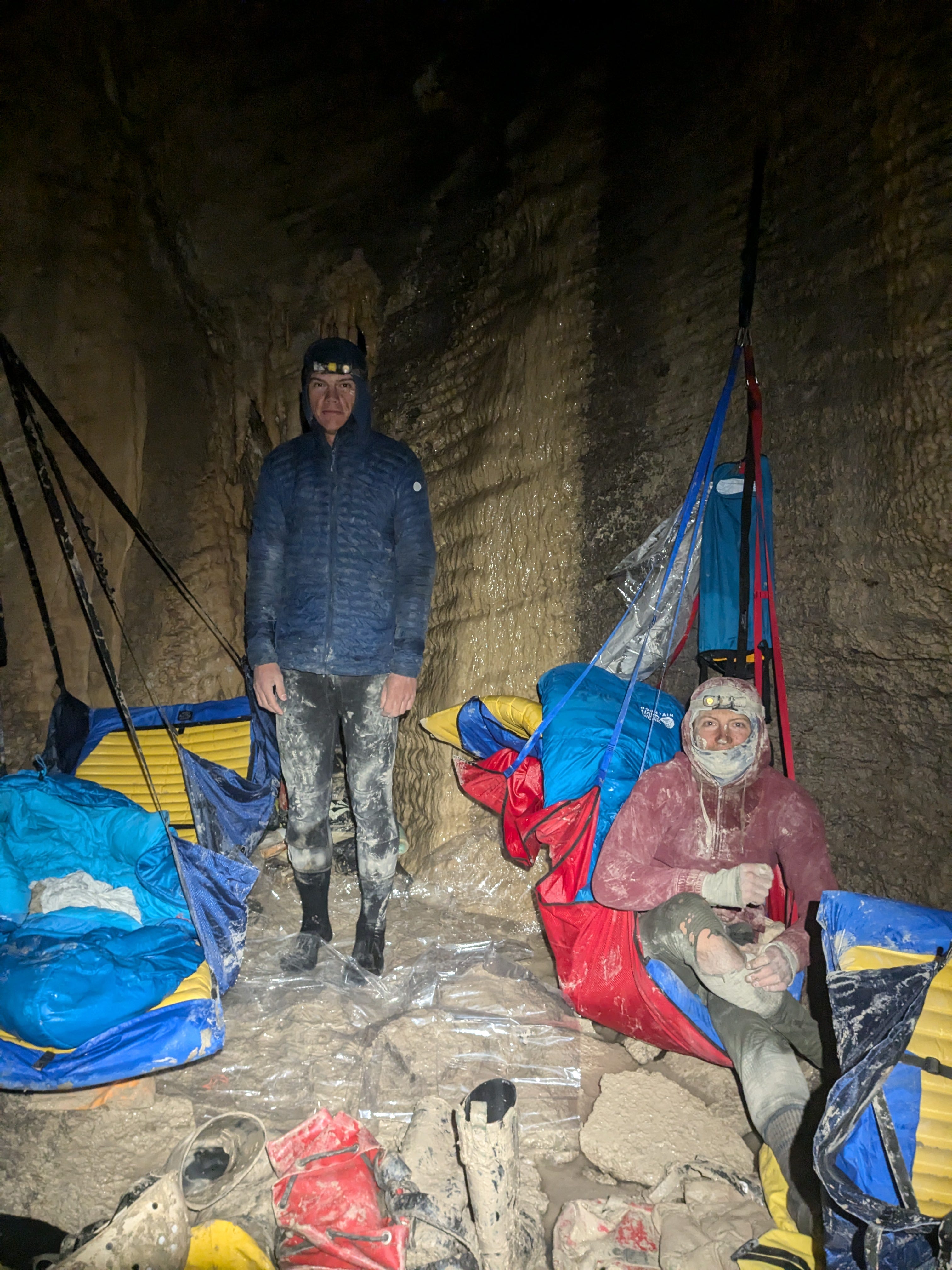
We set aside various corners of camp as gear storage spots and started unpacking all the bags full of gear into those corners. When we ran out of space to put things, we started clipping things to various cords we had hanging from the walls. The walls of the room were sloping, and lacked ledges/shelves where we could store things, so many things had to be clipped to little cords. And recall that most of the floor was a pool of brown water, so we couldn’t store things there.
We also laid down plastic sheeting on top of the rocks in the pool. The idea was that this would let us walk around on the rocks without our boots on and without getting our feet/socks dirty. This worked OK at first, although our feet got very cold walking around on 37 degree rocks with just a pair of socks for insulation. The plastic tarps stayed clean and dry for about one day before mud and water from our clothes, or gear we carried, or from above when anyone passed over the ropes, fell down onto the tarps and made them wet and muddy. Then they were only marginally better than walking around on the rocks sticking out of the pool.
We also figured out what the bathroom setup would be. Because the passage beyond this room quickly deteriorated into a tight squeeze, there was no choice but to go to the bathroom in the small camp room, in plain sight of everyone. We peed in the small stream that left the room and went into the small passage that leads to the rest of the cave. Because we have to crawl through this passage to get to the rest of the cave, we all resolved to try to not pee right before we left camp, so our pee would get diluted out of the stream before anyone crawled through it.
The pooping situation was even more awkward. You couldn’t get more than 3 ft from a hammock anywhere in camp, so you had to get it done in front of everyone. The spot with the stream leaving camp where we peed was also a fairly easy place to stand up, with flat ground, so we designated that the bathroom area and left our toilet paper there. And the poop bags: we were gonna bag our poop, although we hadn’t yet figured out exactly what we were gonna do with it. We were hoping that there would be a spot with enough dirt to bury the bags, which were allegedly biodegradable. However, we didn’t see any substantial volume of dirt away from the stream, so we might be carrying it to the Camp 1 latrine to bury it there at the end of our trip. We would see what we felt like by the time it was time to leave.
The pooping spot was also where we all stepped through when going in and out of camp. So when pooping into the bags it was absolutely critical that we not miss. This spot was also comically close to everyone, especially Tommy’s hammock. How close it was is illustrated by the following comical fact: I forgot my hand sanitizer, so I used Tommy’s hand sanitizer; whenever I needed it, I would ask Tommy for it and he would hand it to me, from his hammock, without Tommy leaving his hammock and without me leaving the pooping stance.
Once we had camp set up to our liking, we set out to go exploring! Finally, on day 7 of the expedition, we were setting out to do what the whole expedition was about: exploring, mapping, rigging new, never-before-entered-by-humans cave passage. Continuing downwards into the deepest cave in the USA. I put on my muddy, soaked cave suit, we packed our bags with rope, survey gear, warm clothes, and other supplies, and we departed camp.
Right after camp is an annoying muddy squeeze. This pops you out into a room with a 30 ft tall waterfall that spews forth more water than we have seen anywhere in the cave. This waterfall is the water source for camp, and fills the clean washed meander below with a fast moving stream. We followed this narrow, slightly awkward, but thankfully clean, meander downstream until just before the sump that stopped George and I in 2022. There, we climbed up into the ceiling, into a dry upper-level passage that bypasses the sump that Jason and Dustin found in 2022, after George and I were stopped by the sump. After a few annoying squeezes, we popped up into the large keyhole upper level, about 10 ft in diameter, unlike any other passage in the cave.
Right after you get into the keyhole upper level, there is a tricky 20 ft climb up as the keyhole steps upward. Last year, Jason and Dustin free climbed up then down it, but said it needed a rope. Since I was rigging today, I went first, and free climbed up the climb. It was a little cruxy right at the bottom, and would certainly be tricky going down. When I got to the top, I rigged a rope down it, so no one would ever have to free climb it again.
From the climb up, you walk for a bit down a nice breakdown-floored tube. This tube is the top of a keyhole-shaped passage with the stream at the bottom, although the breakdown floor hides the crack and blocks the sound of the water, making it seem like you are in a totally different passage. After a little bit of walking, the floor opens up into a deep crack and the water is audible below. I could tell we were about to regain the stream, beyond where we climbed up out of it, and beyond the sump that stopped George and I in 2022. This is where Jason and Dustin turned around in 2022 for lack of rope. This was finally it—unexplored cave passage!
But I had some rigging work to do before we could go down there. I rigged a traverse line so I could go up to and over the edge of the pit. Once I was leaning out over the edge of the pit, I was dismayed to find that most of the rock at the good rigging spots was total choss. I could dislodge chunks out of the wall by hitting it with my hammer. This was gonna require a little bit of creativity, and a lot of trundling, to rig safely.
After ripping several layers of choss out of the walls, I found a spot on the left wall with good rock. There was absolutely nothing usable on the right wall, so I couldn’t do a Y hang. This meant the rope would rub a bit, but that was the best I could do. I started rappelling down. spending at least an hour trundling as I went down, before I found a good spot for a Y hang about 15 ft below the rub point. Below there, the rock was better, and I got down to the stream with minimal additional trundling. One redirect below the rebelay kept the rope freehanging. The pit ended up being about 60 ft.
Dustin and Tommy had finished surveying from where we left the stream to the pit, which did not get surveyed in 2022, by the time I was off rope at the bottom of the pit. In fact they were done early enough to get pretty cold while I was busy trundling. By the time I was at the bottom, they were eager to get moving and start scooping down the passage to warm up. I let them go first, and I took up the rear and carried the rigging gear and remaining rope.
The passage now was quite similar to the stream passage that we just climbed up out of, confirming what we all suspected, that the pit dropped back down to the same passage. It was a somewhat tight meander, although the ceiling was much taller than before, which meant we could pretty much always stay upright. At one point I got to a slightly tricky 10 ft downclimb, which Tommy and Dustin had already free climbed down. I figured this would be a good use of the remaining 15 ft of rope I had, so I rigged it to make our lives a little bit easier on the way out and when returning this way tomorrow.
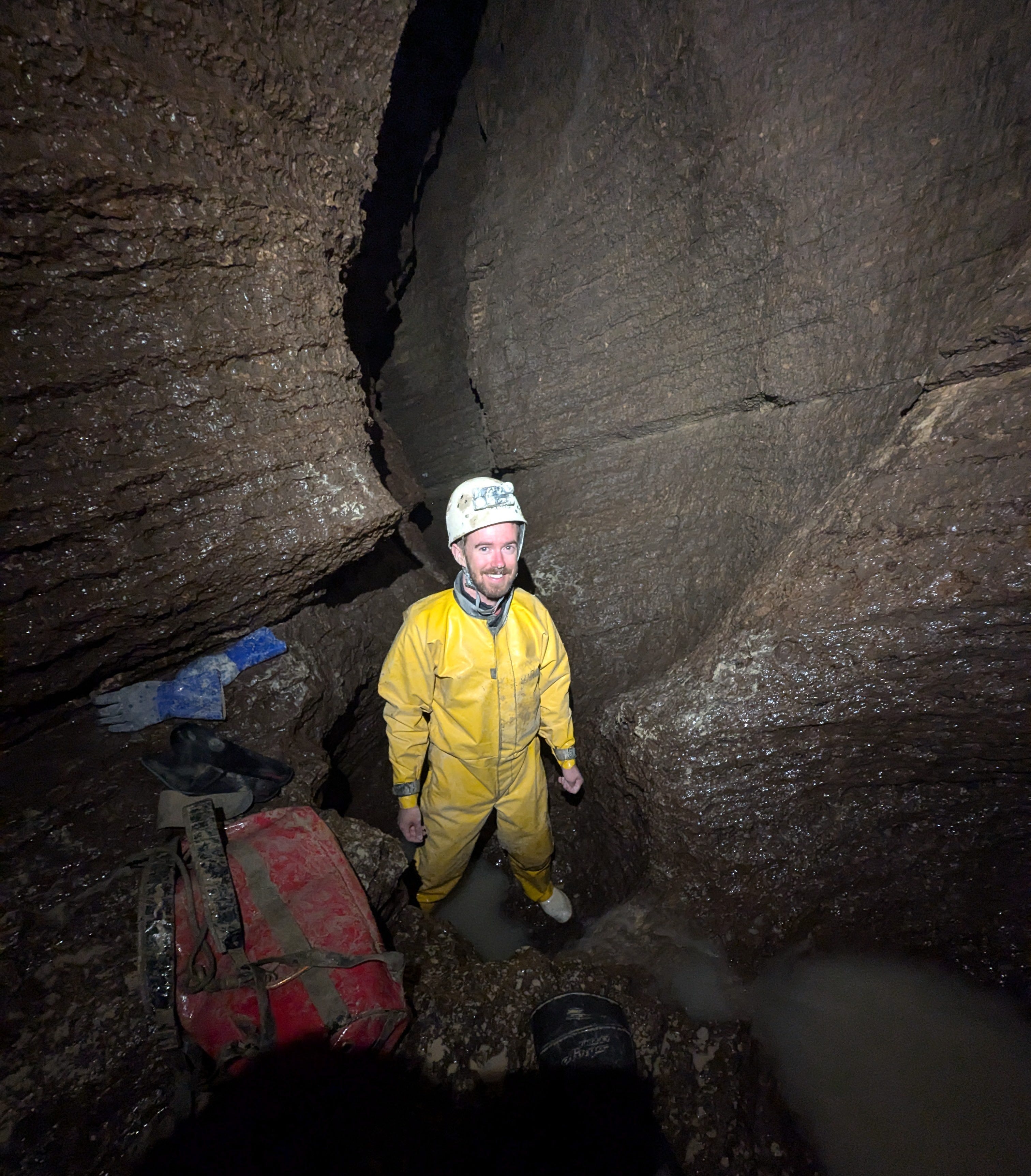
The passage continued this way—a moderately tight meander with a big stream in the floor and very tall ceilings—for about 20 minutes before changing character. It branched, with the tall ceiling continuing as a separate passage to the right above a ledge, and the main passage with the stream continuing straight ahead and gaining a flat bedding-plane ceiling and T-shaped cross section. That cross section was new to the cave, and the flat bedding-plane ceiling was especially interesting because there were no other bedding planes visible anywhere else in the cave. We had gotten into a different kind of rock, different geology, so the cave could do anything now.
I met up with Tommy there, who had scooped ahead to the next pit, just down the main, flat-ceiling passage. He told me that the water disappeared down a small hole in the floor just before the pit, but he could hear it at the bottom of the next pit. He also went down the tight passage on the right with the tall ceiling, but turned around when he heard water, which was presumably the same as that he could hear at the bottom of the next pit. The pit in the main passage was clearly the better lead.
I went ahead just to see the passage all the way to the pit, and I saw what Tommy described. The pit looked small, maybe 20 ft, but the bottom looked spacious, and nicer than the passage that brought us here. I was out of rope at that point, so that was the end of our day of exploration. I left the rigging gear at the pit, and turned around to head back to camp, as Tommy and Dustin had already done. What a great first day of exploration we had! The stream passage was descending moderately, so we probably didn’t gain more than 100 ft of depth, but the cave was going and wide open. Every step downwards we took was another US depth record, as we were going deeper into unexplored passage at the bottom of the deepest cave in the US (although we still had to survey this passage to make the depth really known). I had a hunch that there was much more depth waiting for us ahead.
The trip back to camp was uneventful, and we were all back around 10pm. We made dinner, and got in our hammocks, and before we were asleep, we were pleasantly surprised to hear voices approaching from the YAM Rodeo Traverse above. This must have been Mud Camp Team A, which was supposed to be doing rigging improvements that day. We hooted and hollered as they got closer to us and more clearly within earshot, and heard that it was Sam Marks and Alex Lambie approaching us. Once they got directly above us, they started dislodging chunks of dirt on us, as expected unfortunately. We told them to be careful, even though we knew it was inevitable that they would drop chunks on us, and thankfully we didn’t get hit with anything too big. The plastic tarp did get dirty though. Once they dropped down into camp, we eagerly greeted them then immediately warned them not to step anywhere beyond where they landed lest they dirty the plastic sheet. They basically couldn’t step anywhere beyond the exact spot where they got off rope.
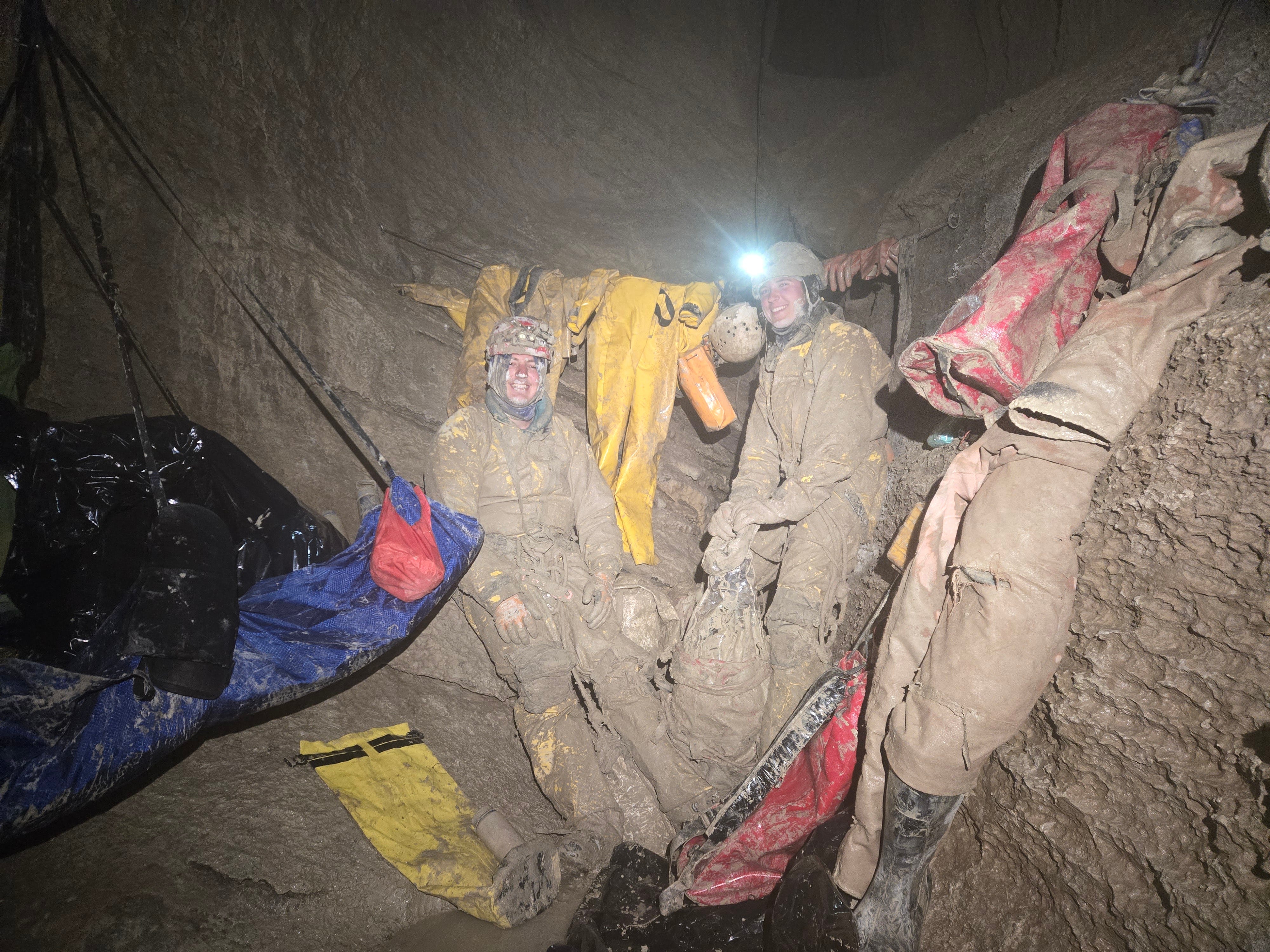
We told them about the excellent, if a bit short, day of exploration we had—we bypassed the sump from 2022, and continued down more tall, clean-washed stream canyon, and were stopped by a pit for lack of rope. They had a great answer to that news: they brought us more rope! 220 ft more. We already had some in camp to use the next day, but now we would likely be set for the rest of the expedition, unless we found a huge pit. Sam and Alex had spent their entire day fixing rigging below Camp 1, carrying rope destined for us the whole time. We were particularly psyched to hear that they fixed up the Brown Trousers Traverse, which was definitely the sketchiest part of the trip from Camp 1 to Camp 2. I looked forward to seeing their good work on the way out.
Sam and Alex were curious to see Camp 2 after Dustin and I gave a grim description of it when we came back to Camp 1. Now that they could see it for themselves, they knew exactly what we meant and understood that it was better for 3 people than 4. Sam described it as “cozy”, which is probably the most positive adjective one could use to describe the place. Given the lack of space, and given the fact that we were already in our hammocks, they didn’t stay long after we exchanged stories. They dumped that rope out of their packs for us, started climbing up the rope that leads out of camp, and continued back to Camp 1. It was past 11pm, so they were having a long day, and would probably get to Camp 1 around 3am. We got rained on with dirt one more time as they passed over us in the Brown Trousers Traverse, then we all went to bed. I fell asleep wondering what lie at the bottom of the small but inviting pit where we turned around earlier that evening.
Saturday, July 27: Onwards, and deeper!
We woke up feeling energetic and ready for a long hard day of caving—in contrast to the previous day, when we woke up feeling beaten down from the previous day’s hauling marathon and thus had a shorter, easier day of exploring. Today was our day to return to continuation at the bottom of the cave and keep pushing until we no longer could—until we ran out of energy, rope, food, or similar.
We stuffed our bags full of rope and other supplies and hurried out of camp in the morning, not wanting to spend any more time there than necessary. We quickly returned to where we were turned around yesterday, the ~20 ft pit. We resumed the same roles as yesterday: I rigged while Dustin and Tommy surveyed behind me. I rigged down the pit, which needed one rebelay and ended up being more like 30 ft.
At the bottom of this pit, I was psyched to find going walking passage, 3-4 ft wide and 8 ft tall, descending steeply downwards. The water that disappeared right before the last pit reappeared as a waterfall coming out of a tight crack in the wall of the pit.
I ran excitedly down the walking passage and enjoyed my team-sanctioned scooping frenzy. This walking passage was quite surprising and was one of the nicest passages in the whole cave (nicer than the borehole in some ways, as there wasn’t thick sticky mud threatening to rip your boots off your feet). But I didn’t get too excited, as I expected the walking passage to quickly degenerate into the usual tight slithering canyon that makes up most of the rest of the cave.
To my great surprise, the walking passage stayed wide and tall for quite a long time as I scrambled down the many pouroffs in the passage. The pouroffs were just a few ft tall, so not difficult to scramble up/down, but just athletic enough to keep me working hard and warm as I ran down the passage, rapidly gaining depth. After what felt like hundreds of ft of elevation loss going deeper into the cave, I began to wonder if maybe I should stop and return to help with the survey effort, since the cave seemed to be charging ahead at an unstoppable pace with no pits for me to rig.
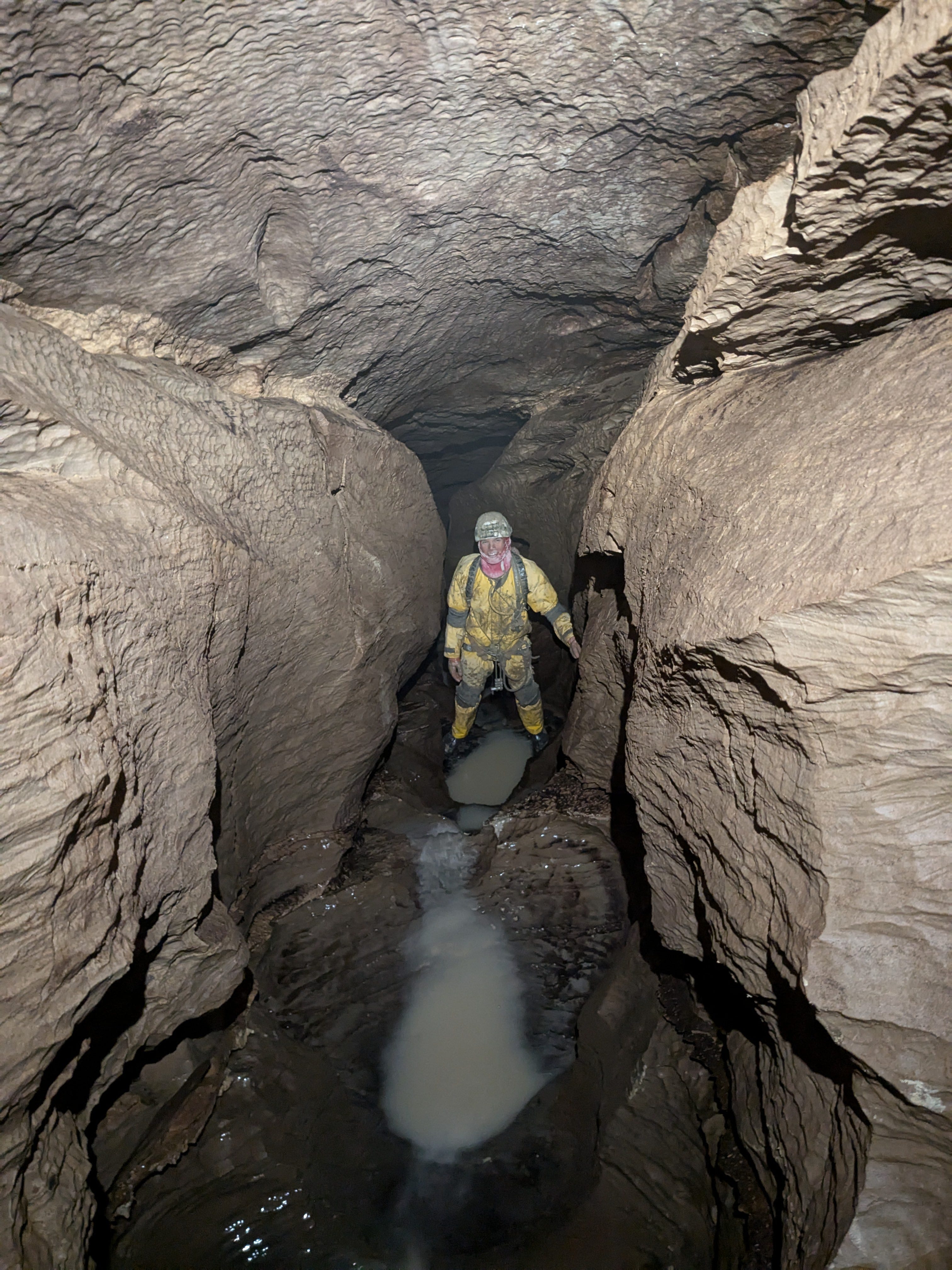
Soon enough though, the passage shrunk down to crouching size, and the clean-washed walls above the flowing stream at the bottom gave way to thick globs of slime coating the walls, which got all over me as I now had to be all over the passage walls to progress. It was a good run with the pleasant walking passage while it lasted, but now the cave was back to its usual slimy, tight, unpleasant self. After running all the survey numbers (that Dustin and Tommy dutifully collected while I ran ahead hauling rigging supplies as far I could take them), we found out that we gained about 200 ft of depth in this amazing run of walking passage!
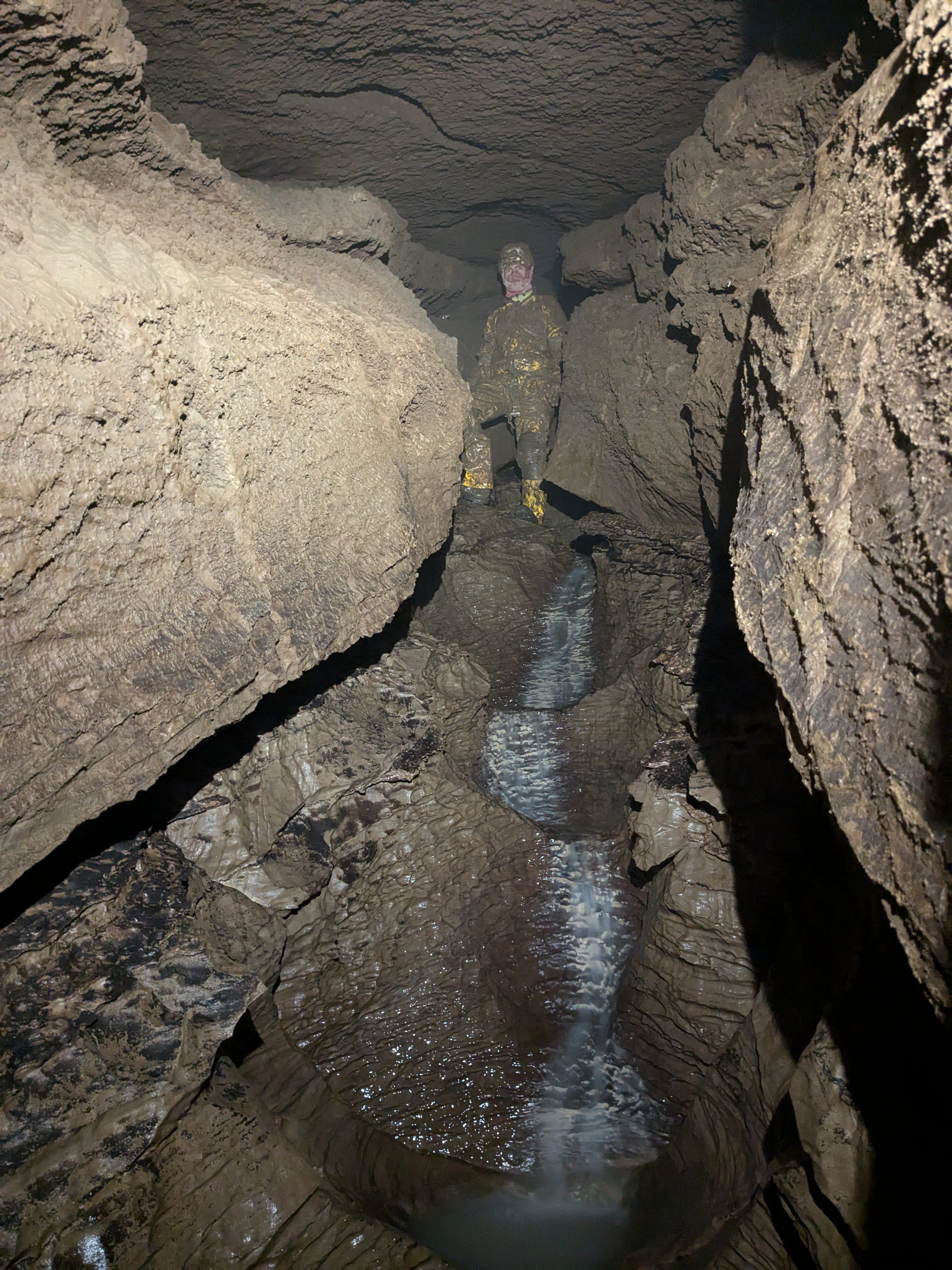
I continued down the now-tighter and muddier crouching passage. We were back to packs-off terrain, the norm for the cave. Eventually, water disappeared down a too-tight crack, while human-sized passage continued as a small mud tube bypassing the water above. The tube looked quite tight, like it wouldn’t go, so I ditched the pack full of rope to see what was down there.
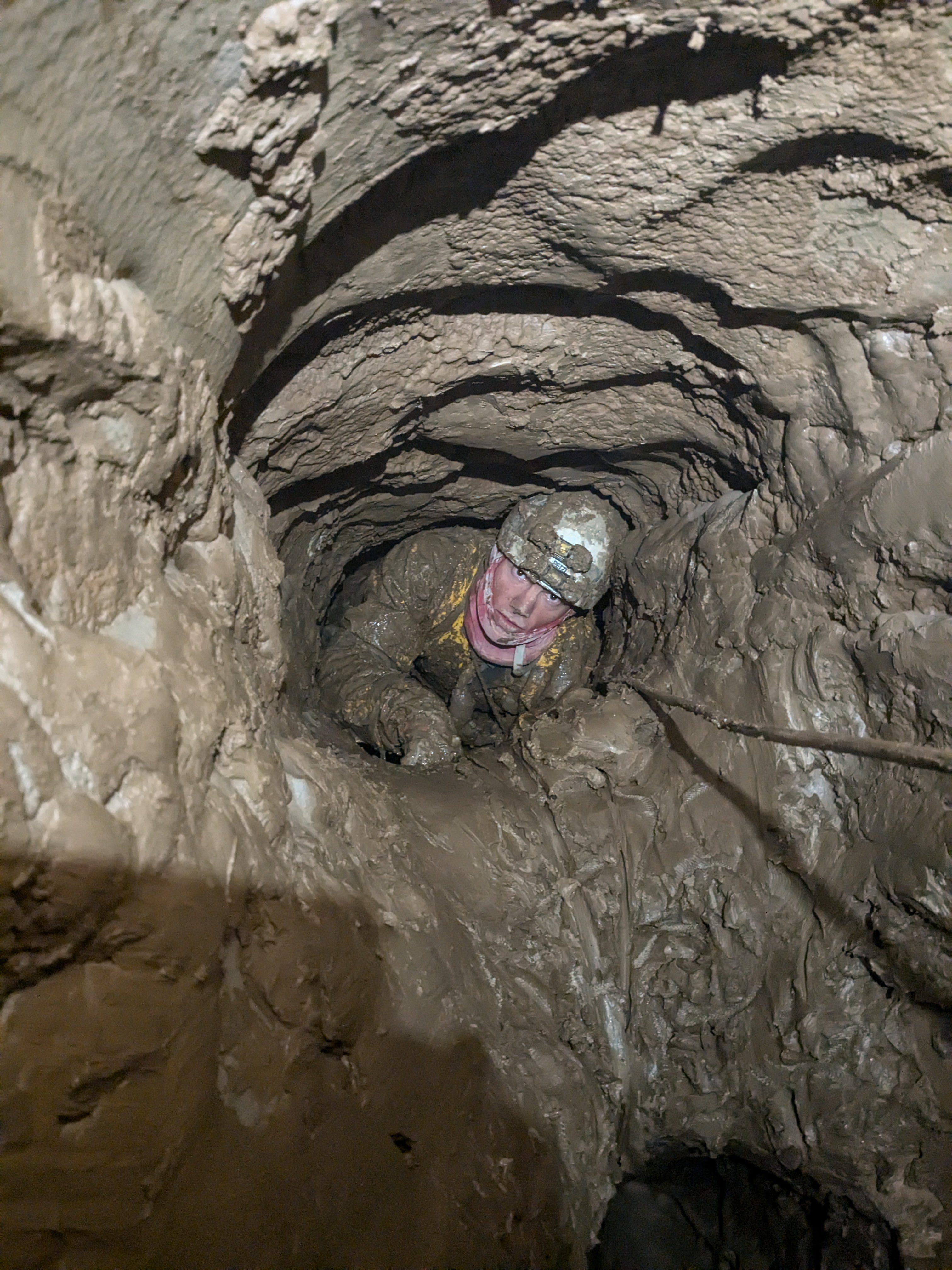
I slithered down the mud tube, which descended 35 degrees downwards as a slick chute, and popped out into a small standing room. Here was a mud floor, and just in front of me the ceiling descended into the mud floor. It was a mud sump, with no hope of continuation, no clear spot to dig. I was simultaneously disappointed that the incredible run of the cave passage going deeper and deeper can to an unambiguous end, and also relieved that we had an excuse to go back to camp, as all the time in the tight wet muddy passage had sapped quite a lot of heat out of me.
It took several tries to climb back up that 35 degree mud tube (oops), and by the time I had struggled my way back up there, Dustin and Tommy had just made it to me. Dustin witnessed me pop out of the horrible body tube and was shocked that I went down that alone and without a rope. I shared with them the bad? good? news that the cave ended at the bottom of that tube, and that there was essentially no hope for continuation without a fairly hopeless mud dig. Dustin and Tommy said let’s survey it and get the hell out of here! They had stopped surveying and ran ahead to me to meet me because they got cold standing around surveying and needed to warm up. I then rigged a rope going down the tube for them to go survey to the bottom, then began packing up all the rest of the rope and rigging supplies, as we wouldn’t be needing those for the rest of the day.
Dustin went partway down the tube, not even feeling the need to go to the very bottom once he could see the bottom and shoot a survey shot down to it. After he made it back up, I asked the team whether they would prefer me to join the survey team to finish the rest of the unsurveyed passage they skipped when running ahead to me, or take all of their stuff and haul it back to camp so they could have light packs the rest of the day. I was hoping they would tell me to take some heavy things and run, as I was quite cold after rolling around in the mud for a while, but of course I would do whatever the team felt was best. Thankfully, they told me they would rather have light packs the rest of the day, so I loaded up everything they wouldn’t need to survey a bit of walking passage and bolted back to camp. It was probably an hour and a half back to camp at this point.
I ended up doing 2 runs between camp and the survey team to haul gear. I noticed as I was doing these haul runs around camp that my left arm felt funny. The tendons on the back of my forearm would pop and grind as I flexed and extended my wrist, and my whole forearm seemed somewhat tight. Pushing against the walls of the cave with that arm, which is a very necessary movement for all sorts of stemming and other movements, starting causing me some pain. I didn’t think much of it, and figured I could sleep it off.
Everyone was back in camp around 10pm that night. We went to bed in our hammocks feeling triumphant about all the new cave we had discovered, and how much deeper it had surely gone (although we did not know the exact numbers yet).
Sunday, July 28: Oh no, injuries
I woke up that morning and immediately tested my arm to see how it felt. It was much worse than the day before. My wrist and forearm were swollen and stiff, and moving my wrist made even more dramatic popping and grinding sounds and sensations than the day before. I deliberated for a while before reluctantly deciding that I should give my arm a rest that day. We were all in a very, very remote place, and we needed ultimate self reliance and fitness if we wanted to get ourselves out of there. I couldn’t afford to make my arm much worse than it was, so I decided to take a rest day in camp.
I felt bad about this decision because it takes a lot of work to get people here, to the frontier of the cave where new exploration can occur and the cave can be pushed deeper. Not just effort by me to get myself down here, but also effort by everyone else who hauled gear for us so that we could be well-supplied at the frontier. By taking a rest day, I was not only wasting some of the products of my effort to get myself to this place, but also their efforts to supply us. So I did not take the decision to take a rest day lightly. But I did conclude that it was the right decision after some deliberation, as I needed my arm to function well to get out of the cave.
Dustin and Tommy then did a slightly easier day, finishing the last bit of passage that hadn’t been surveyed, so there was a whole connected survey all the way down to the bottom of the cave. They then went to the top of the 60 ft pit in the dry breakdown tube and continued horizontally across the top of the pit. This required rigging ropes horizontally above the bottomless chasm in the floor, so it was slow going, but apparently a very good lead. A dry tube at the top of a keyhole continued onwards, and seemed to disconnect from the stream at the bottom (where we explored the previous days) around the point where they turned around. That would be an excellent lead for the next team!
Dustin and Tommy returned around 10pm, just like the day before, although it was a shorter day because we all slept in today instead of waking up early like the day before. Apparently Tommy started having shoulder issues that day. Oh no! We could all tell that the cave was taking a toll on us physically. It’s a harsh, unforgiving environment down there, and our cramped hammock sleeping setup didn’t exactly lend itself well to good physical recovery—merely maintenance. We were all ready to begin our 2-day journey to the surface tomorrow and be out of the cave.
Monday, July 29: Departing Camp 2, and even more complications
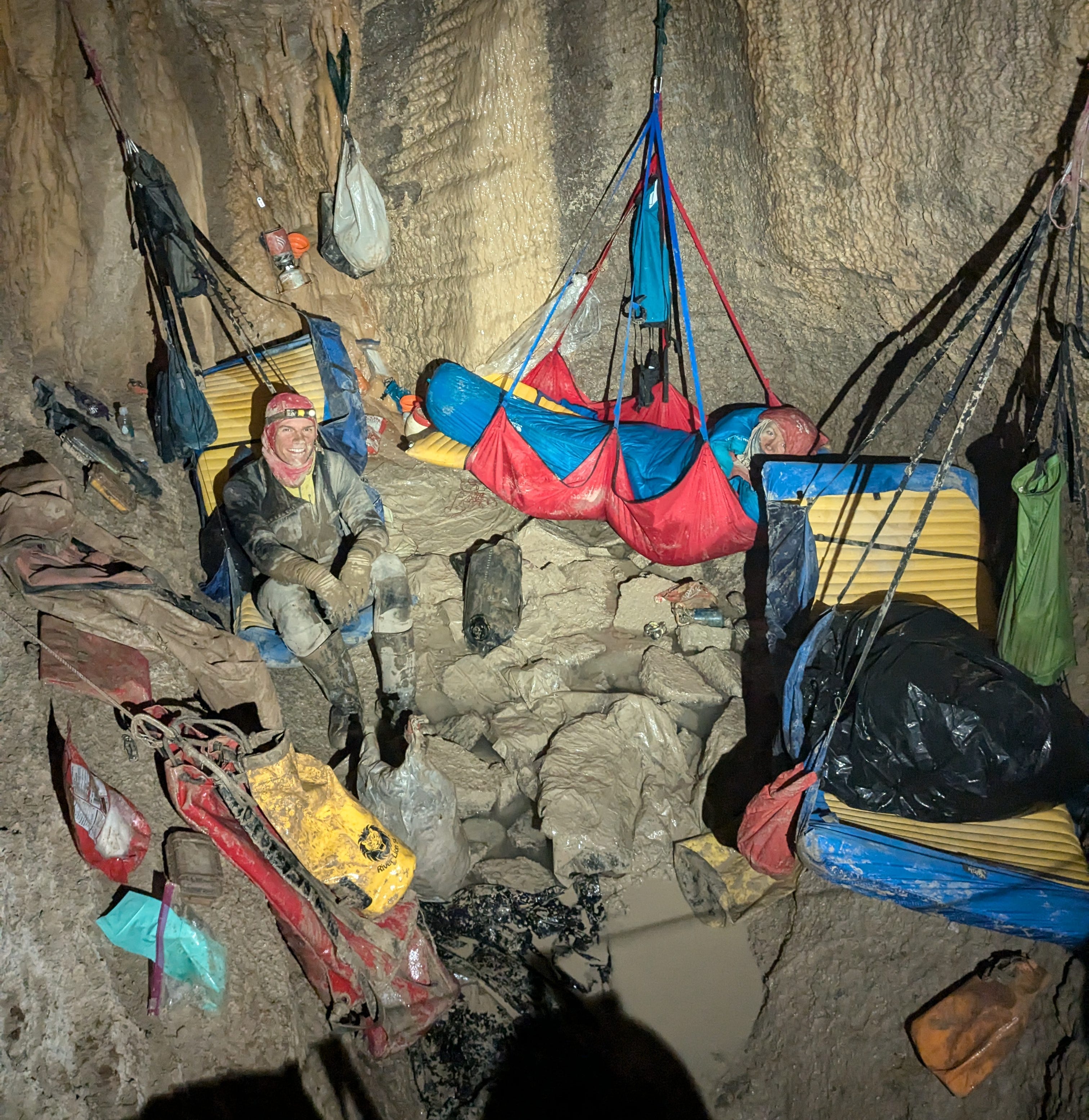
My usual not-so-restful sleep I would get in the portaledge hammock was rudely interrupted at 3am that morning when I woke up in a pool of water in my hammock! The tarp that I placed between my hammock and the faint drip down the wall it was up against must have gotten out of position. So 37 degree cave water dripped slowly into my hammock all night. The tough, durable fabric of the hammock was waterproof enough to hold water in it, and I woke up in a pool of water, with my sleeping bag and clothes totally soaked. I got out of my hammock as quickly as I could (recall this is an awkward, difficult maneuver), dumped it upside down to drain the water, and got to work adjusting my tarp to keep the water out. I was too bewildered to be mad at the whole situation, and honestly I found it kind of funny. After a few minutes of messing with the plastic tarp, I got it into a position that was satisfactory to me and got back in my hammock. I managed to get that all done before the shivers hit me too bad, although I did wake up Dustin in the process. Alright back to bed, that little nightmare is over.
6:30am. I wake up again in a pool of water. Shit, I must have not gotten the tarp in the right position. I was quite cold this time, as I had been in wet clothes and a wet sleeping bag for hours at that point. I hurried out of my hammock, and tried to fix the situation while shivering and standing in my socks on a muddy rock poking out of the pool filling our entire camp. In this situation I realized that it was futile to try to get a few more hours of sleep in this state, and said aloud to my still-mostly-asleep team “guys, we need to leave”.
We were already scheduled to leave that morning, so I was merely getting the other up and moving a few hours earlier than they would have liked. Dustin, who was more awake and who saw what happened a few hours ago, understood what was up and started getting out of bed. Tommy, who was more asleep and didn’t quite get what was going on, resisted my initial attempts to rouse him from his slumber, but eventually relented.
I drained the hammock again and took the sleeping bag out of the hammock and wore it like a shawl, so I could both warm myself up and partially dry off the bag for the next team that was to come down here and use it. During the hour and a half in which we packed up our stuff to leave camp, I think I dried it off a little bit, although the next team would surely have preferred the bag be drier.
That morning, my arm felt a little bit better than the day before, but still not good; the popping and grinding sensation as my tendons moved along the back of my forearm remained. I took a some ibuprofen to reduce the swelling, in what was probably the first time I had ever used any drugs from my first aid kit. Tommy felt worse than the day before. His rotator cuff was giving him trouble, more than it was the previous day. We were now down to 1 uninjured person out of the 4 we started with. Derek bailed at Camp 1 due to some vague malaise, I had weird tendon issues in my forearm, and Tommy had rotator cuff issues. Dustin was the only one left in tip top shape.
All of us would be fine getting out of the cave on our own, although we did decide to redistribute gear to be carried out of camp. Since we stashed food at Camp 1, we had not too much to carry out. Tommy took no bag. I took a light bag, 15-20 lb. Dustin took the heavier bag, 30-35 lb. Notably, Dustin carried all our shit bags from our few days down there, as we determined that there was no feasible place to bury them except at the Camp 1 latrine. American Hero, that guy.
We left Camp 2, Camp Dangle, at 8am. We bid goodbye to that godforsaken place, happy to be out of that hellscape, but also thankful that it enabled us to get some amazing exploration done. Camp 1 would be luxurious by comparison, and we were all looking forward to spending a night sleeping on flat, dry ground, where we could roll around and spread our limbs (a little bit—we would certainly bump into our camp mates doing that).
The trip back to Camp 1 went smoothly, with minimal aggravation to my wrist/forearm. Much of the caving is actually packs on, made difficult only by the exposed mud stemming. The packs on travel didn’t bother me much, as I could generally stem with my elbow and other body parts to avoid putting a ton of pressure on the bad wrist1. We made to to Camp 1 at 11:30am, a pretty reasonable time. The 3.5 hours it took us to get from camps 2 to 1 is similar to the travel time we took at the beginning of our trip. Not bad for mildly-injured cavers, although we did have lighter packs.
At Camp 1, the next team hadn’t yet left. Pete Johnson, Katie Graham, and Max Koether were still in Camp 1, almost ready to leave. We told them the story that explained why we were at Camp 1 so early in the day. In particular we told them about 2 options for the problematic hammock: either fix the tarp once and for all to keep water out, or move it to the other wall where we planned to have the 4th spot. The other wall was lower angle and thus would be much less comfortable, but it was dry.
I was surprised to see that Jason wasn’t there, as he was supposed to be. After hearing from Sam and Alex Lambie what Camp 2 was like and how it would be really grim with 4 people, he volunteered to back out of that camp trip so the others could go. How selfless of him. He really is an excellent expedition leader.
I actually felt great at Camp 1 and suggested we keep going to the surface. It was early in the day and I felt fine, and I didn’t want to wait another day and see my arm possibly get worse again. Dustin said he was worked and would much prefer to stay in camp. I was totally fine with that too, and we all got into the camp tent as the team of Pete, Katie and Max left for Camp 2. We wished them luck and collapsed into our sleeping bags at Camp 1, eager to hear about what they would find several days later.
In Camp 1, we all lied down flat and relaxed in our sleeping bags. It feels weird to type that as if it were some rare luxury, lying down on a flat surface, but it had been several days since any of us had been able to do that! My sleeping bag was wet unfortunately, but I was able to dry it out pretty effectively, drying out everything but the toe box. We also ate a ton of food that we had stashed there; it was a proper feast. We hung out and talked and basked in the glory of our epic for several hours before deciding to attempt some sleep at 4pm. We set an alarm for 3am. We figured it would be nice to get out of the cave early in the day and subsequently enjoy a full day of sunshine and warmth and socializing at base camp. Dustin announced his intent to naked sunbathe, and I thought that was an excellent idea and resolved to do the same myself.
I recall sleeping OK that night, when we went to bed at 4pm. I did not exactly get into a deep slumber due to the unusual schedule we were on, but I did get some good physical rest on our cherished flat dry surface.
Tuesday, July 30: Out of the cave!
I woke up to Dustin’s alarm at 3am. I gorged myself on a huge breakfast of oatmeal and peanut butter and peanut M&M’s (it wasn’t as good as it sounds, but it fueled me adequately), popped a few more ibuprofen, and we all left camp at 4:30am. Our packs were more equal now that Dustin wasn’t carrying all of our shit from the past few days, as he dumped it in the Camp 1 latrine.
We made it to the top of the Bunga Bunga at 7:11am. We were making good time, and I felt great. I was disfavoring my left arm, but that wasn’t slowing me down too much.
About 2 hours from the entrance, I had yet another complication on this trip: we went a little too high, above the standard route, and I found myself in a very tight untraveled chimney full of grabby popcorn that hadn’t been worn down from travel. The popcorn grabbed my suit and I moved too fast, tearing a hole in the butt of my suit before I realized what my motion was doing. I was so close to making it the whole trip without a new hole in my suit, only about 2 hours from the entrance. I also tore through the butt of my fleece undersuit. Recall that I forgot underwear when I hiked over to the cave from base camp, so those 2 layers were all that was protecting my skin from the cave. I would have to cave the next 2 hours out of the cave with an ass cheek exposed to the cold, sometimes abrasive, sometimes muddy cave walls. I was rawdogging the cave. Or was the cave rawdogging me?
Whatever, I had been through worse this week. For the rest of the trip out, I was caving with mostly 1 arm, and mostly 1 butt cheek! We made it to the entrance at 9:47am. That was 5 hours 17 minutes from Camp 1 to the entrance, not bad at all. I didn’t even stop to eat food or pee once. If I stopped to drink water it would have been only sucking from the walls of the cave.
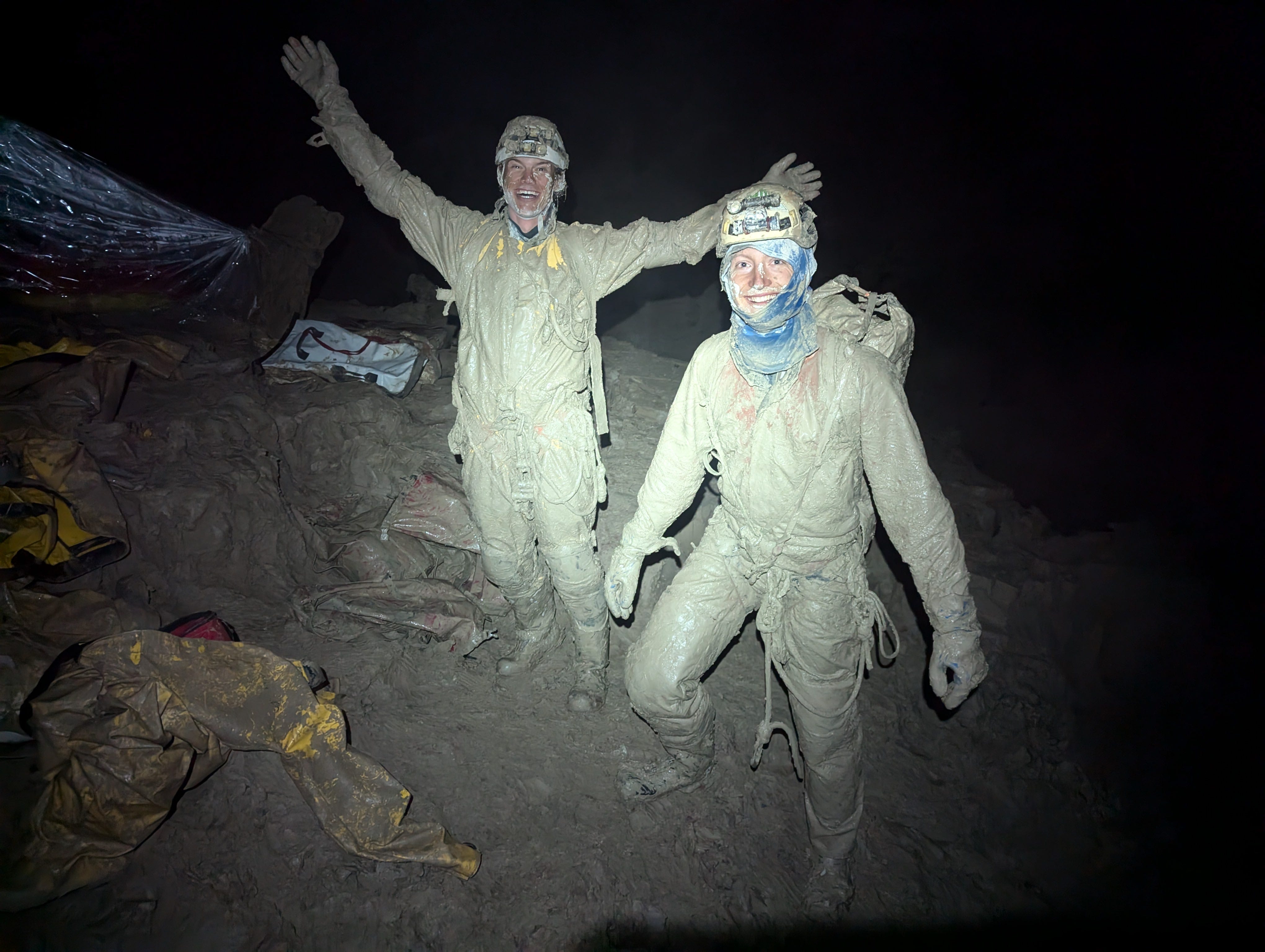
Adrian was at the entrance when we got there, retrieving some gear he had left there. His knee was feeling OK and he had been caving the past few days. We all excitedly relayed him the news from the past few days. We took a bunch of pictures in the entrance of the 3 of us, the first team to live in Camp 2, before heading back to base camp.
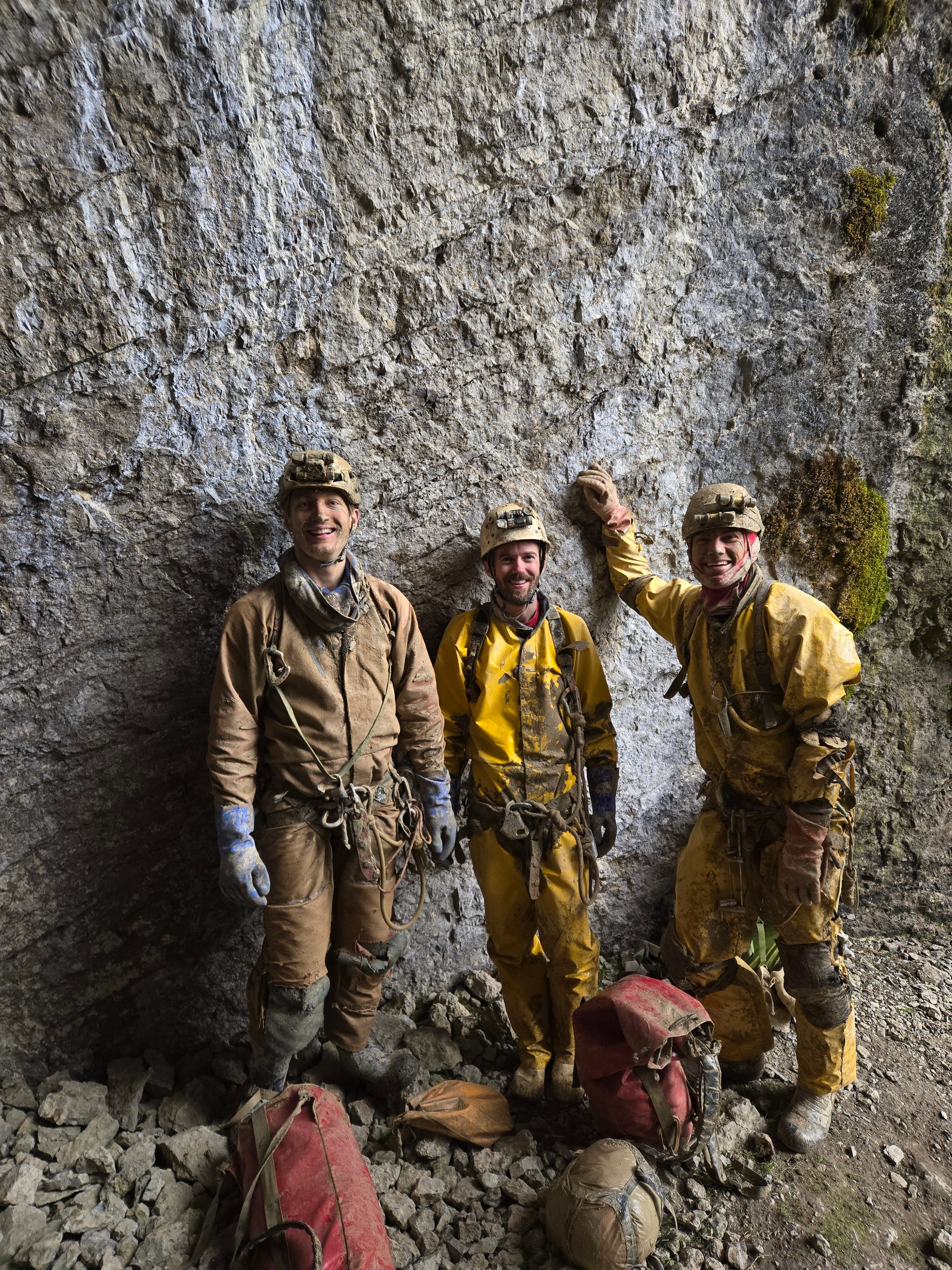
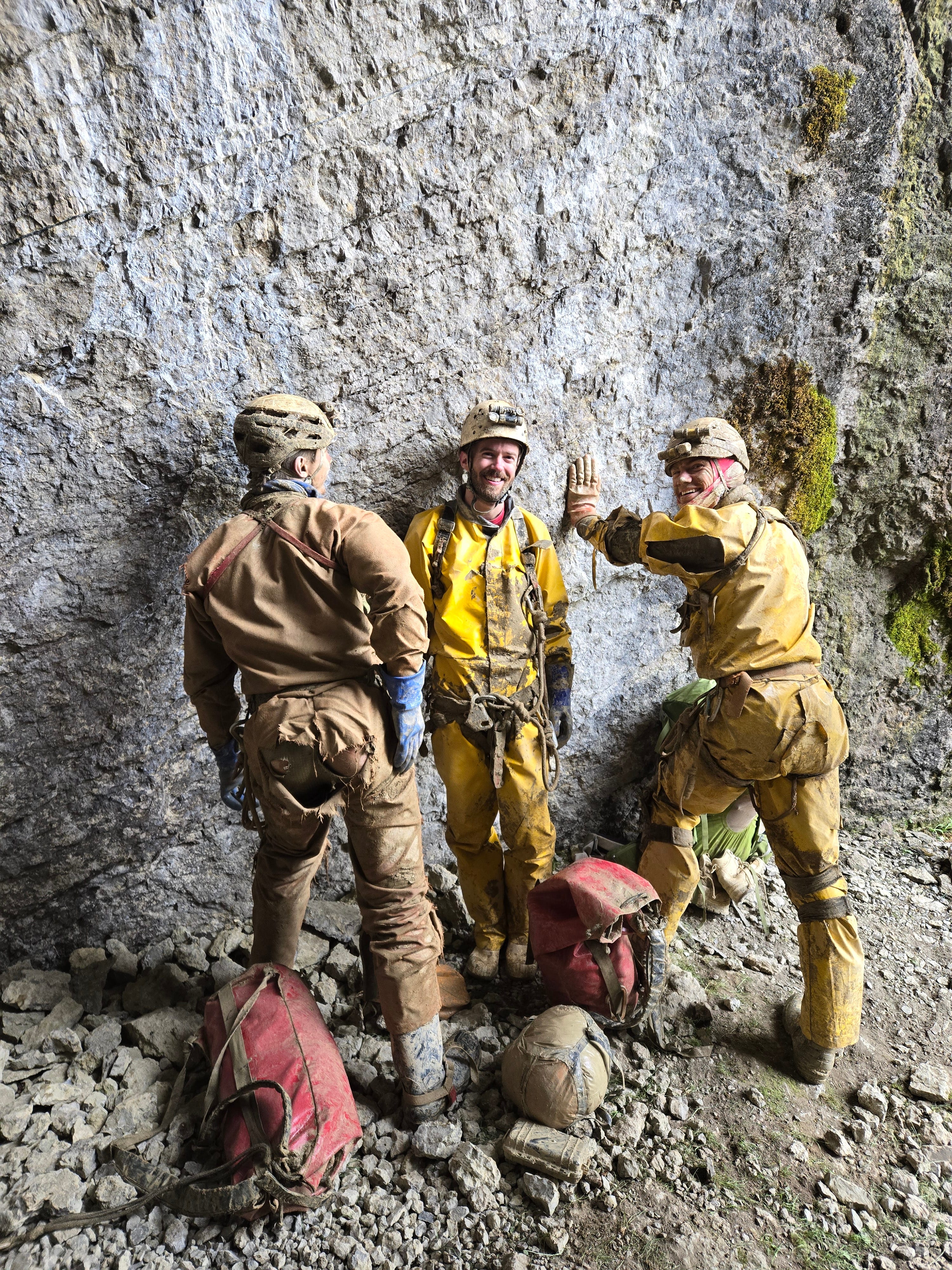
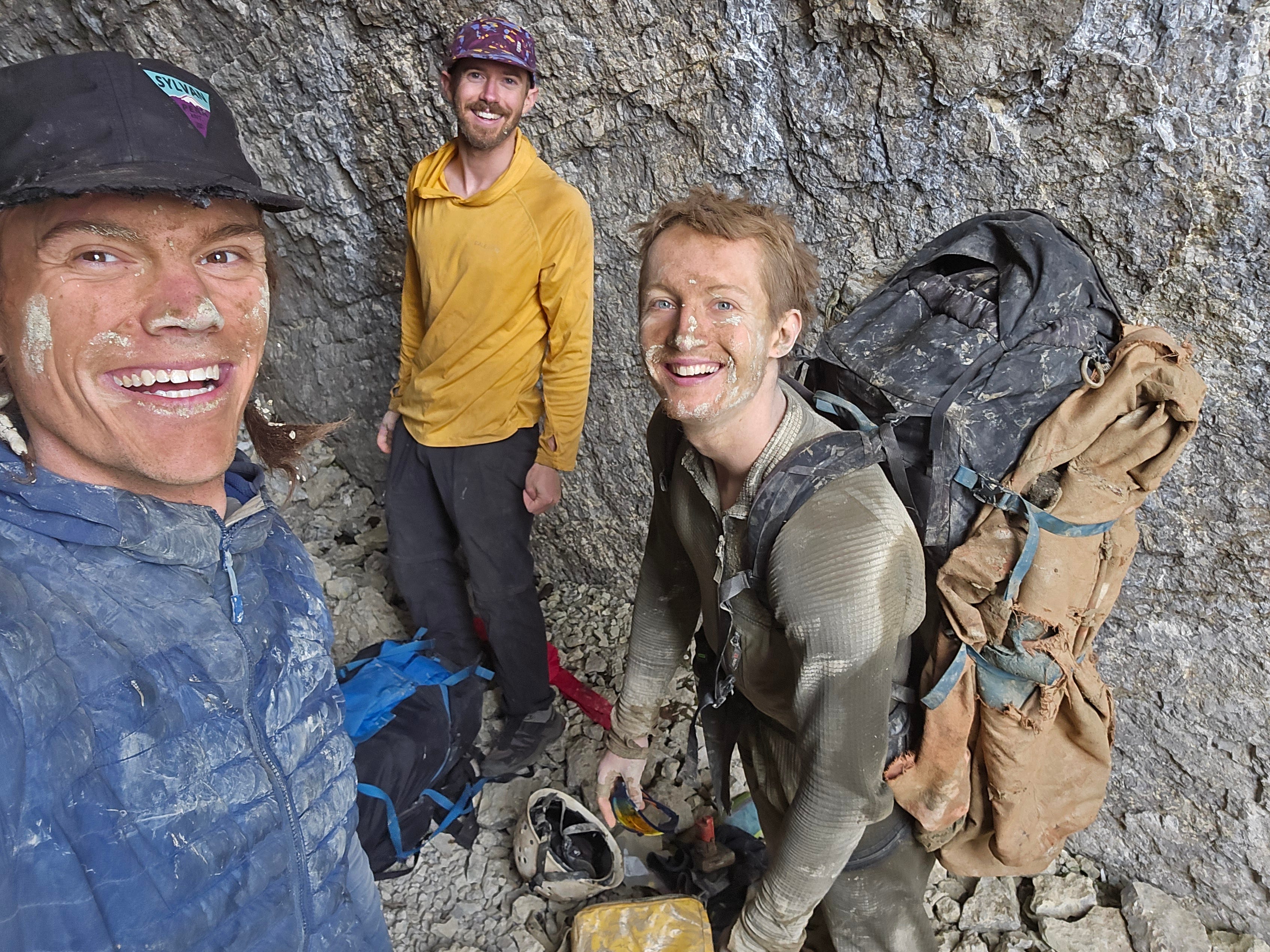
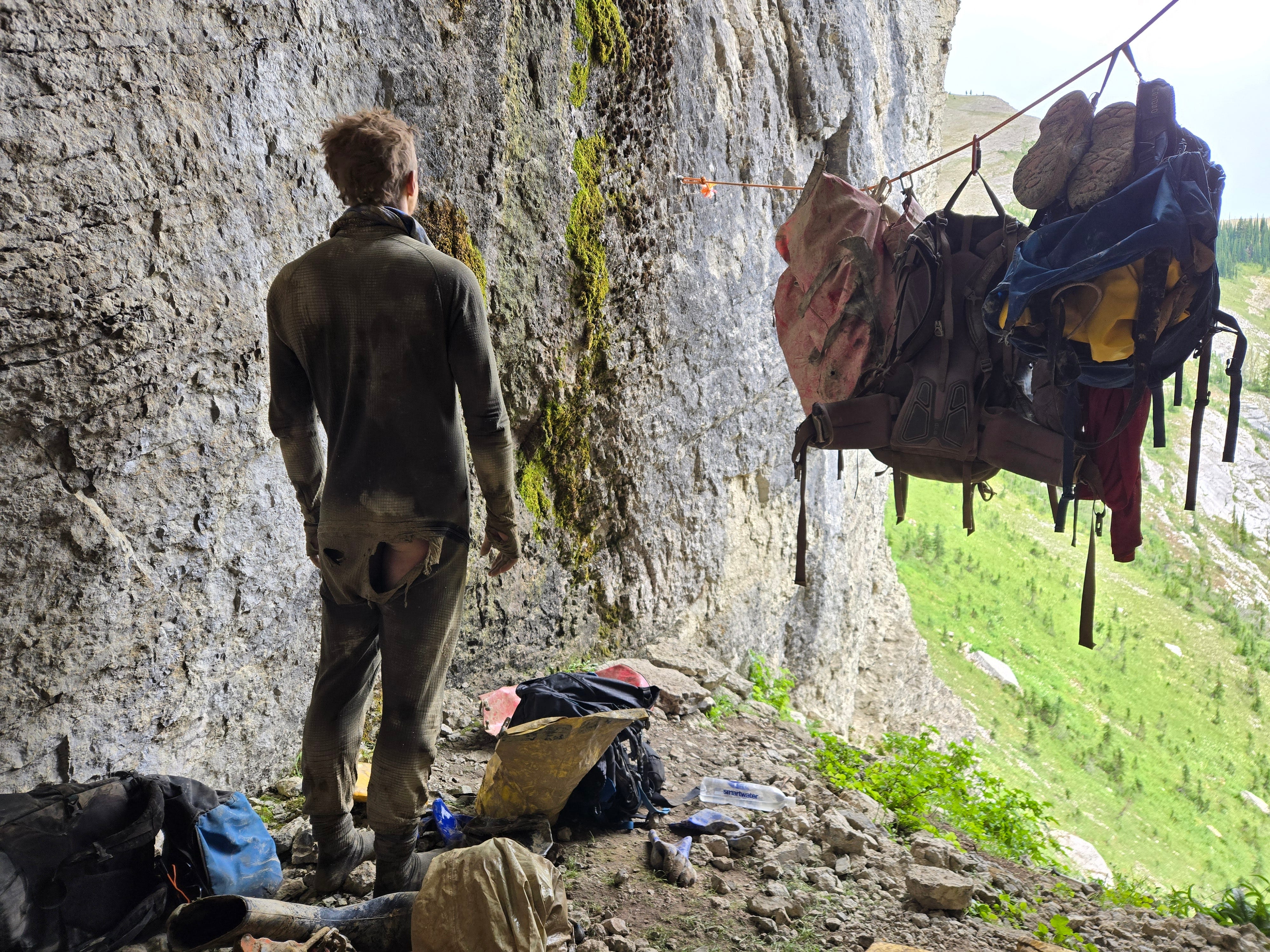
There was a beautiful fog covering the mountains when we got out. It was not exactly the warmth and sunshine we were expecting and hoping for, but we would take it. It would be nice to slowly ease back into the 90+ degree heat and intense sun that we had experienced the rest of the week. This kind of weather is rare in the Bob Marshall Wilderness, so we cherished the views. People always say “it never rains in the Bob”.
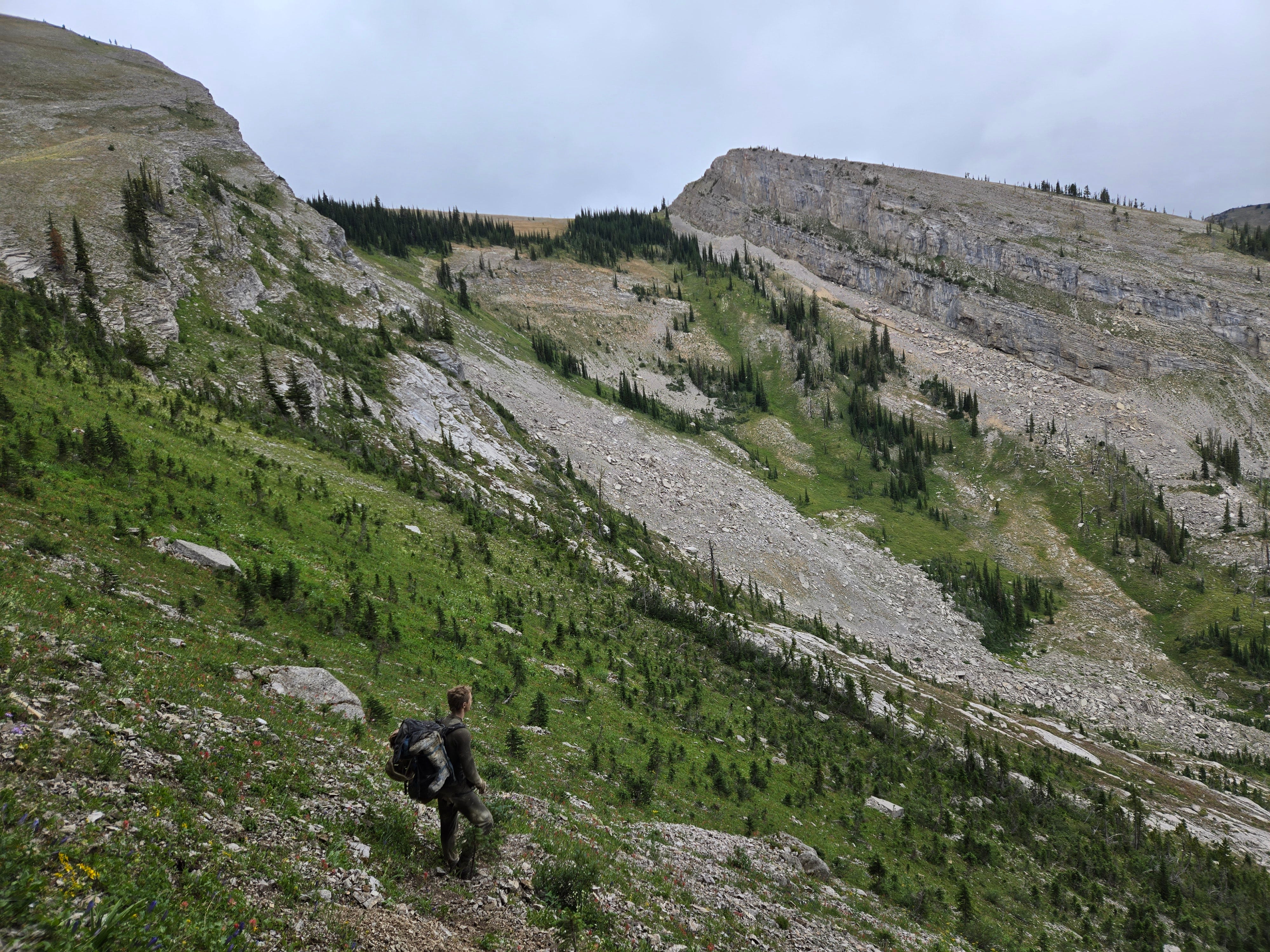
I debated changing into shorts and a t shirt before hiking back, but I stayed in my undersuit because it was chilly, in the 50s, and it seemed like it was about to rain. And rain it did, shortly after we started hiking. I led the hike back to base camp, feeling energetic and proud of what we had all done, despite the numerous little things that had gone wrong.
We got back to base camp to a small crowd, as many people were off caving that day in Virgil. Everyone was huddling underneath various tarp shelters as the rain got stronger and stronger, and we told them tales of the prior several days while all gathering underneath a tarp. Dustin was hiking over to Silvertip the next day, so he had to spend the whole day out in the rain cleaning gear and packing up so he would be ready to depart for Silvertip and do the 8 mile off trail hike early the next morning. It was honestly kind of a terrible day to exit the cave. I had nothing to do the next day or 2, so I lounged around under a rain shelter tarp, eating hot food and sipping hot drinks and socializing with whoever was at base camp.
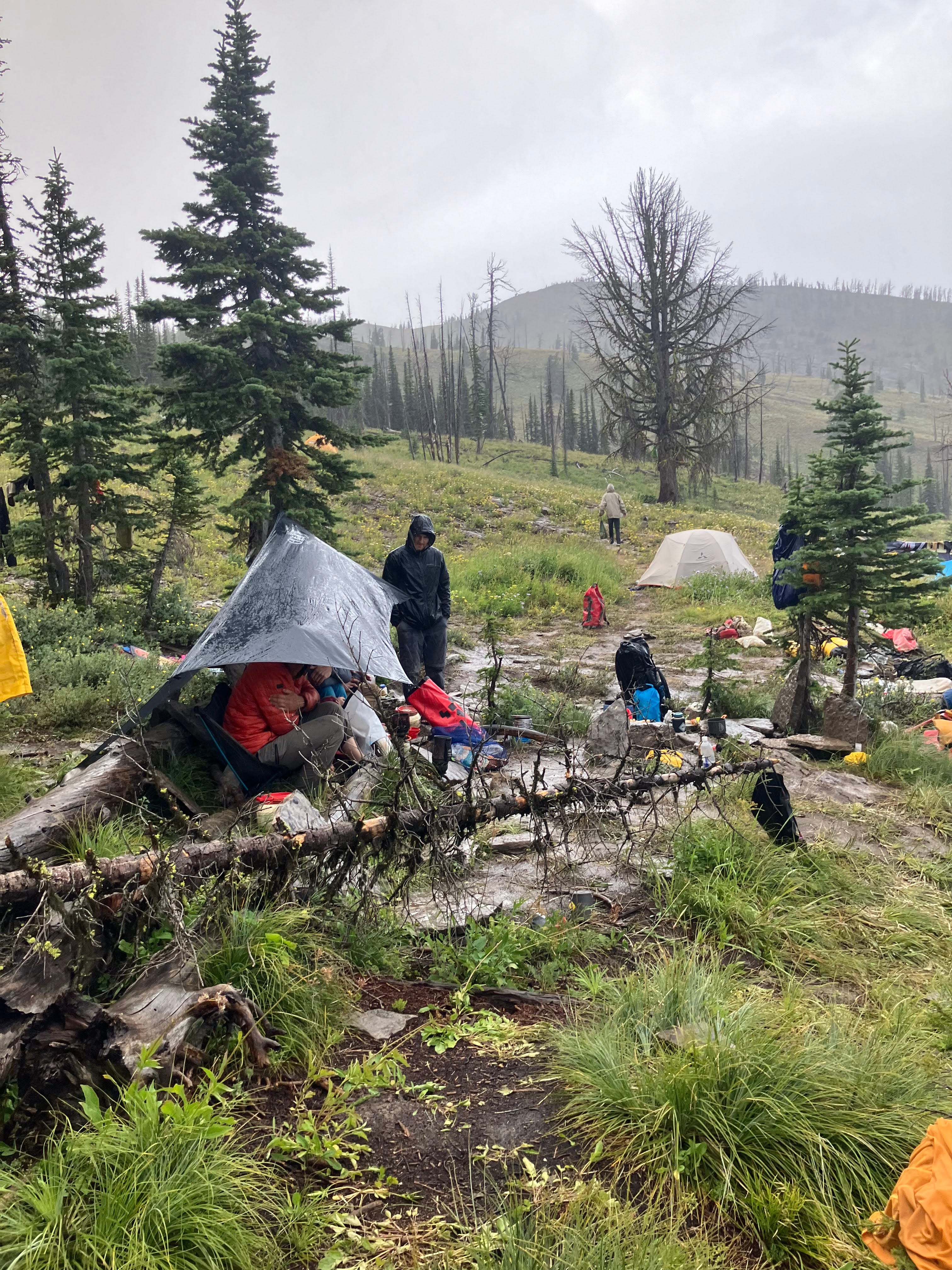
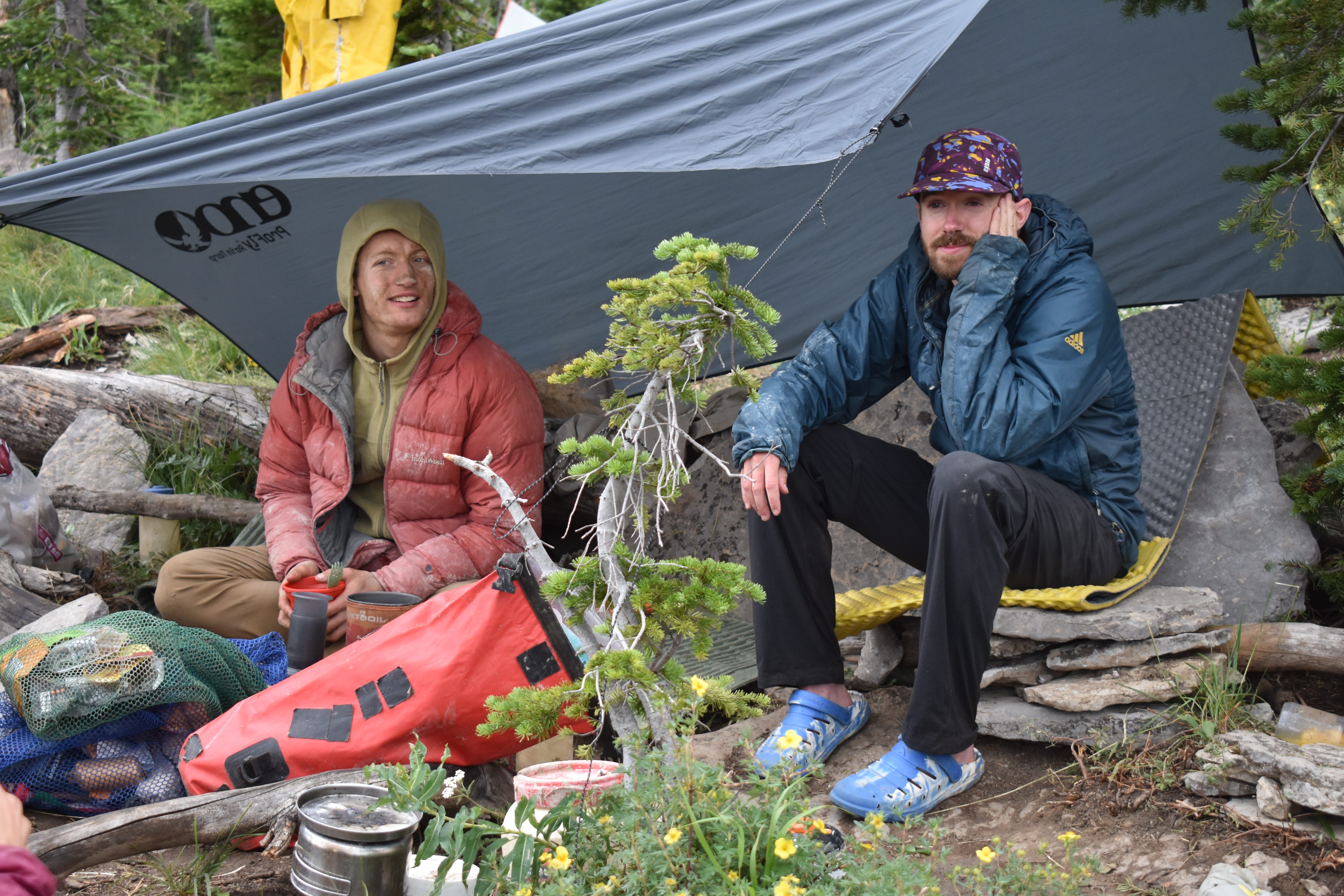
Jason came back early in the afternoon and I eagerly told him the news, although he had already heard an abridged version from Adrian. He was psyched to hear about all the new passage we found, and that the cave had gotten so much deeper. He entered the data from our survey notes into a tiny laptop he carried in, and calculated that the cave was now…
Drum roll please…
2477 ft deep!
This further cemented Tears of the Turtle as the deepest solutional cave in the US, extending the lead over Lechuguilla Cave (a very nice cave that I’m a fan of), which is 1589 ft deep2. We also overtook Bisaro Anima at 2257 ft deep. It’s notable that Katie Graham, the Canadian who runs Bisaro exploration, was on this Tears of the Turtle Trip. To our south, much deeper caves in Mexico (Huautla and Cheve) are the deepest caves in the Americas.
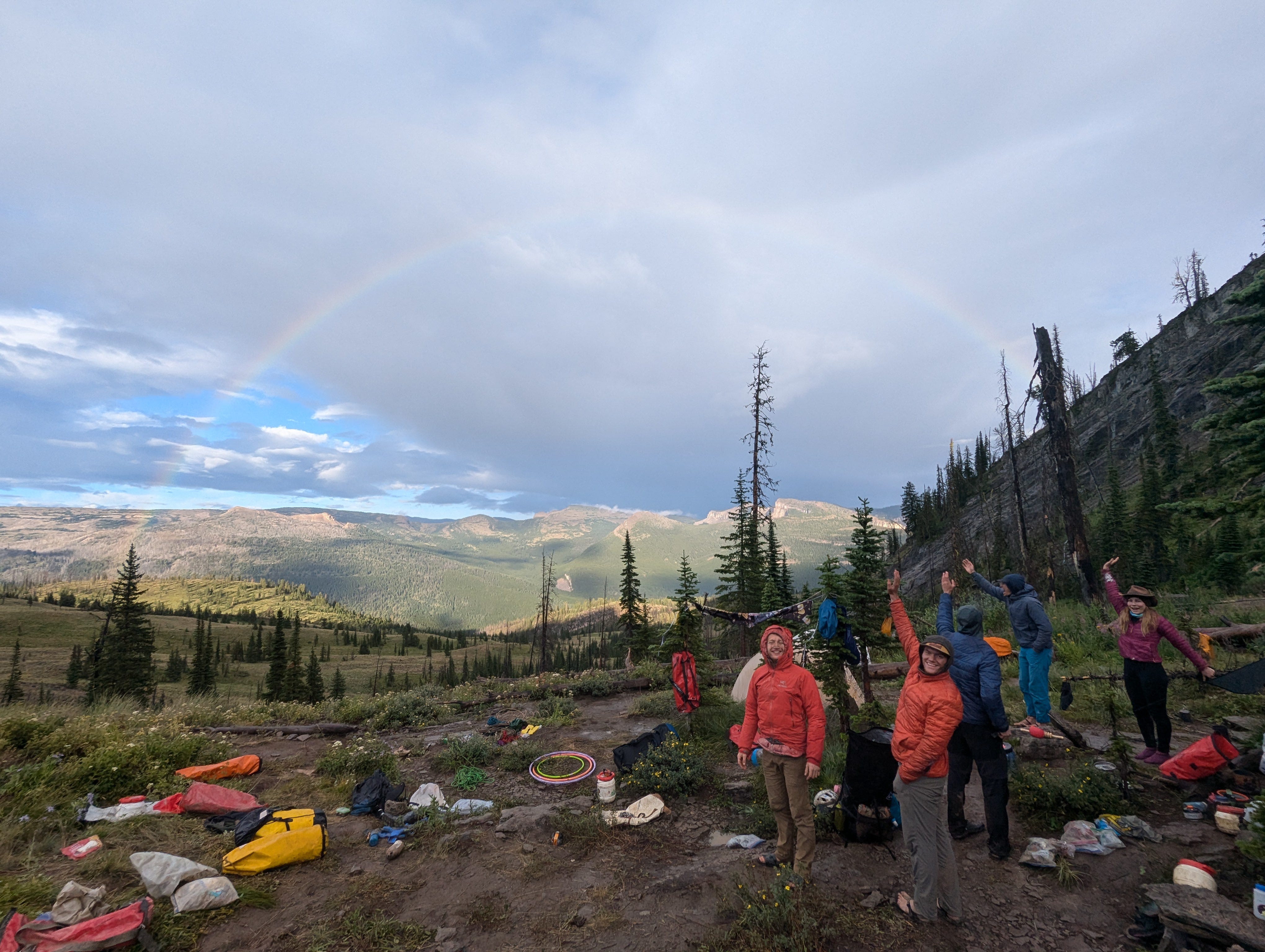
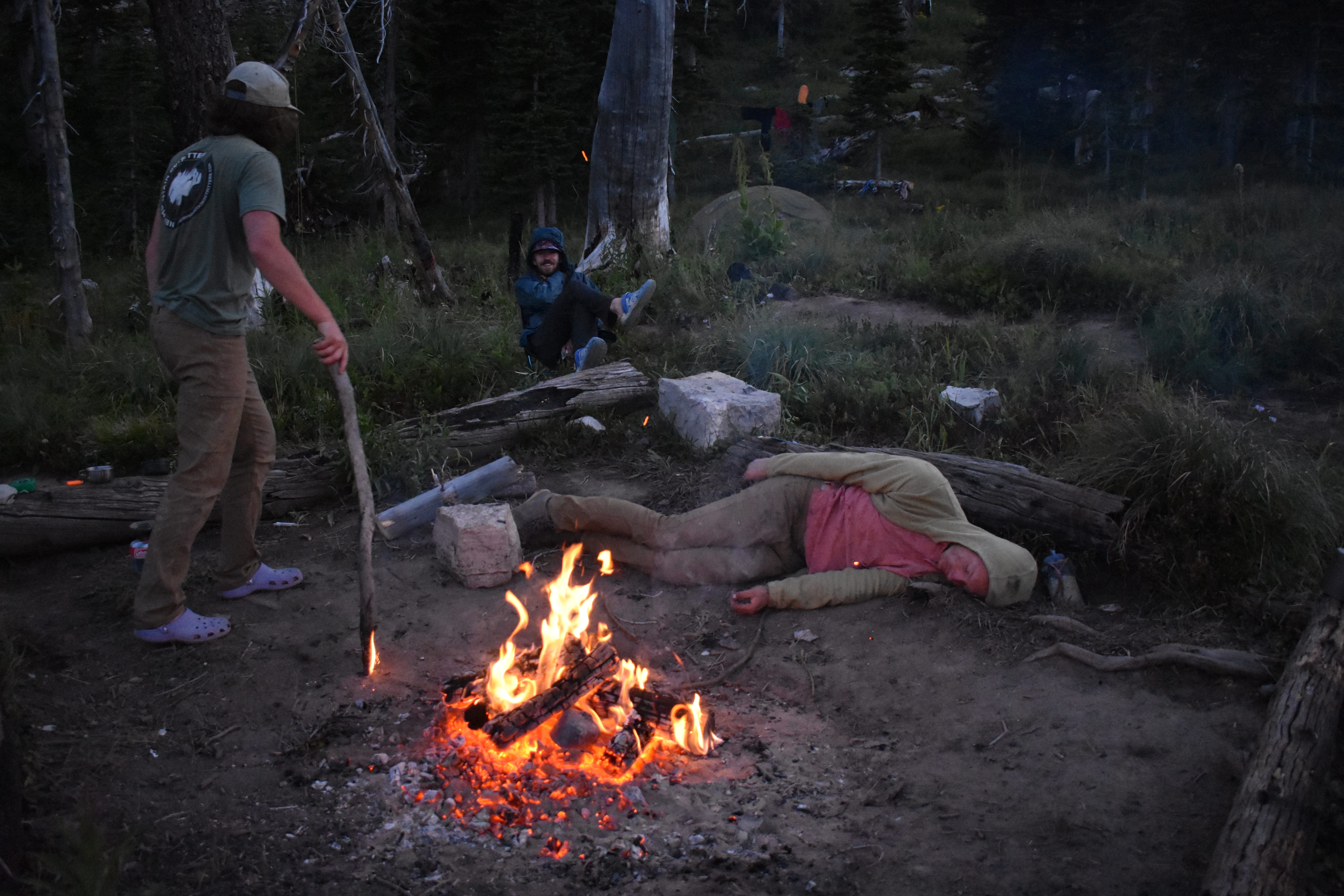
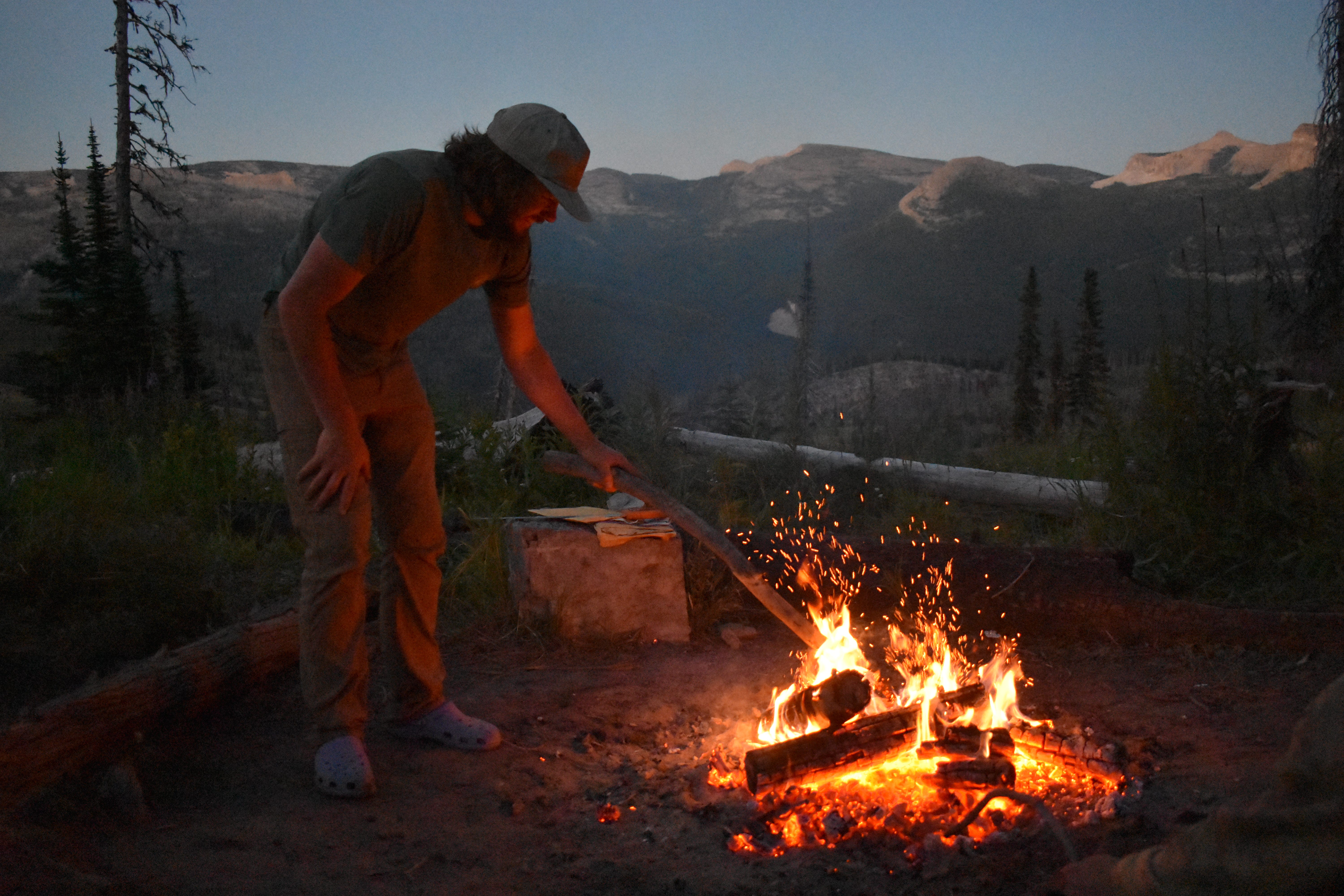
The rest of the team that wasn’t camping in Tears came back later in the afternoon, and the party started then. The rain broke around 9pm, and it was still light out, so we got a big rainbow. We started a fire and all warmed up for real, finally. Everyone was relaxed and excited about the good news and life was good.
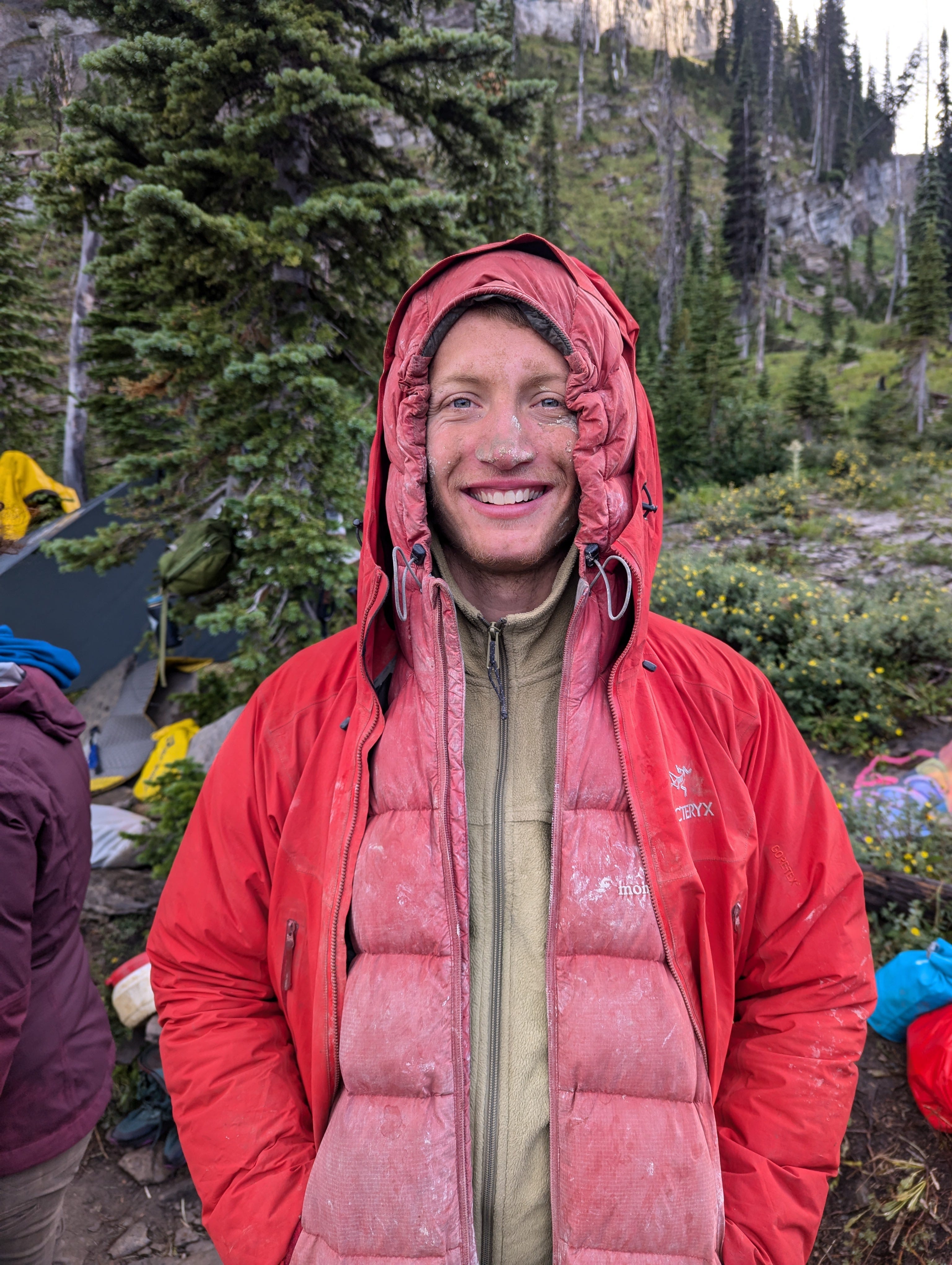
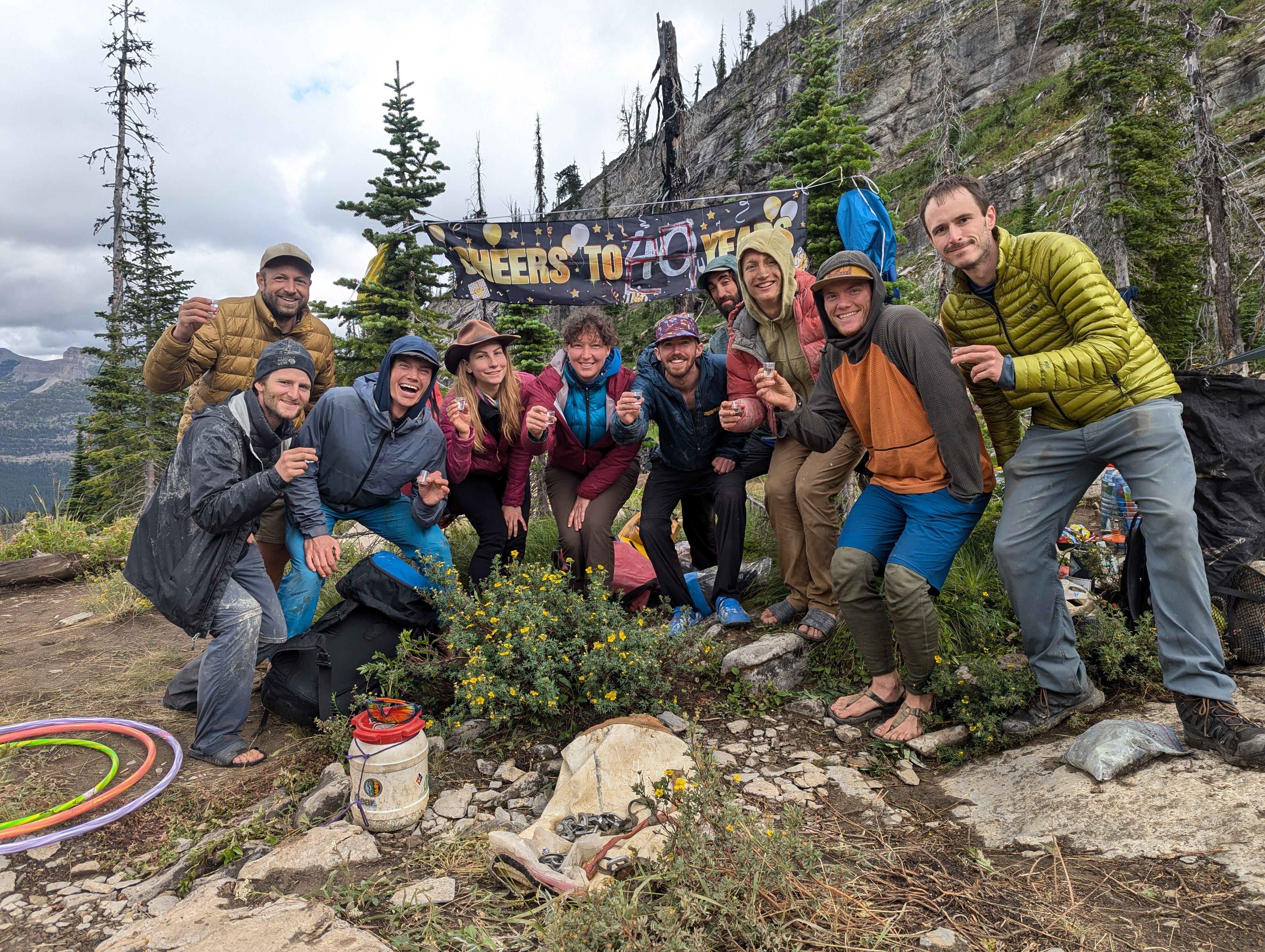
It was Tommy’s birthday that day. That was the second birthday that week, after Pete’s birthday. Pete’s birthday, and a small celebration for it, happened when I was in the cave. But now it was time to celebrate Tommy’s birthday! We all took a shot of tequila and lit a candle in a small pastry Jason carried in.
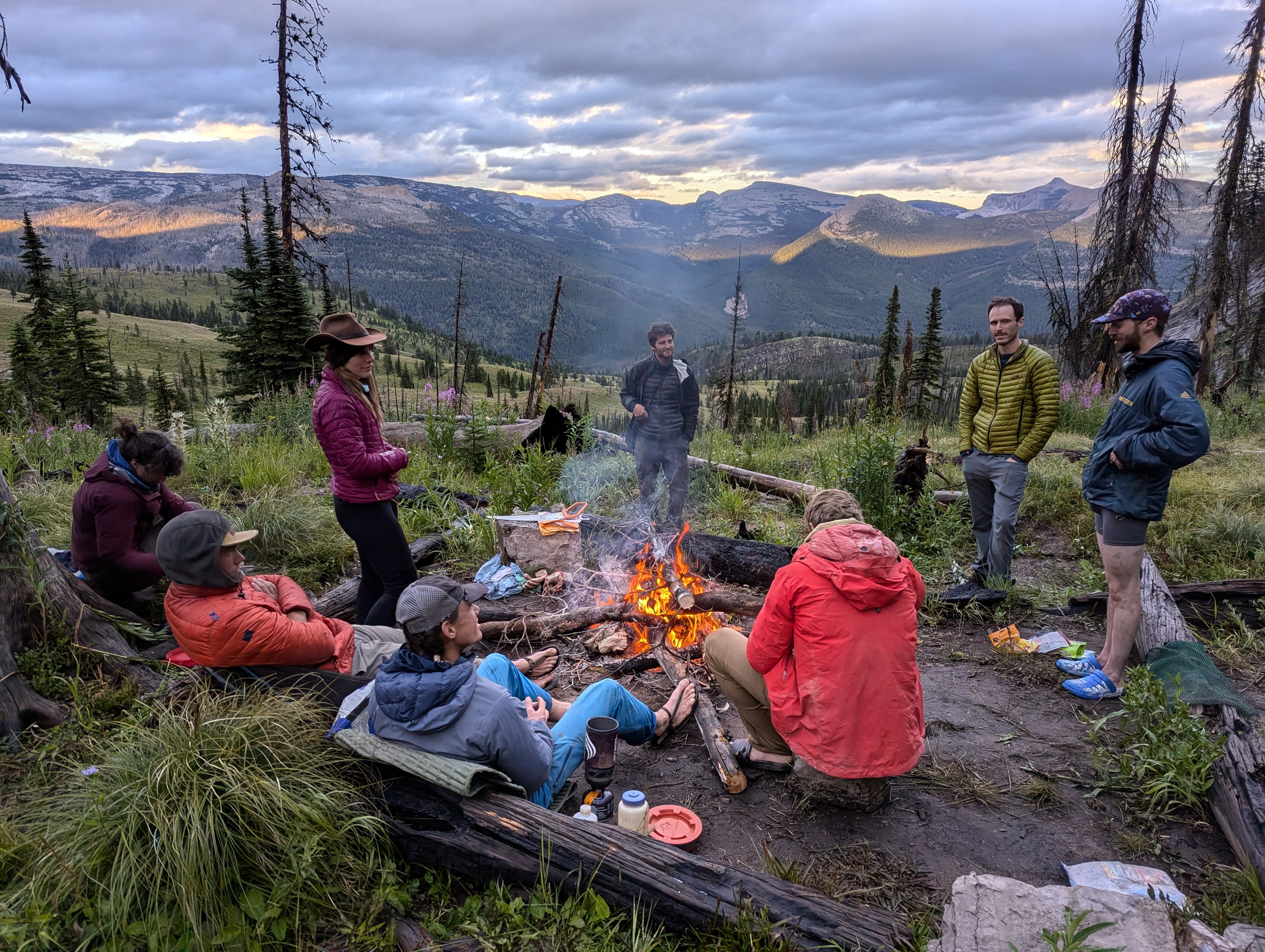
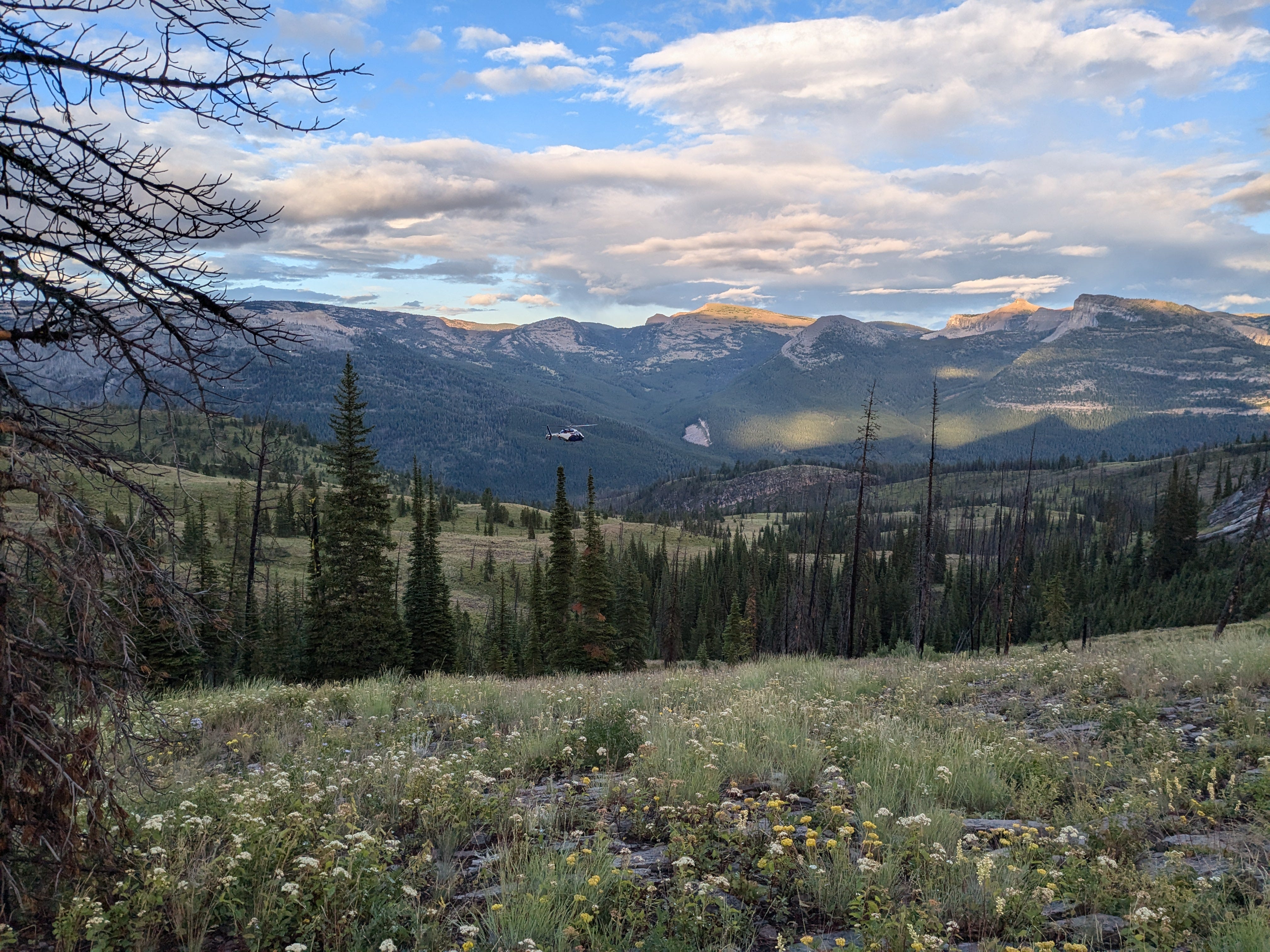
Something strange happened that night shortly after we got a fire started. We noticed a helicopter flying in the distance, in the White River valley below us. This was odd, as we were over 20 miles from the nearest road, so one wouldn’t expect helicopters to fly over here. The helicopter kept going up valley towards us and getting louder and louder. When it got near our little side valley off the White River, the helicopter left the valley and started flying directly towards us. We thought at the point that it might be heading for us, although probably it would go past us to something else.
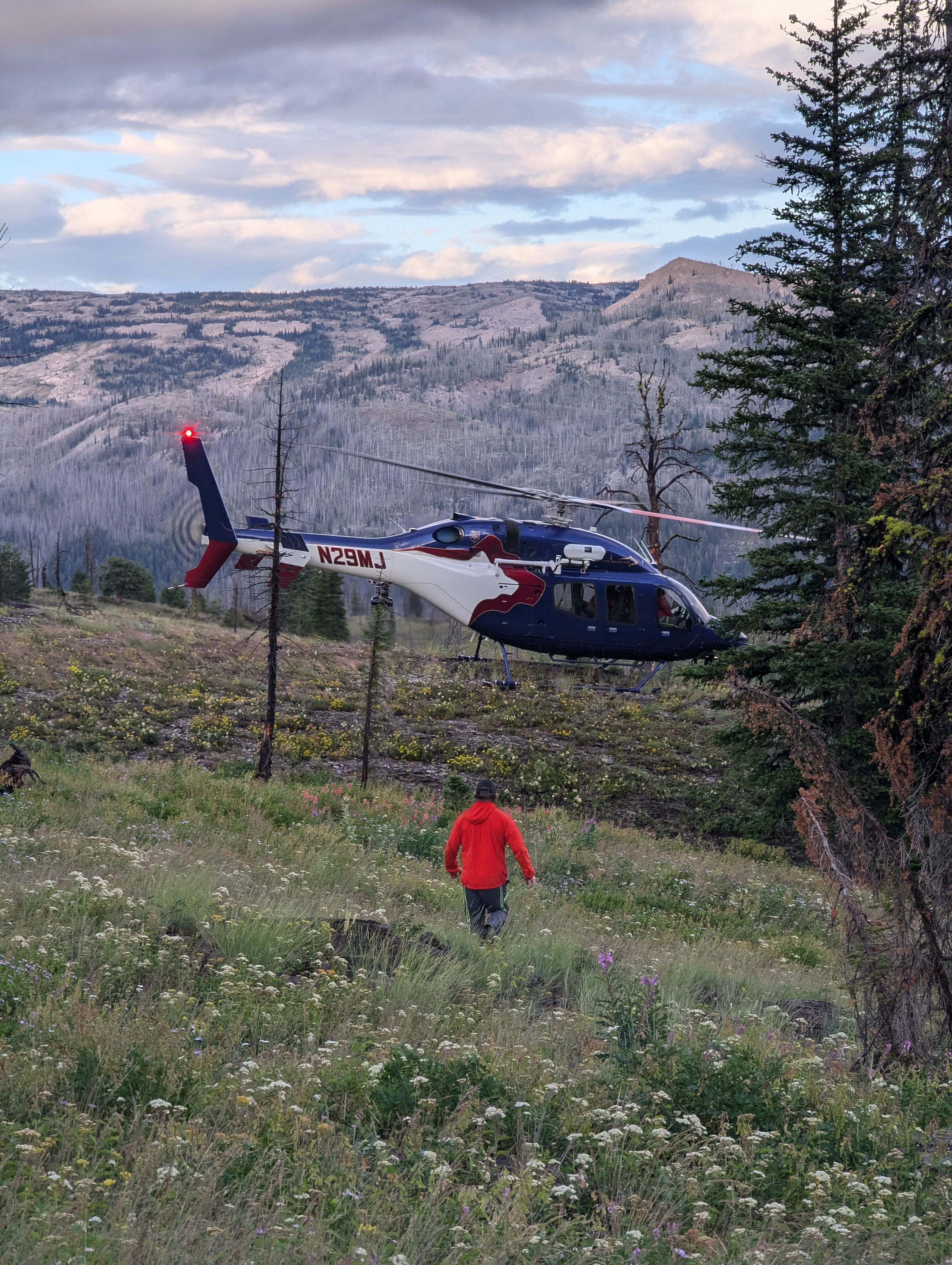
As it got closer and closer, it got lower and lower to the ground, and we eventually realized it was heading straight for us. It landed in our campsite, a few hundred ft from where we were all gathered round the fire.
Everyone ran towards the helicopter, eager to find out what was going on. Our fearless expedition leader Jason Ballensky went in front and went to talk to the pilots. The imagery was reminiscent of a scene in an alien movie when a lone, fearless human approaches an alien craft to make first contact with them. I sat back and watched.
Jason talked to the guys in the helicopter for a few minutes, then started walking back to camp. The helicopter took off shortly after. We all eagerly awaited to hear what went down between him and the pilots as he walked back. But before that could happen, we got to watch the helicopter take off and fly away. I had never seen that before3.
After the helicopter took off and flew away and we could all hear each other again, Jason told us what’s up. Apparently those were search and rescue guys looking for a lost hiker. A young guy was hiking nearby Haystack Mountain with his friends. Somehow he got separated, his friends never found him, and they called for search and rescue. It had been over a day at that point, so he was probably dead. Haystack Mountains was 7 miles away from us as the crow flies, so it would be quite unlikely that he would have made it over here, but the search team was scraping the bottom of the barrel at that point. They saw our fire and figured they could check if somehow that’s him, or if we had seen him. Jason told the guys we hadn’t seen any lost hiker, and they went off.
That was the last unexpected event that day, one of many days full of many strange, unexpected events. The Virgil Cave infeeder lead team, Adrian and Sam, returned after dark, after the helicopter event. They didn’t get to the lead because they didn’t like the breakdown stemming they got to before the lead, especially being weighed down with a ton of gear for 2 people. I agree that going to that lead is kind of a big task for 2 people.
Wednesday, July 31
Today was another rest day for me. I didn’t have much to do, so I kept recovering by eating food and intermittently napping and sunbathing. Now that the rain and clouds were gone, I finally got to do my naked sunbathing that I had been looking forward to the entire time I was exiting the cave.
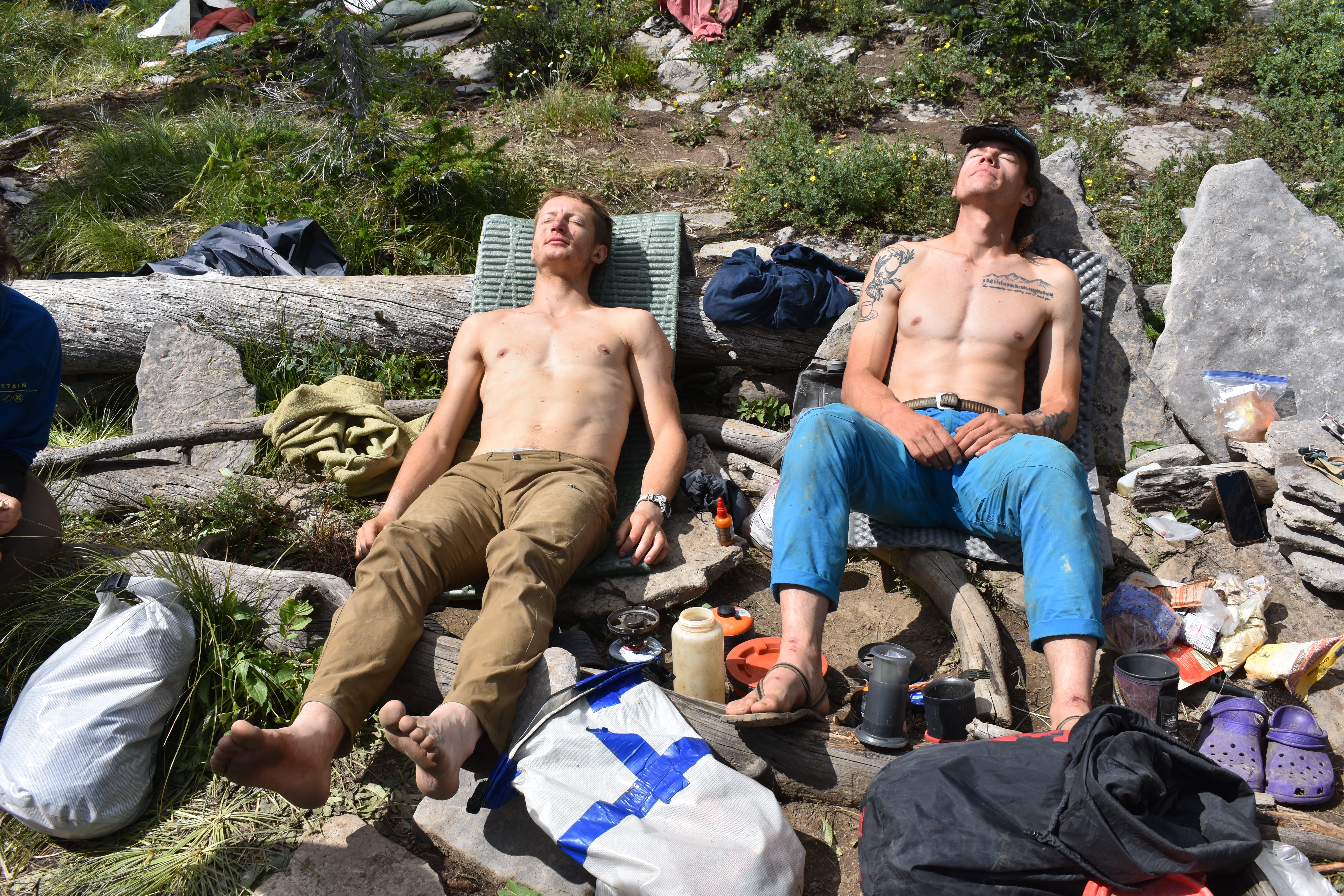
My arm felt much worse today than it did the day before, the exit day. The forearm swelling was very visible, and I had reduced range of motion. I could hardly make the popping/grinding tendon sensation because I didn’t have the range of motion for it.
This confirmed to me that my decision to take a rest day in the cave was probably the correct one. The rest day made the arm feel pretty good when exiting, but caving on it made it feel terrible the next day. If I had caved that day, my arm might have felt much worse when exiting.
I hoped that I would be able to participate in the haul trip in 2 days. I wanted to be a team player and participate in the less-glamorous parts of the expedition, like hauling. I didn’t want to be the guy who only did the glamorous push trip.
I did a few miscellaneous useful tasks besides eating and napping and sunbathing. I cleaned and inspected all my muddy gear. My homemade vertical gear was in great shape. The gear loops were frayed, but the load-bearing webbing was fine. Both of my cows tails were coreshot at the barrel knots. Classic.
Dustin left for Silvertip that morning, and I said my goodbyes to him. I felt like we experienced a lifetime together over the past week and a half, and I was bummed we wouldn’t get to close out the expedition together. But he was gonna get up to some more awesome caving soon in Silvertip.
I also did a Pagoda Pass run to haul some gear we no longer needed to the spot on the trail where the mules would pick it up in a few days. I timed it right so that clouds rolled in right as I started the uphill hike towards Pagoda Pass. That was some good active rest.
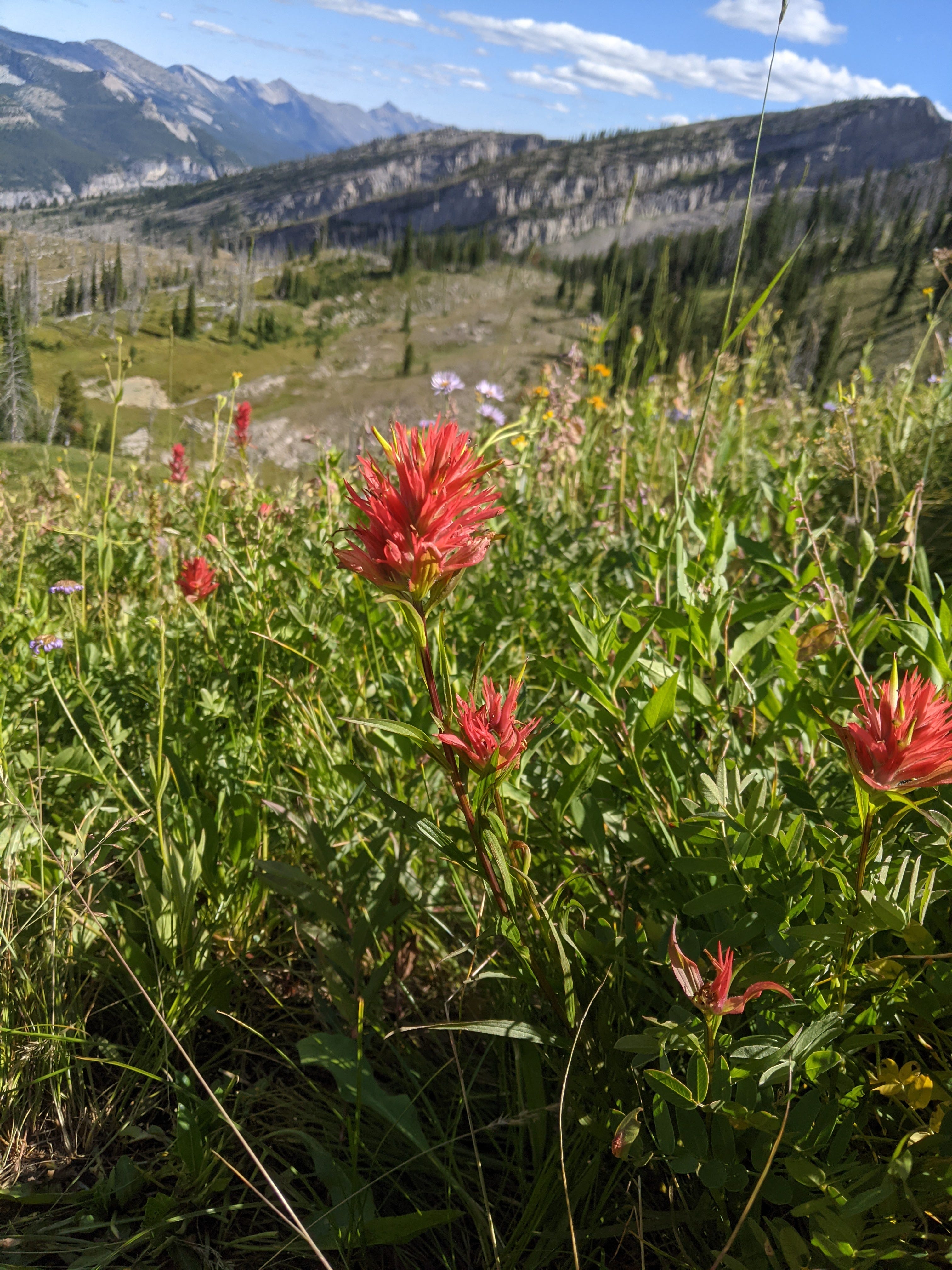
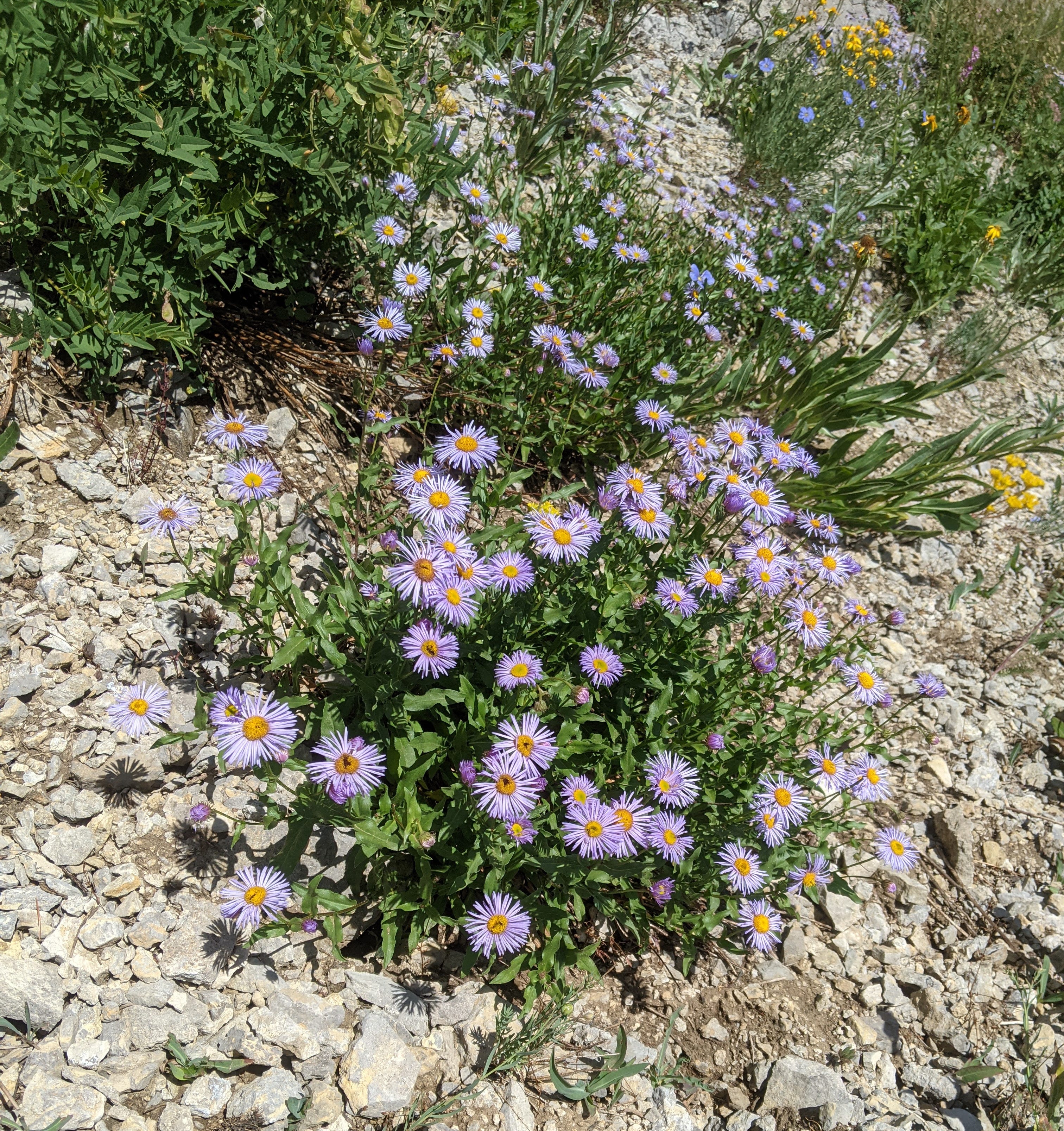
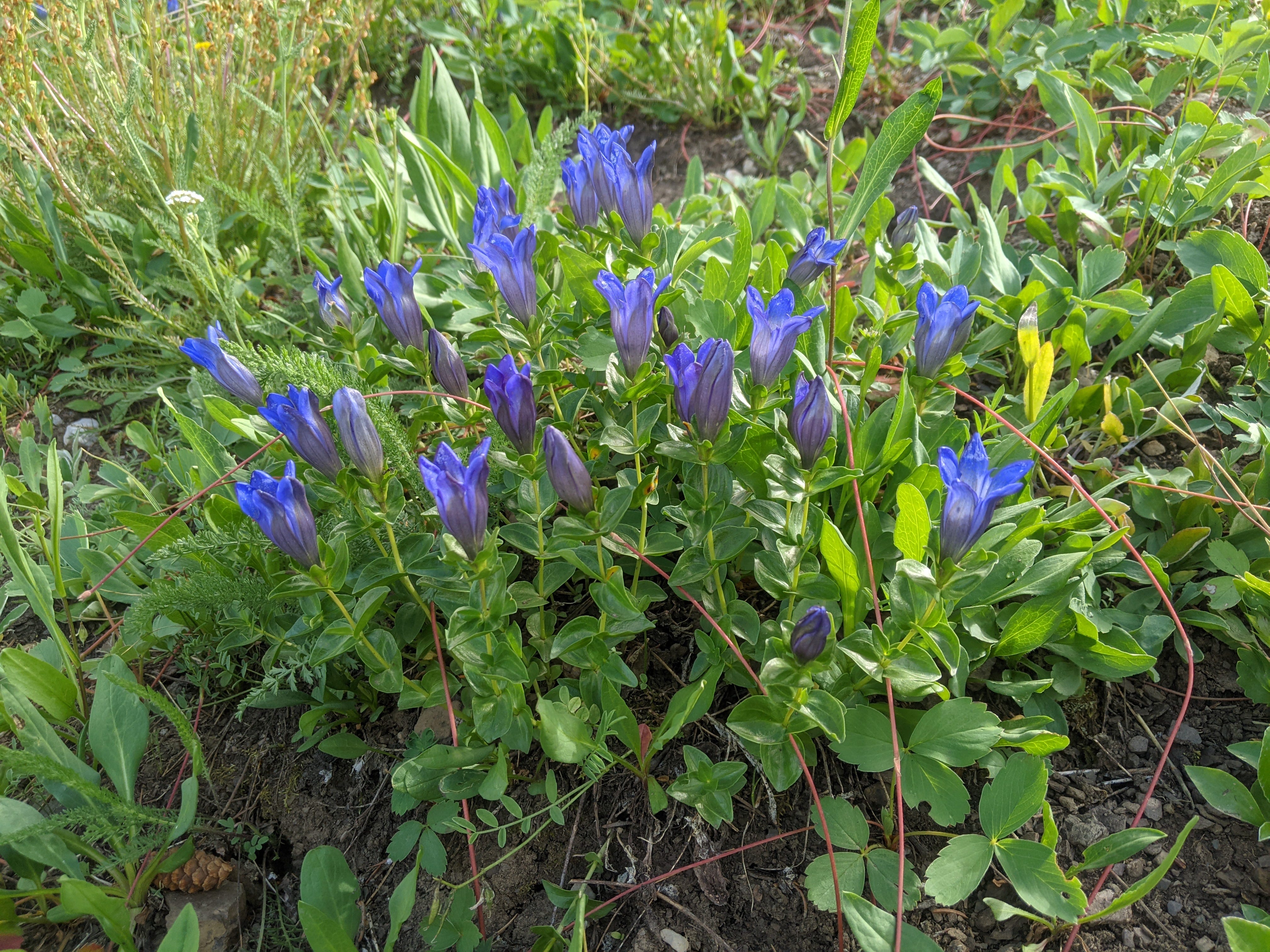
The hike back to base camp from Pagoda Pass was so easy and pleasant with no weight going downhill. The wildflowers were in full bloom and I felt like a fairy tale character, prancing around a green field without a load on my back or any care in the world. I stopped to take some pictures of the wildflowers on the walk back:
After my active rest activity, I lounged around again for the rest of the day, having done at least one productive/useful thing. Later that evening, Pete, Katie, and Max unexpectedly arrived in base camp. They were not supposed to arrive until the two days later. They explained to us that they also had debilitating issues with that one cursed portaledge.
The portaledge that I had trouble with due to the flooding issues ended up being Pete’s. Pete decided to move it to the other wall that was dryer but less than vertical, so it presses you into the wall somewhat uncomfortably. Pete apparently popped the inflatable sleeping pad that goes inside that hammock, due to it grinding against the wall as he shifted around. Thankfully, there was a patch kit there, and he patched it up. However, just like how I had a second identical mishap with that portaledge the same night, he popped it again later that night. Instead of patching it, he tried to sleep in the portaledge without a pad. This was apparently the worst night of sleep Pete ever had. Without an inflatable pad in the portaledge to hold it open, the taco portaledge literally wants to taco and scrunch you up, in both the long way and the short way. Pete had a very uncomfortable night of “sleep” in the cursed taco, and decided to leave camp the next morning, a day before their scheduled departure. Just like how I forced my team to leave camp when that portaledge failed on me for the second time in one night (with a different failure mechanism). At least for me that was the day that our team was already supposed to leave.
That portaledge truly was cursed. We would have to find another cave camp solution for the next trip in 2026. The dry breakdown-filled tube at the top of the 60 ft pit would probably be a better (but still bad) camp spot. The large breakdown floor would mean we would be hammock camping, but at least we would have a dry floor. We would have to go down the 60 ft pit to get water, but that would be no big deal.
Anyways, with the last exploration team out of the cave two days early, that would mean the haul out effort would start one day early, tomorrow. I should have repaired my cave suit that day instead of waiting til the next day to do that, oops. It would also mean one less day for my arm to recover in time to haul. Oh well.
We made another fire that night and celebrated another camp trip being done, after yet more complications. What else would screw us over in the few days we had remaining in the expedition?
Thursday, August 1: Haul out
I woke up that day with my arm feeling just as bad as the day before, with visible swelling and limited range of motion. I would not be helping with the in-cave haul that day. In order to not be useless, I volunteered to haul gear on the surface, between the cave entrance and base camp, and between base camp and Pagoda Pass.
Before the hauling extravaganza started, we all sat around together and had a conversation about what to do about Camp 2 during the next expedition. There was some talk of declaring the cave dead, as the bottom was a hard end, and the next good lead was 400 vertical ft up, and it was an aid lead. However, Jason quickly declared that a walking dry tube was too good to pass up, so we all determined that there would be a return expedition in 2 years.
Given that, we needed a better plan for Camp 2. We might want traditional hammocks, not these fancy new single-point suspension portaledge-hammocks, to keep the hammocks away from the less-than-vertical walls. It might be worth moving more rocks to fill in the pool in the floor. With a few hours of piling rocks, we might be able to sleep one person on the floor. It also might be worth it to move camp to the dry breakdown-floored tube above the 60 ft pit beyond Camp 2 (Camp 2.1?). Being a half-hour further into the cave would certainly be useful.
After that conversation, it was haul time. Everyone went to go haul, except the team that just got out of the cave yesterday (Pete, Katie, Max), Tommy, and I. I did several runs carrying heavy shit between the entrance and base camp and Pagoda Pass, so I was not useless thankfully.
We got everything hauled out of the cave at a reasonable hour that night, and celebrated all the caving done with everyone coming out in one piece (albeit with many minor injuries). We made one last bonfire at base camp before departing the next morning.
Friday, August 2: The beginning of the end
Today was the beginning of our journey back to civilization. Due to the early exit of the second push team due to the portaledge hammock failures, we were one day ahead of schedule. Thankfully, Jason was able to get in contact with the mule packers and get them here a day early. A train of mules arrived around mid day today, and we loaded them up with all of our gear we didn’t want to hike and raft out with.
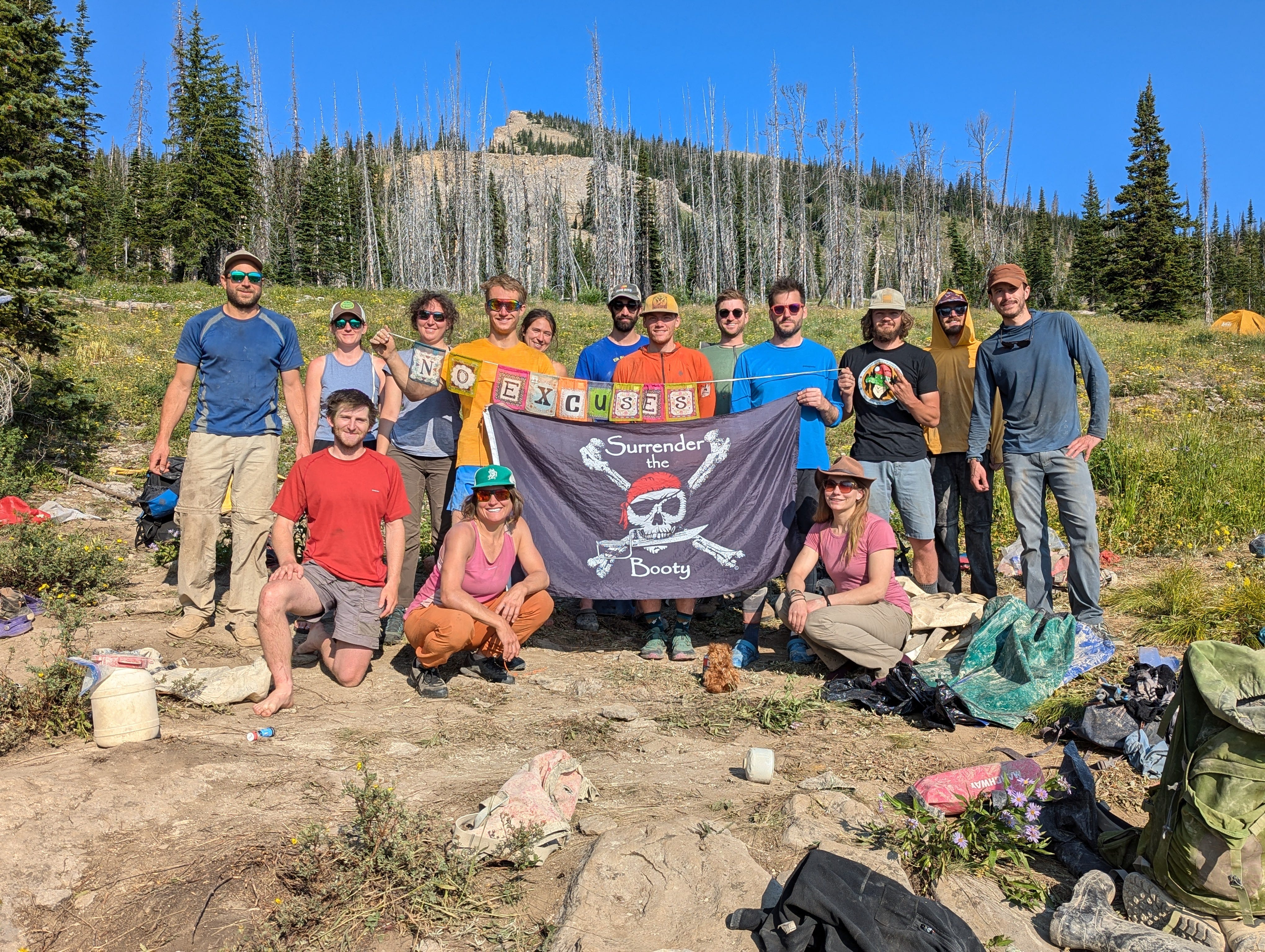
Unfortunately, the mules didn’t quite have enough capacity to carry everything we would have liked them to. So we had to carry some of the unnecessary caving gear out ourselves. I ended up carrying a bunch of extra stuff, so my hike out was heavy, not unladen as I was hoping and expecting it to be.
At the start of our hike out we encountered another Complication, albeit one we had been expecting all week. The dead mule carcasses from the week before were by now rotting and smelling and attracting grizzly bears. The Forest Service had closed that trail we took to Pagoda Pass, the Helen Creek trail, for hiker safety. So we had to take another way down to the Flathead River. The Forest Service rangers recommend we take an abandoned, unmaintained trail that followed the ridge south of Helen Creek.
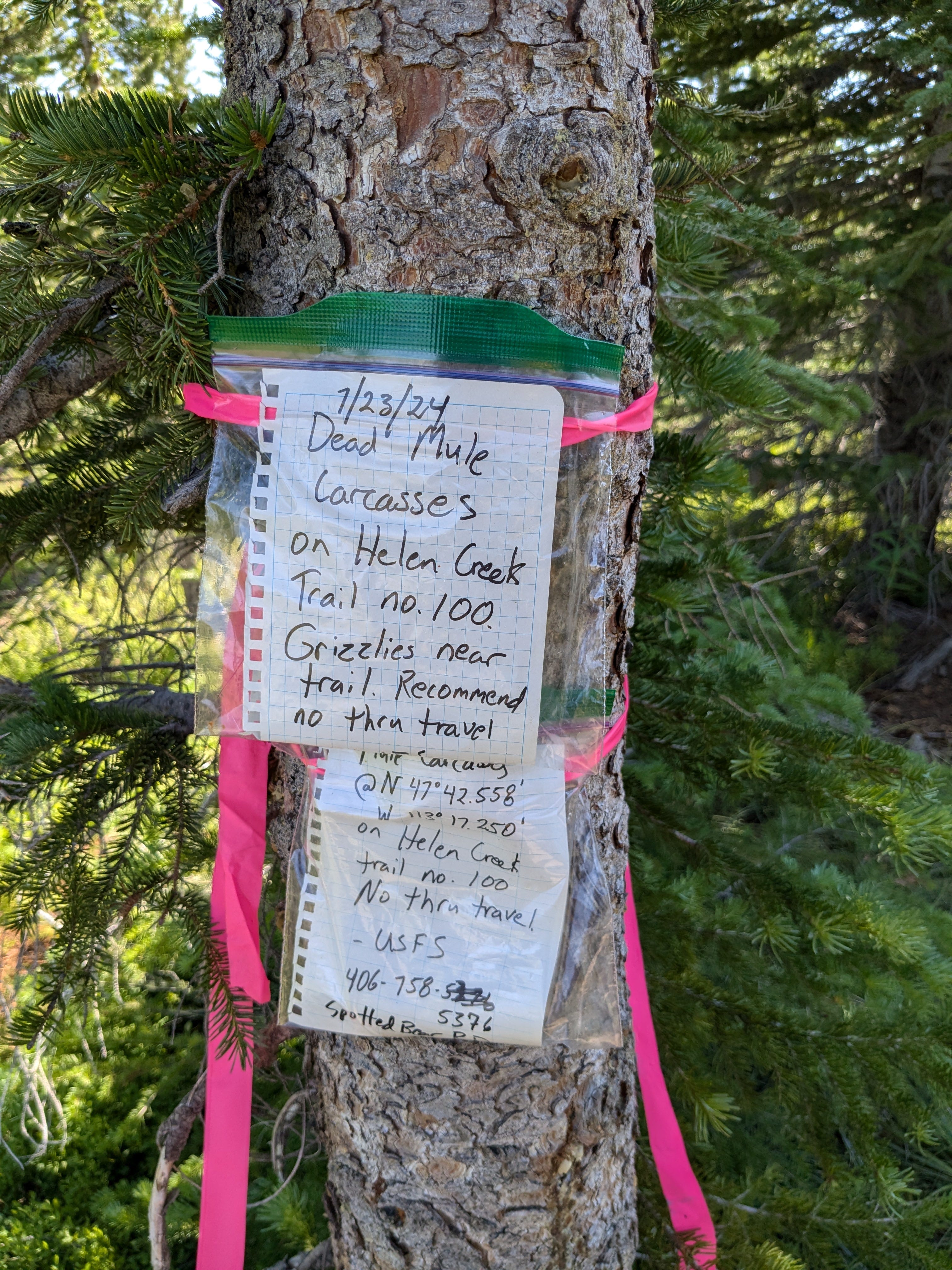
No one had any idea what kind of shape this trail was in, if there was even a trail at all, as no one we knew had ever taken it. Also, there would be no water on this route/trail, as it followed a high ridge, not a drainage like Helen Creek. And it would be sunnier and thus hotter.
Given all those cons, we considered trying our chances at the Helen Creek trail. We figured that even if there was a grizzly bear actively guarding 2 mule carcasses for food (likely), it wouldn’t attack a very large group of humans like us (dubious). I even volunteered to go first through the section near the mules, wielding 2 cans of bear spray in my hands. However, our better senses prevailed, and we ended up taking the ridge route south of Helen Creek instead.
This route was about what we expected. There was not much of a trail anywhere, although it was generally easy to follow by staying on the ridge. Also, we all had phones with GPS. There was no water anywhere along the 6 miles from Pagoda Pass to the South Fork Flathead River, as we expected. There was intermittent shade, although the vegetation was generally much sparser on the ridge top, and burned down in spots, so we spent most of the day in the sun. It was hot out, just like the beginning of the trip.
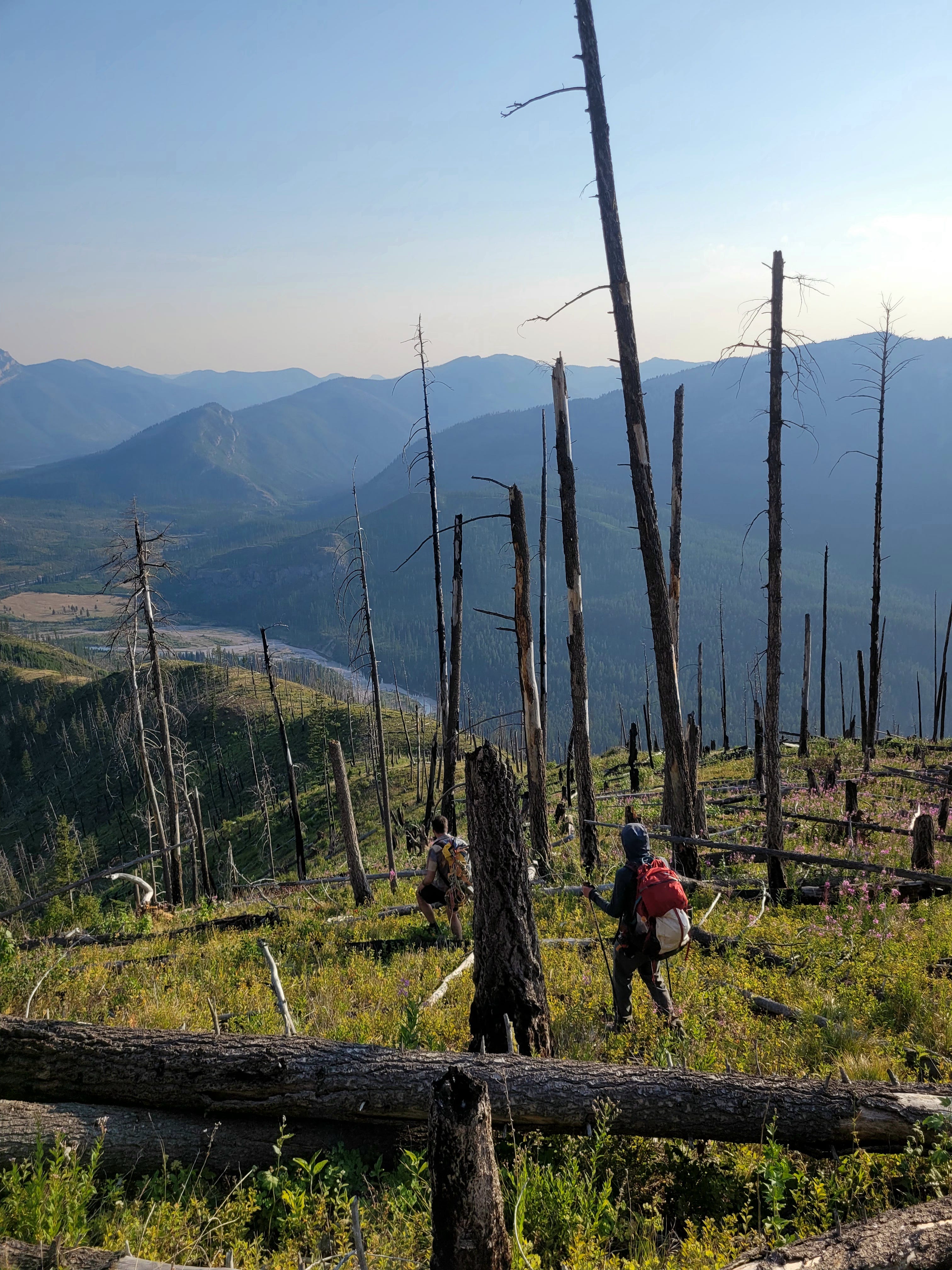
There was yet another Complication that happened on the hike out, that you’ll have to ask me in person about if you ever see me…
The route was mostly straightforward until we got to the end of the ridge, where it rounded out and transitioned into more of a steep hill in all directions, at the end of the ridge. We went as low as we could on the ridge until we were forced off the ridge onto the steep hillside below. Then we had about 1000 ft of elevation loss on steep, loose, burned hillside to make it down to the Flathead.
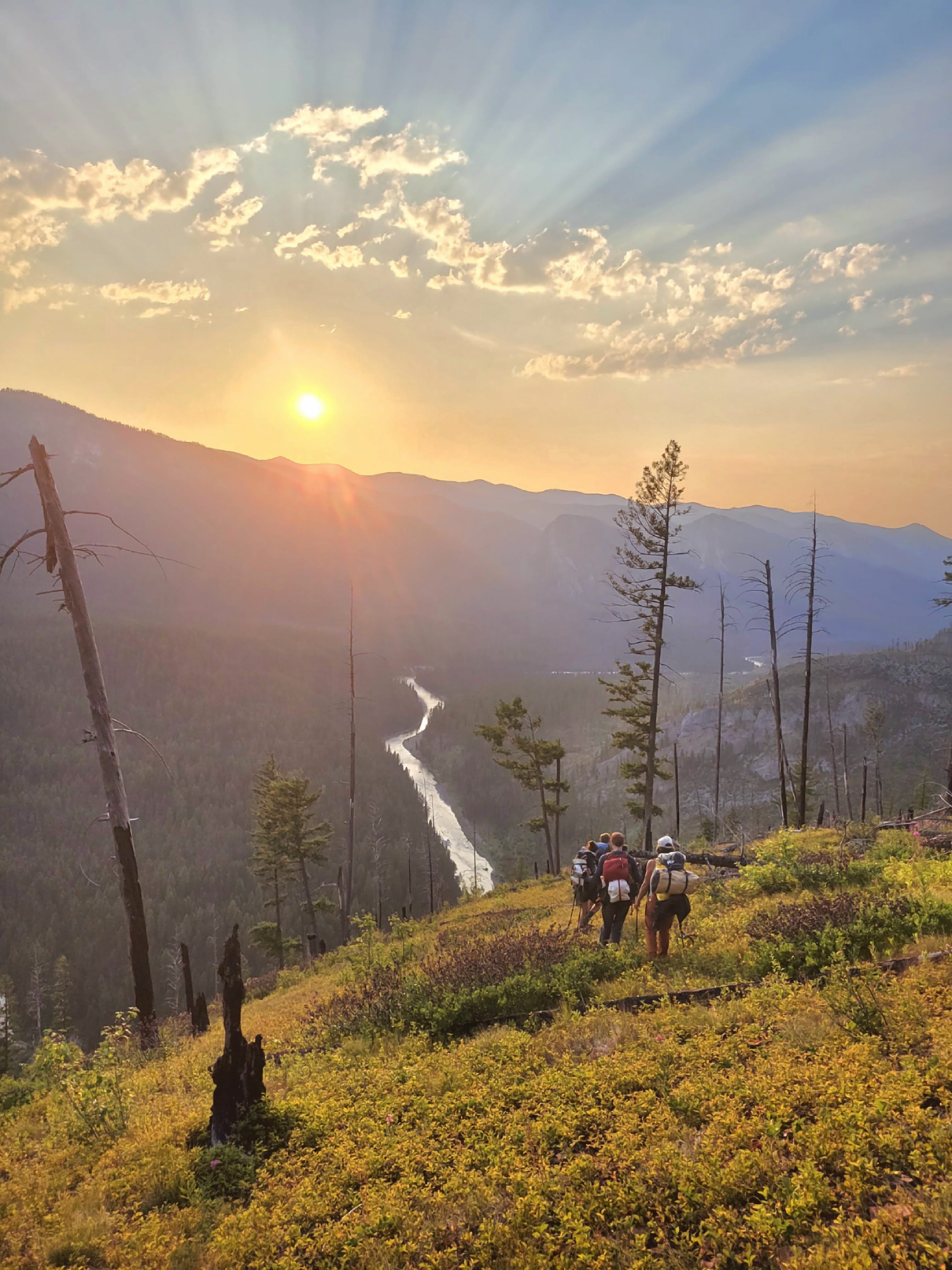
Once we were forced off the ridge top, we endured another 1000 vertical ft of loose dirt slopes and hopping over huge downed burned trunks. This was more taxing than traveling along the ridge, but fine. It actually looked more intimidating from above, like we were gonna get cliffed out somewhere on the steep slope. But that never happened; the worst scrambling we had to do was over huge downed trees.
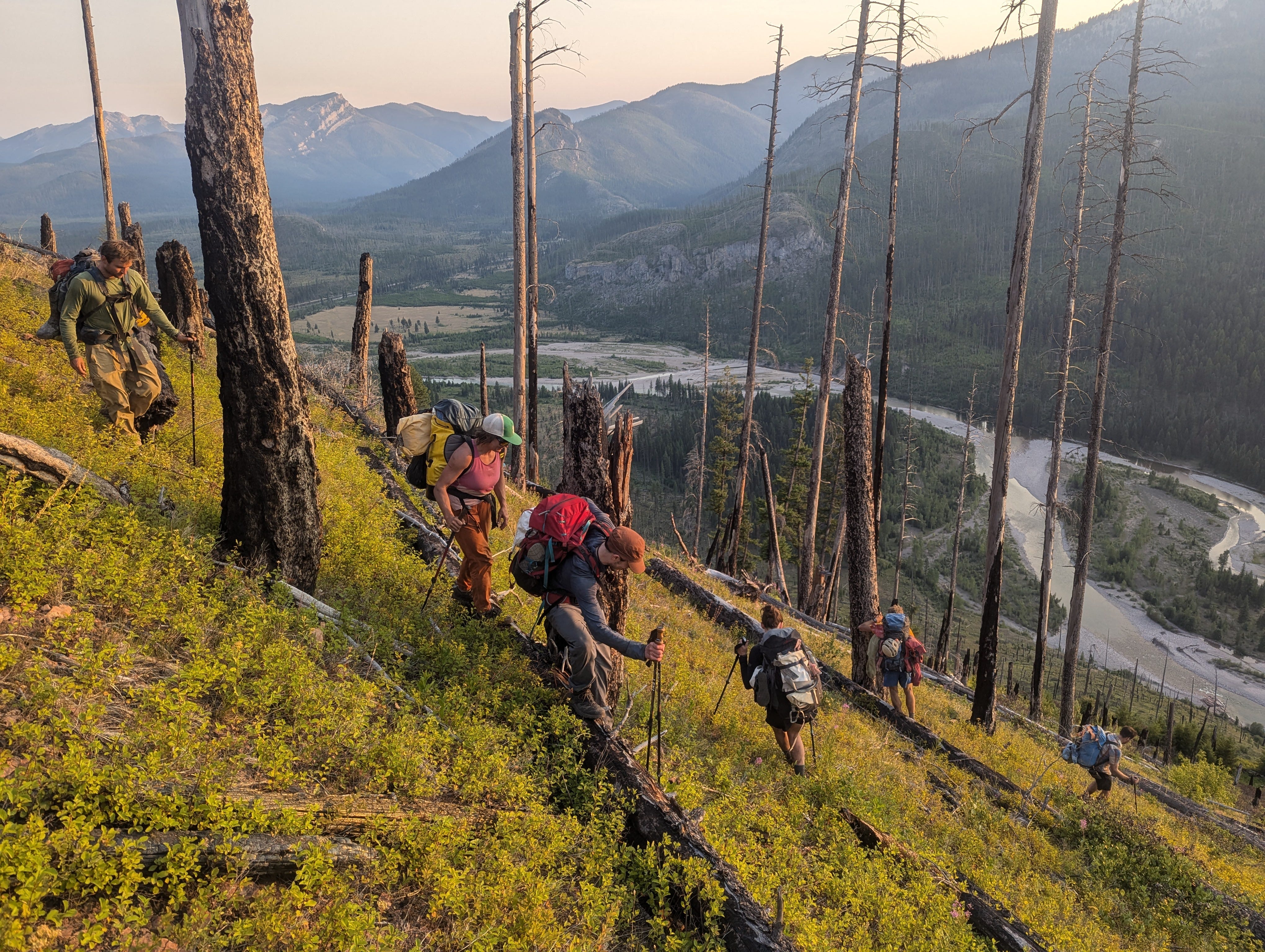
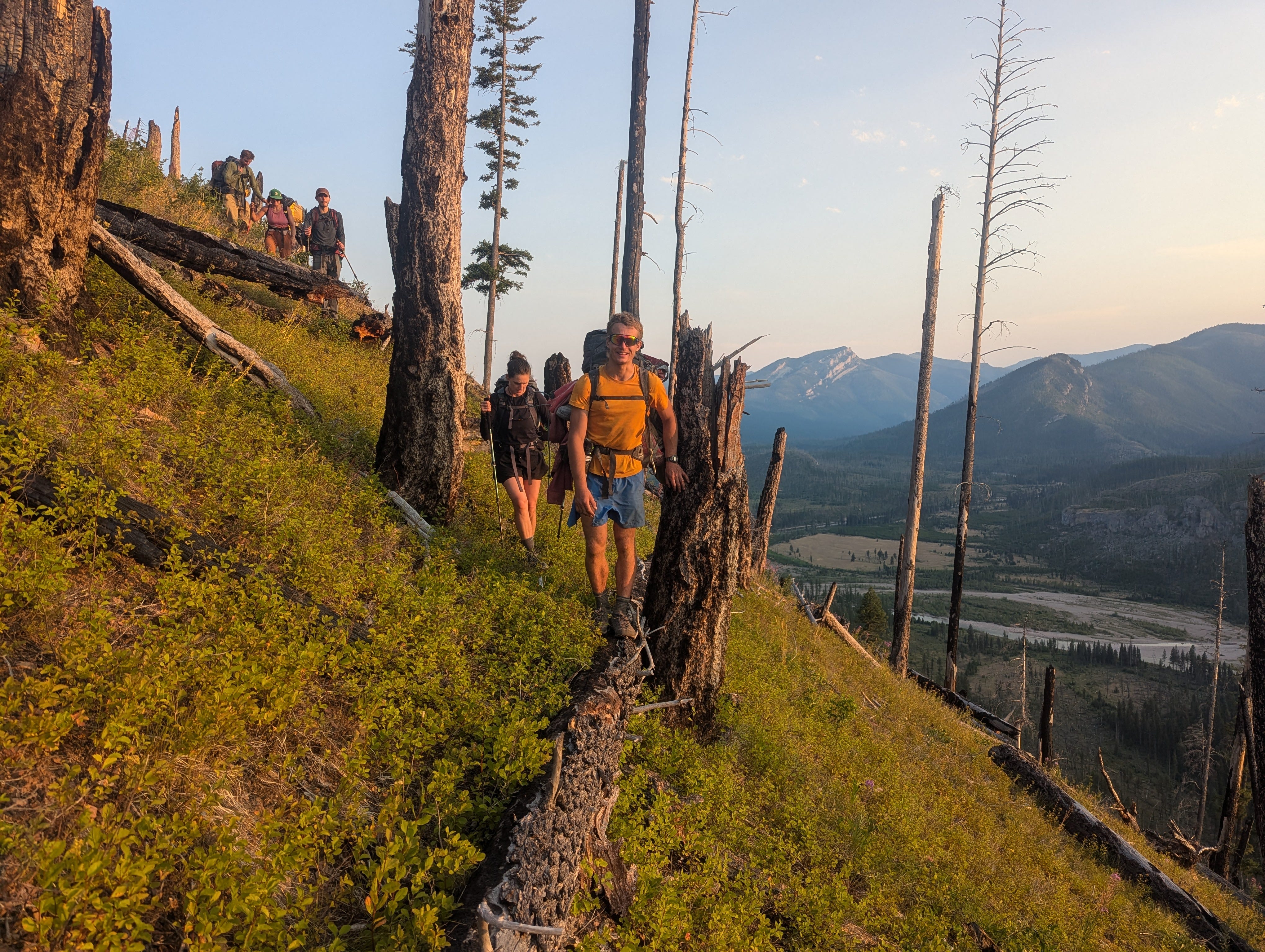
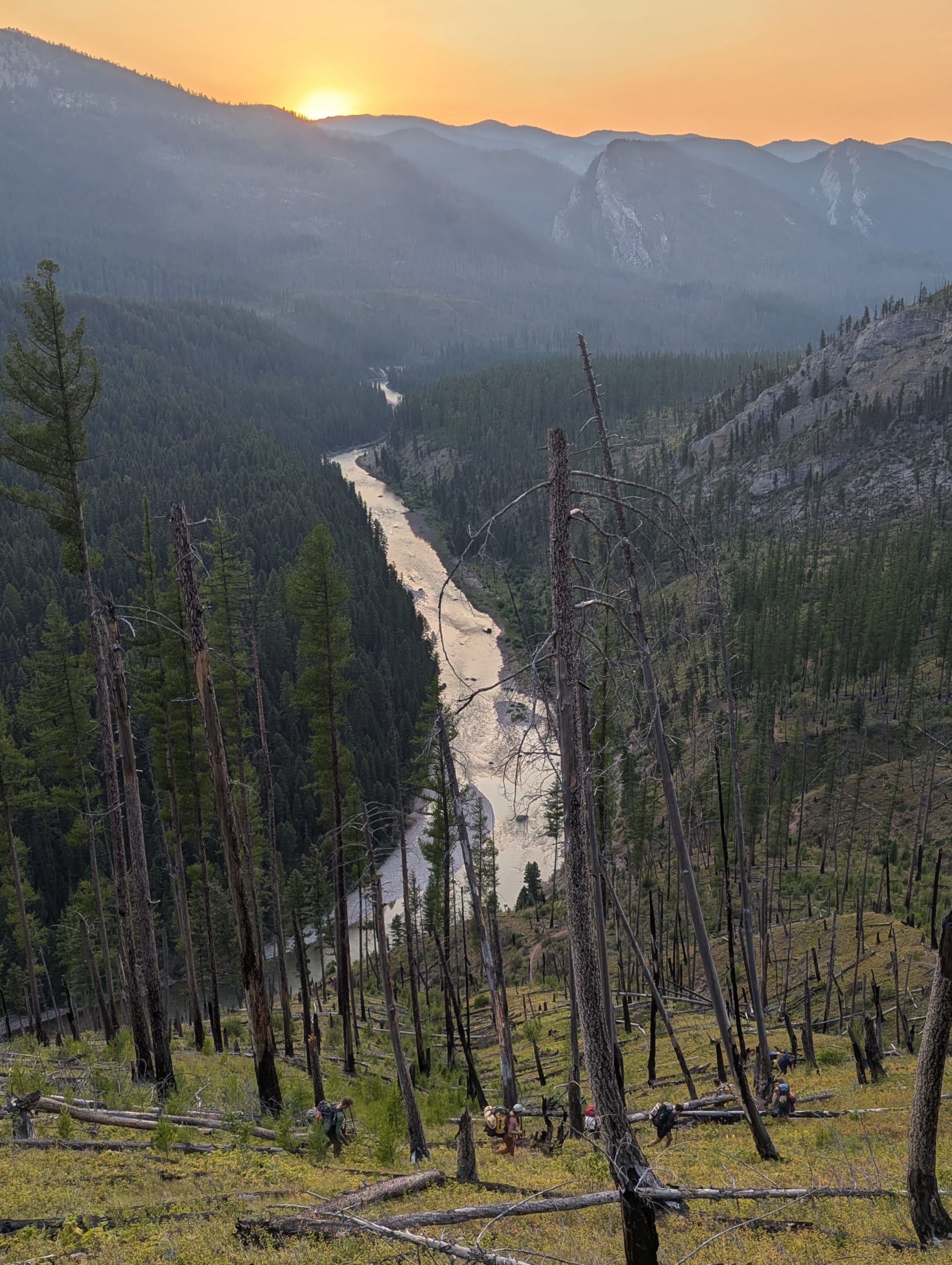
We made it back to the South Fork Flathead trail just before 10pm, amazingly still with some light out. We were officially all done with anything remotely dangerous by that point, so it was time to celebrate! All we had to do over the next 2 days was raft out. We hiked another 4 miles along the trail to a campsite on the beach at the river, where we would camp for the night and put in on the water the next morning. Our rafts were waiting for us there.
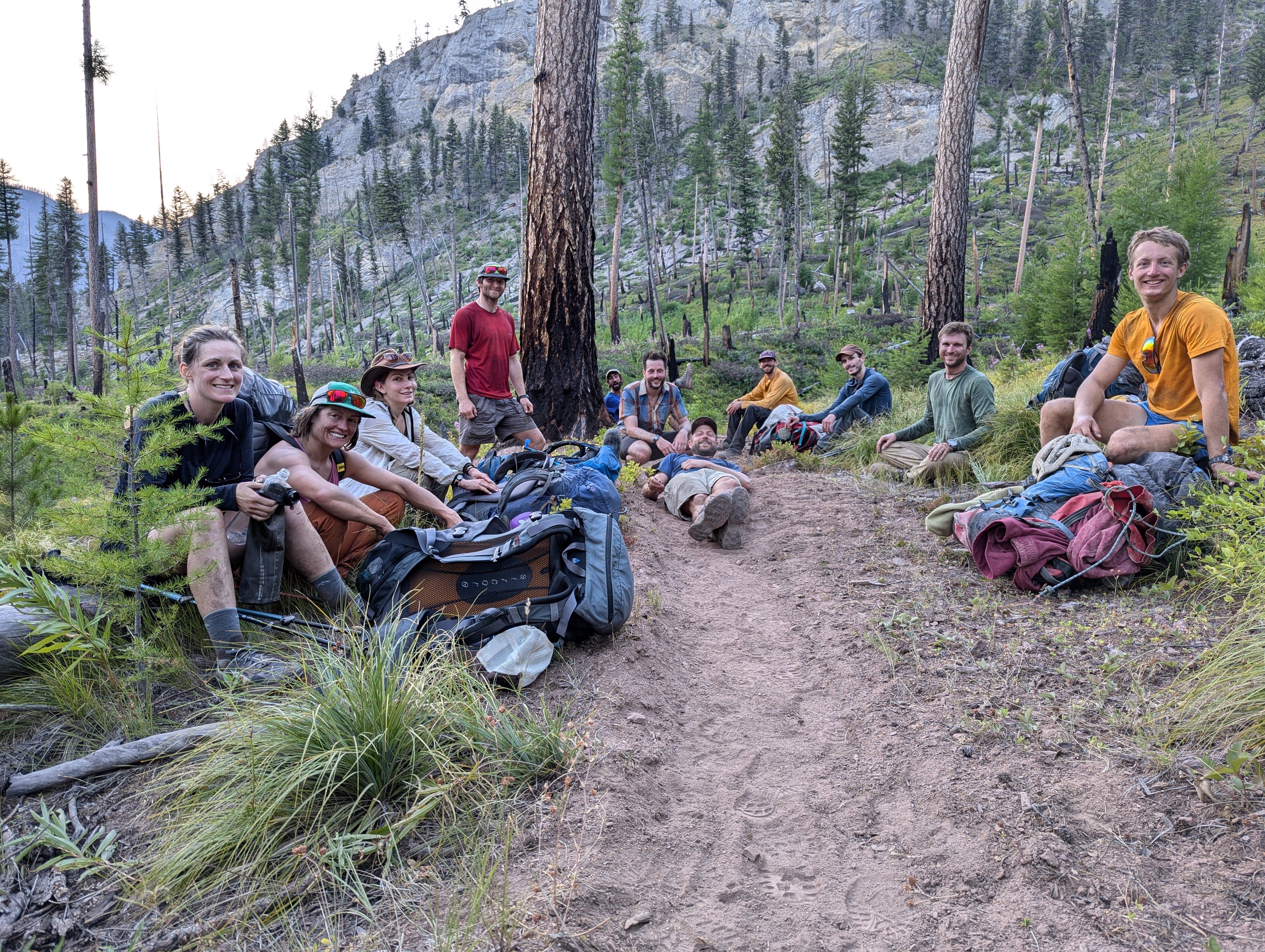
Saturday, August 3: Raft out
The last day of Tears of the Turtle expeditions is, in many ways, the most fun day of the whole expedition. That’s when we raft out the rest of the de-approach. The mules that meet us at Pagoda Pass to pack out our caving gear also bring rafts and drop them off at the river campsite for us, so we don’t have to carry our rafts. About 8 miles of the approach hike is along the Flathead, going upstream, so the de-approach is downstream and we always raft it. The water is pretty mild, mostly flatwater with a few tiny whitewater section, so people raft it with a variety of dinky rafts. There is one very short rapid that people usually call class 3, that often results in many people flipping.
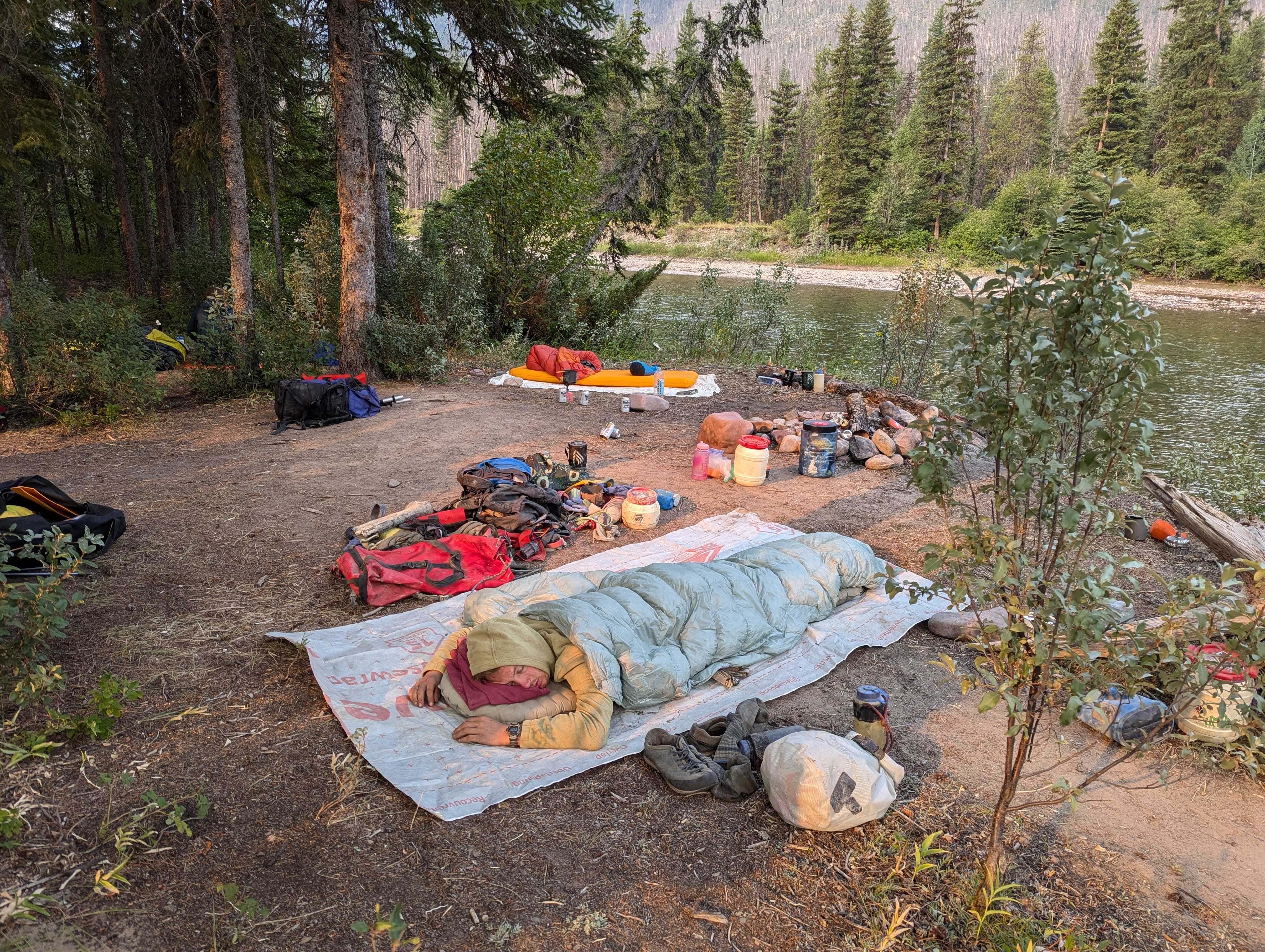
I use this $30 Walmart raft as my watercraft. It’s pretty dinky, but I won’t complain about what I can get for $30. In 2022, I didn’t flip in the 3rd class rapid, but only barely: I accidentally rammed into George Breley, and he flipped, but I didn’t, as I stabilized myself off him. George made the ultimate sacrifice so that I could send. Sorry/thanks George!
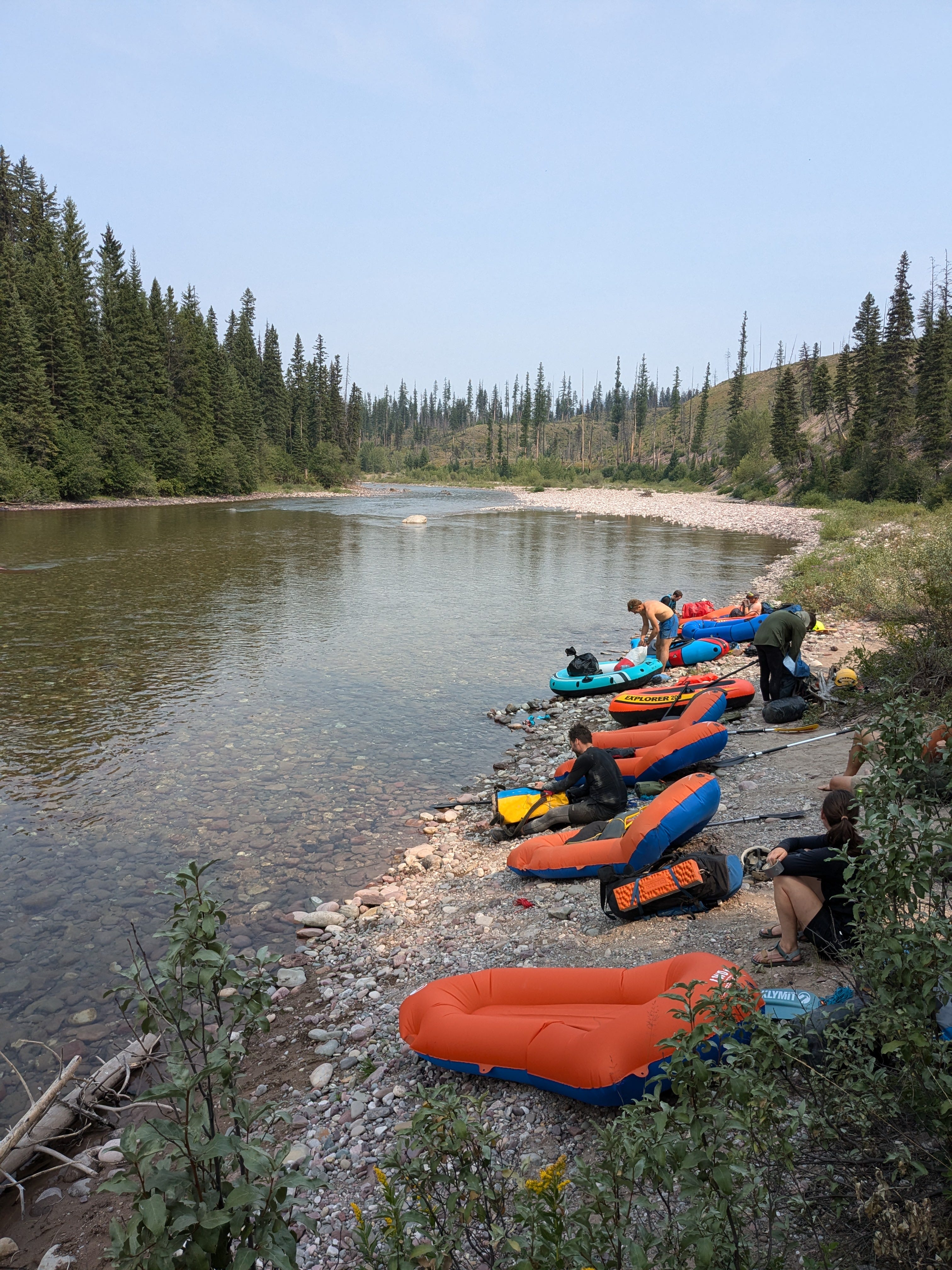
We were on the water a little before noon, and that’s when the party began. Beers were cracked open and everyone was in pool party mode. The water seemed a little lower than in past years, probably due to low snow levels. I recall scraping bottom and having to drag my boat more often than usual.
Sometimes we do the raft out in 2 days, to get the wonderful experience of packrafting and camping on the beach wherever we feel like stopping for the day. This time we did it all in one day. We were off the water early in the evening, around 6pm. The 3rd class section was super mild this year, again probably because of the low snow year. No one flipped on it, which I believe is a first for any Tears of the Turtle expedition.
We had 3 miles to hike with our packrafts after getting out of the water. We were back at the cars around 8pm. There was talk of camping at the cars another night or trying to find a restaurant/lodging that would be open. The restaurant/lodging crowd won out, and thankfully one of the hunting lodges, the Diamond R Guest Ranch, was open. We dashed over there before they closed and ate burgers and slept under roofs for the first time in nearly 2 weeks that night.
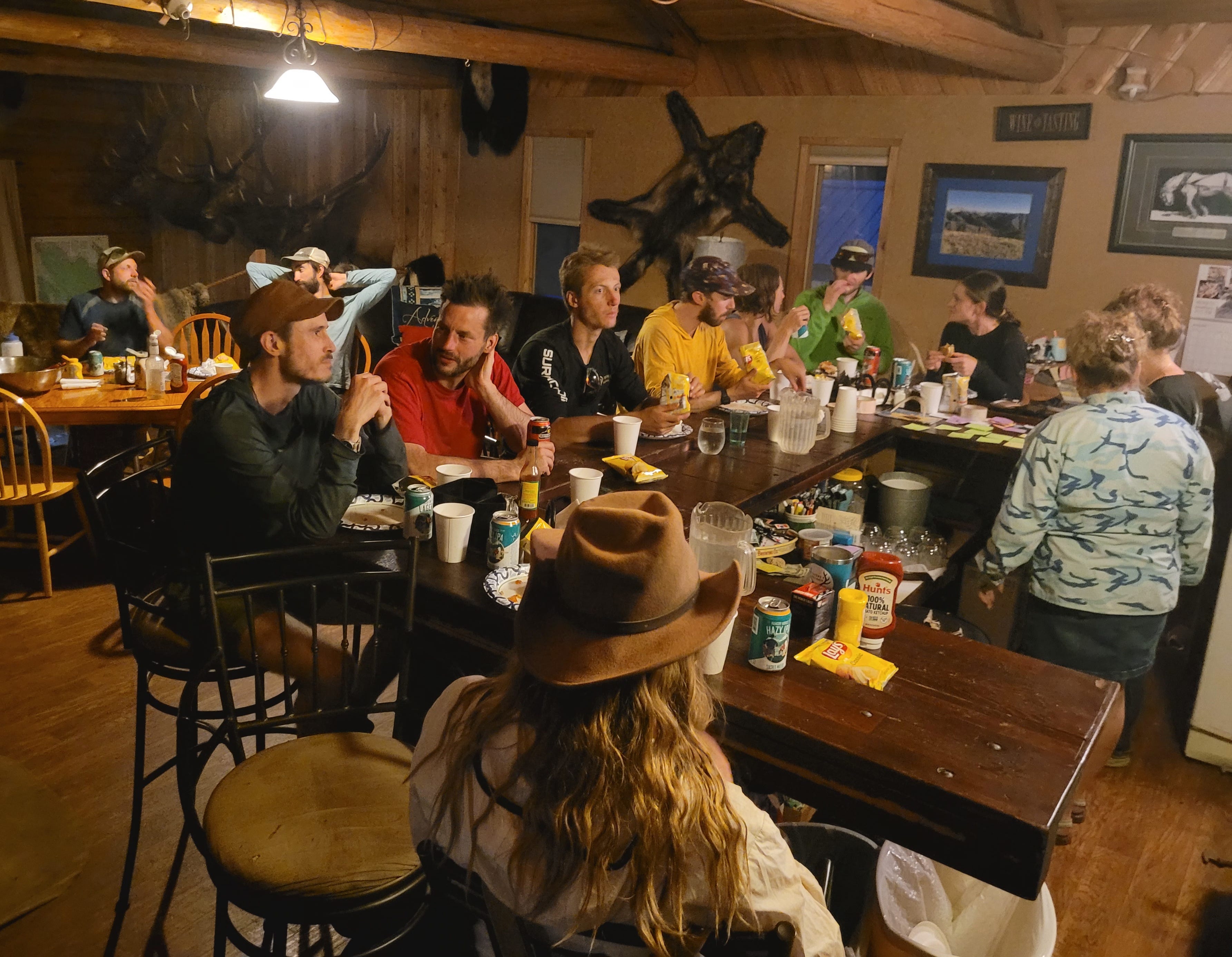
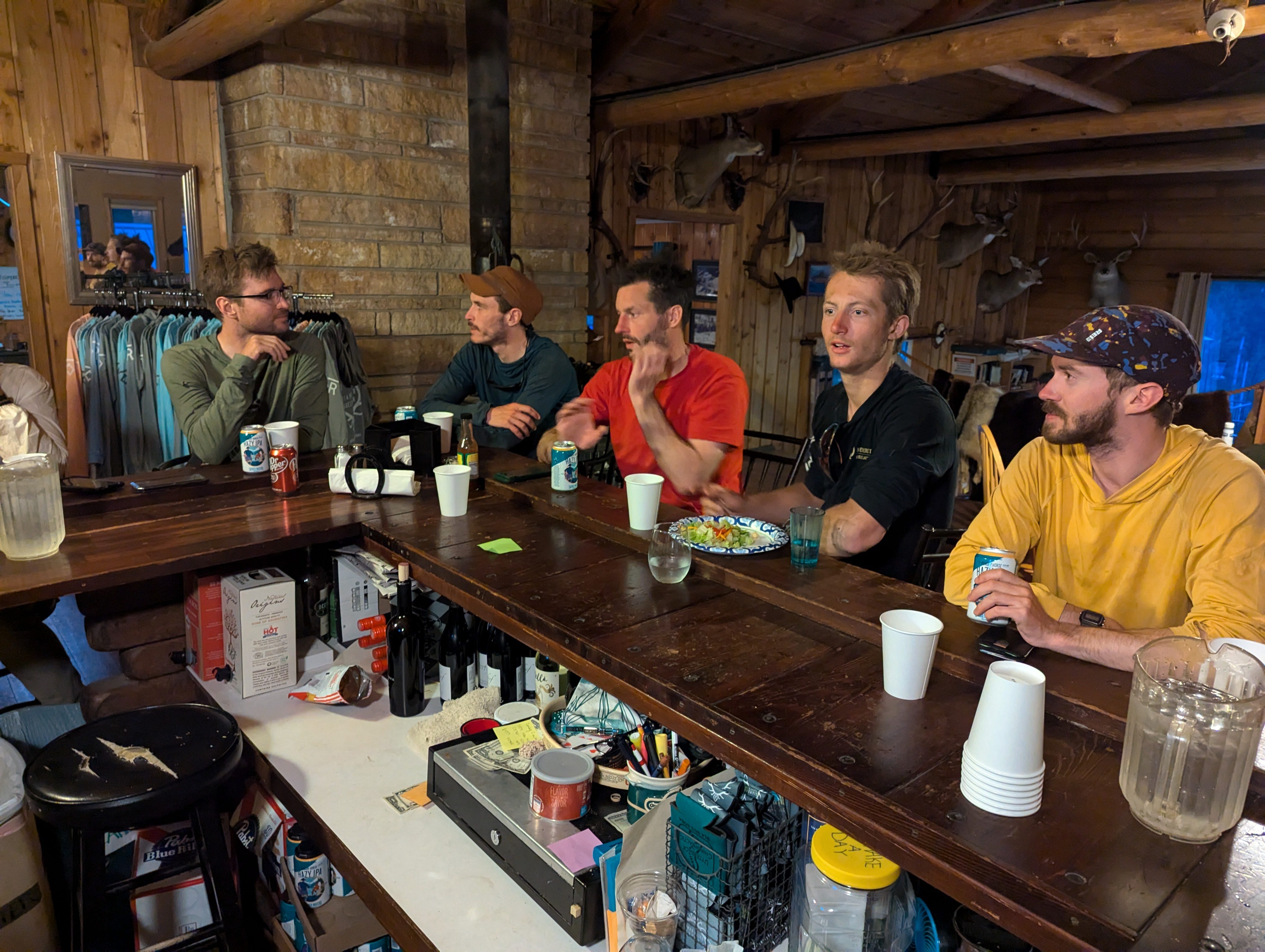
We regaled the hunting lodge staff with tales of our odyssey, and they were very impressed. We all retired to bed after they closed, with only one stage of our journey remaining: the drive back to Hans Bodenhamer’s house in Kalispell.
Sunday, August 4: Return to civilization
The next morning, we left the hunting lodge and drove to Kalispell. We convened at Hans Bodenhamer’s house, where we were greeted with a caver party with many of the high school students he brought at the start of the week and their parents. All of them were excited to hear what had happened since they left earlier in the expedition, especially since the high school kids helped us out in cleaning up the mule wreck at the beginning of the week. We told them all about what happened and basked in the glory of the send that was the entire 2 weeks.
Once all was said and done and I was reflecting on the events of the prior 2 weeks, the craziness really set in on me. So much had happened since the expedition started that it really felt like we had all experienced decades together. From a global computer meltdown that delayed many people’s flights, to a mule wreck we all had to clean up, to the worst cave camp any of us had ever experienced, to several critical hammock failures, to a closure of the trail we needed to get the heck out of there, we had all experienced so much hardship together that some strong bonds were developed in that short time. I can’t wait to return to the cave with many of the same people this summer 2026. Stay tuned if you wanna hear what happens!
Note that this bad wrist is from the tendon aggravation that happened this time in summer 2024, and is totally unrelated to the bad wrist I got from a distal radius fracture later on, in December 2024. I’ve previously written about my bad wrist on this blog, which refers to the distal radius fracture, not this injury.
At the time of this writing, since the 2024 expedition happened, nearby Bobsled Cave, also in the Bob Marshall Wilderness, overtook Lechuguilla to become the second deepest solutional cave in the US.
I later saw a helicopter take off much closer to me, about 30 ft away, at the Parks Ranch rescue.
Wow, what a trip! Thank you for sharing so many details, I really enjoyed reading about them.
I'm so excited this just dropped!! I've been looking forward to it for the past year (was very curious about Tears, and your posts are always so wonderfully thorough). Thanks for the update!